


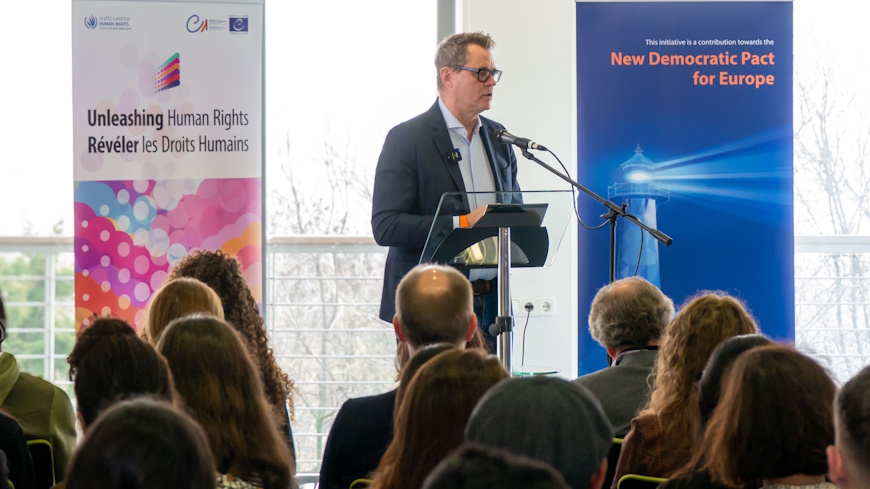
The Human Rights Education Forum: Unleashing Human Rights is taking place in Budapest this week, bringing together participants from around the world to exchange ideas, share experiences, and strengthen their work for the years ahead. Held from 9 to 11 December at the European Youth Centre, this year's Forum comes at a time when human rights are under unprecedented pressure worldwide, making collective thinking, dialogue, and action more essential than ever.
 Matjaž Gruden, Director for Democracy of the Council of Europe, underlined that democracy is inseparable from human rights, and that this event is an important contribution to the New Democratic Pact for Europe, a major initiative of the Council of Europe aiming at organising an effective response to democratic backsliding.
 “In human rights and human rights education, the role of young people will be essential to success. Our priority is to apply the youth perspective across all areas of public policy making. This game-changing, revolutionary approach is an investment in our collective capacity to find effective solutions to the problems we face. We will not be able to find those solutions without the specific experience, perspective, creativity, energy, disruptiveness, and impatience that young people bring”, he said.
 Co-organised by the Council of Europe and the UN Office of the High Commissioner for Human Rights, with non-governmental partners including Amnesty International and the European Youth Forum, the Forum welcomes over 200 participants from all regions of the world. They include young multipliers and activists, education professionals from formal and non-formal sectors, government representatives and youth leaders from civil society organisations.
In his opening remarks, Francesco Motta, Regional Director of the Regional Office for Europe, Central Asia, Middle East and North Africa at the Office of the UN High Commissioner for Human Rights, stressed: “Across the world, young people are pushing us forward — demanding climate justice, inclusion, and accountability. Online and offline, they are raising their voices for human rights. I am inspired by young people’s courage, clarity, and unshakeable determination to build a better world for all.”
Over three days, the Forum focuses on major threats to human rights and human rights education such as democratic backsliding, shrinking civic space, armed conflicts, or inequality.
The Forum showcases young educators, activists and practitioners as drivers of innovation; their experiences and priorities shape the future of human rights education. Panel discussions, working groups and workshops will explore how human rights education can respond to today's crises and empower young people to build a culture of peace.
Nina Grmuša, Chair of the Joint Council on Youth, underlined that human rights education is indispensable. “It turns principles into practice, translating the abstract into the everyday with empathy. It orients us when the world shifts and inspires us to live by universal human rights — with, for, and by young people. This Forum brings together the community of practice that makes these rights tangible, lived, and lasting across the world”, said Grmuša.
The Forum marks important milestones: 75 years of the European Convention on Human Rights, 30 years of the European Youth Centre Budapest, and 25 years of Compass and the Council of Europe's Human Rights Education Youth Programme.
Marie Struthers, Director of the Eastern Europe and Central Asia regional office of Amnesty International concluded: “In a time of escalating authoritarianism, value-based and action-oriented human rights education is more vital than ever. At this critical moment, we must ‘unleash human rights’ to strengthen people’s power in the face of overwhelming state control. By embedding human rights across school curricula and youth spaces, we can root values like freedom, equality, and justice in local cultures and traditions, restoring their universality.”
 Also marking Human Rights Day on 10 December, the Forum underlines the role of human rights education in building a fairer future and demonstrates how co-ordinated action can strengthen an ecosystem capable of addressing emerging challenges while building on decades of achievement, for more democratic resilience


.jpg/1a97125e-d0f3-77d5-bad8-9cbc8cf06f0b?version=1.0)
.jpg/f3d263df-de46-9c1e-a730-9f3fad27a741?version=1.0)
.jpg/b797e66c-9820-c1e9-ab46-48c5db068adb?version=1.0)
.jpg/4ce043e0-74a6-a455-b94f-a0fdcea1f460?version=1.0)
.jpg/42eda458-8cb2-4b8e-b224-7ed7e3154543?version=1.0)
.jpg/aa0ec6df-eca1-bf16-1a90-aa4d5f63f1ee?version=1.0)
.jpg/bef81152-b979-fb9a-0e19-6e1118280892?version=1.0)
.jpg/e29fc27d-ce30-8521-fa95-d6c5e2ebaf9b?version=1.0)
.jpg/96feeeaa-3101-391f-4b25-0ea6611db9fb?version=1.0)
.jpg/afbe2ec2-33cb-7bcd-d87a-942373c516df?version=1.0)
.jpg/bc47508a-29e9-9f3f-8f34-b8fbbe1b3a3e?version=1.0)
.jpg/105bd1e1-cd6d-6a16-a3d9-041c236349d3?version=1.0)
.jpg/b64e3695-5516-28e6-221d-7b7bdbf5ceee?version=1.0)
.jpg/d6c62135-f95a-92af-055c-36ce087adc1d?version=1.0)