


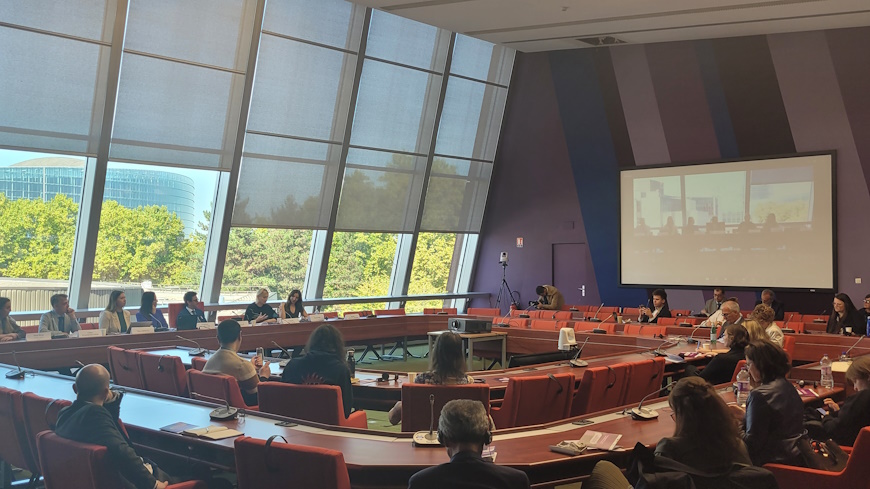
On 2 October 2025, IFLRY in co-operation with the Youth Department of the Council of Europe, organised a side event to the Parliamentary Assembly of the Council of Europe session. The event was hosted by the ALDE group in the Parliamentary Assembly of the Council of Europe (PACE).
 “Serenity now: mental health and youth in European politics. Supporting youth participation through mental health-aware policy making” includes high level speakers, such as Ms Francesca Camilleri Vettiger, Ambassador of Malta to the Council of Europe, Iulian Bulai, president of ALDE- PACE, Nina Grmusa, chairperson of the Advisory Council on Youth, and Ms Hania Knio, president of IFLRY, and was moderated by Yevgheniia Kravchuk, chair of the PACE Subcommittee on Youth and Society of the Future, PACE Youth Rapporteur, and Vice-President of ALDE – PACE.
 The side event took the form of a discussion on how mental well-being is perceived by the young generation of politicians and activity. At the event, IFLRY presented its newly developed toolkit, designed to strengthen mental health and resilience of young politicians. This year-long project was funded by the European Youth Foundation of the Council of Europe.
 The main discussion points concerned the overall threats mental health issues pose to democratic societies. Speakers recognized the importance of well-being and mental health for young politicians, highlighting the human dimension of the political environment. The challenges preventing young people from entering or staying in politics must be addressed. The goal is not only to help young politicians survive but also to ensure they thrive in the political sphere. Mental health challenges affect individuals’ well-being and, collectively, by weakening democracy (youth does not vote and distrusts in the institutions). Hate speech online is mentally draining, especially when mental health support is undermined or absent. Young female politicians are even more exposed to hate speech, contributing to a gender imbalance and discouraging their participation. Young people with strong moral ambitions are often dismissed as “too young” or “inexperienced,” and denied equal opportunities in politics. Political spaces for young people are shrinking, making it even more urgent for youth to fight for their rights.
 In this context, the side event was also the opportunity for IFLRY to advocate for a motion to be introduced on the topic of well-being, young people and politics. IFLRY will also continue to promote its booklet “Surviving Politics. A Well-being guide for Young Politicians’.


.jpg/d3715e0f-7dc3-0956-bdd7-660dd9735dc6?version=1.0)
.jpg/bee6f49c-030c-a10e-9f2a-4dd27308810d?version=1.0)
.jpg/0faffb5a-1a78-8510-a9fb-0cd5487cef55?version=1.0)