
Election observation missions complementing the system for monitoring local democracy

The Congress of Local and Regional Authorities has been taking part in the observer missions for local elections in the 47 Council of Europe member countries and beyond since 1990, and for example it was also involved in election observations in Israel in 2008.
The Congress has conducted almost 100 election observation missions to date.
Observing local elections is one of the Congress’s action priorities. This activity complements the political monitoring of the European Charter of Local Self-Government, which constitutes the cornerstone of local democracy in Europe.
In 2007, the 47 Council of Europe member states consolidated the Congress’s unique role in this field through the intermediary of the Committee of Ministers.
How does the Congress organise its election observation?
The observer missions are conducted at the official
request of the national authorities concerned (eg a
ministry or the Central Electoral Commission). On
receipt of such a request, the Congress sets up a
delegation responsible for observing the election,
normally comprising between 10 and 15 of its members (elected
representatives of territorial communities in the 47
Council of Europe member states).
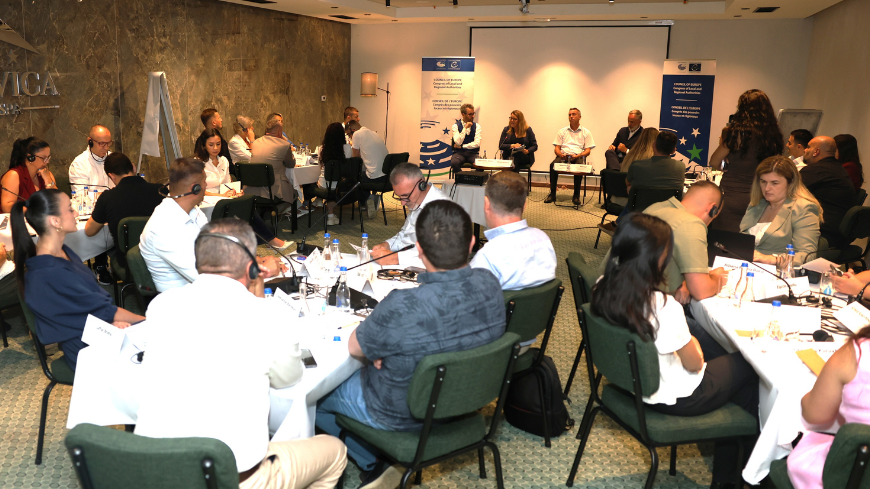
Before the day of the election, several meetings are
held to assess the state of electoral democracy, with
the participation of governmental institutions, local
and regional elected representatives, representatives of
the public administration (electoral commissions),
political parties (government and opposition), the
media, diplomatic circles and civil society.
Pending a decision from the Bureau of the Congress, a
pre-election delegation (comprising between two and five
members) may also be detailed to assess the overall
political situation of the country and the electoral
campaign and investigate the legal framework for the
elections.
Who are the Congress observers?
The political composition of delegations is proportional
to the representation of the political groups in the
Congress. The Congress also ensures fair representation
of its non-registered members.
EPP/CD = 28% SOC = 26% ILDG = 14%
It also strives to achieve balanced gender
representation (minimum one-third female members, in
accordance with the Charter of the Congress). Lastly, it
attempts to secure balanced representation of both
Congress Chambers and of the various member states of
the Council of Europe.
The EU Committee of the Regions is associated with the
Congress’s election observation mission as part of its
co-operation with the European Union.
Conclusions and follow-up
At the end of every election observation mission, the
Congress delegation publishes a preliminary statement,
which is normally read out at an on-the-spot press
conference at the close of the elections. A report is
subsequently drawn up by the Congress member who was
appointed Rapporteur for the mission.
His or her report deals not only with the procedures and
facts observed on election day, particularly during the
voting and vote-counting, but also with the general
political situation in the country, including the state
of fundamental rights and freedoms, the atmosphere which
prevailed during the election campaign and any progress
noted on the democracy front.
This report is submitted to the Bureau of the Congress.
It is subsequently assessed and adopted by the Congress
in plenary session. A recommendation (to the national
authorities) and resolution (to the local and regional
authorities) mark the end of the observation exercise.
Recent documents on observation of
elections
Consult all the documents / Search a document