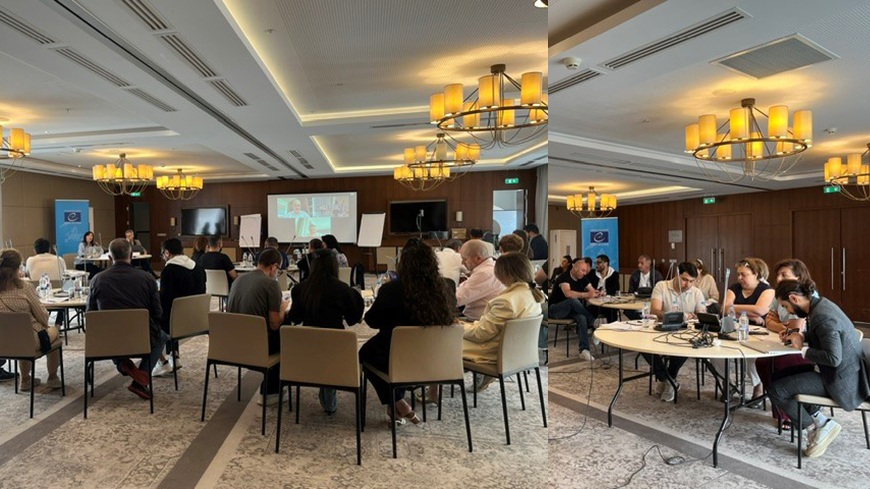
| Events |
|
Budapest 27-28/11/2012 |
|
Reykjavik - Iceland 28-29 May 2009 |
|
|
| Documentation |
|
|
|
|
|
|
|
|
|
|
|
|
| Useful links |
003_en-2.jpg)
Strasbourg, May 2004 |
MM-S-OD(2004)003 |
|
European Forum: Internet with a human face – a common responsibility _____ |
|
Warsaw, 26-27 March 2004 _____ |
|
General report prepared by Andrea Millwood-Hargrave _____ |
|
|
Content
Day One: Setting the scene
Workshops
Day Two: Looking ahead
Summary themes and outcomes
APPENDIX I: Programme
APPENDIX II: List of participants
APPENDIX III: Participants by country and per activity sector
* * *
This two-day conference was organised by the Council of Europe and the Safe Borders Consortium and co-sponsored by the European Commission, through its Safer Internet Action Plan. The conference was organised in conjunction with NASK (the main Internet service provider in Poland) and the Association of Polish Consumers (Stowarzyszenia Konsumetow Polskich).
The conference was designed to bring together a wide variety of those interested in Internet safety related issues. In this it succeeded very well. Forty countries were represented. The range of countries, with keen representation from those about to become part of the European Union, with differing levels of regulatory maturity within the communications industry, allowed the issues to be looked at afresh. Further, the variety of disciplines at the conference (NGOs, academics, researchers, industry representatives, consumer organisations, government officers and others) created a rich and diverse group of views.
There was no disagreement that the Internet is a positive force and that its benefits are considerable and should not, and cannot, be ignored. It is accepted that the Internet allows access to a wide array of material that may be available elsewhere but the power of the delivery system lies in its ability to deliver such material quickly and potentially unmediated. This in turn raises issues about the regulation of the Internet so that it is a force for good, both social and individual, and not a means to harm, coerce or distort. However, the Internet is a place where all these negative experiences can be had and the expressed intention of the Forum was to offer ‘an opportunity to exchange experiences and best practices as well as ideas and opinions on Safer Internet, all with the aim of creating a pan-European platform for stakeholders that seek to make the Internet a safe place’. The prime objective was to discuss how such an intention could be met, through the creation of responsible mechanisms of whatever form.
In addition to plenary sessions, which covered a variety of areas, there were four key themes developed in workshops:1
1. Education, Internet literacy & awareness raising: this workshop had a particular emphasis on the role of education in developing a responsible approach to the use of the Internet;
2. Law enforcement, liability of service providers and utility of hotlines: this workshop looked at a variety of regulatory frameworks possible to allow the policing of the Internet space;
3. Ethical issues: how can users be empowered so that the Internet is a force for social and individual good?;
4. Technological measures: what mechanisms can be put in place for a safer surfing environment?
Many of the papers presented at the conference are available through the Safer Internet website. It is not the intention of this report to repeat what was said but to offer an overview of thoughts and comments made that may not be captured in presentations or pre-prepared material.
The Ombudsman for Children in Poland, Pawel Jaros, opened the proceedings describing the rights of children to protection in Polish law. This included the right to use the Internet as a positive source of information and education. Its benefits are many and he listed some:
(i) its global nature which can open minds to other ways of thinking
(ii) the ability to access infinite amounts of content
(iii) its interactivity
(iv) its consequent socialisation benefits.
It also reaches all ages, with content produced and attractive to the very young child and on.
However, Mr Paros argued that the newness of the experience offered by this delivery system means that it is still relatively untried and the ability for it to act as a positive force is affected by the way it is used, both by the end user and by the content provider. Some of the benefits of the Internet could also be its negatives such as the anonymity it offers, the ability for it to be accessed anywhere and the potential for a subsequent denial of responsibility. Mr Jaros cautioned in particular about the dangers, especially to young people, of ‘inadvertent contact’.
Mr Jaros cautioned against the abuse of the rights of children to enjoy and use the Internet by others and referred the audience to the Children’s Rights Act. The use of the Internet as a way of reaching young people and children with inappropriate material or as a delivery mechanism for promoting the abuse (not always physical) of children was referred to, and was mentioned frequently throughout the conference.
Mr Jaros described ways in which his office was trying to work with industry, organisations and government departments to encourage an ethical framework and create a safe environment in which the Internet could be used positively and for the good of the community at large. This required the involvement of parents as well as the educational establishments and industry, supporting their ability to prevent the unauthorised access of illegal or harmful material.
Ms Richardson, Chair of the conference and member of the SafeBorders Consortium, briefly described the SafeBorders project, which has three broad objectives:
(i) To create a Europe-wide network and awareness raising programme
(ii) To harmonise the messages being delivered across nations
(iii) To adapt material for different countries’ needs
The ultimate target audience for this project are children and youth. She used the analogy of house building to describe the way in which the Internet should be built on solid foundations and value systems within sound legal parameters that protect the rights of the individual. The role of the meeting was to find ways to ensure that there was an exchange of information and to build practices that could be used regardless of the network or country because the fundamental values were constant.
Mr Hartig, Head of Media, Equality and Minorities Department in the Council of Europe, echoed many of the sentiments expressed by Mr Jaros, but placed the discussion within the broader context of the European Convention on Human Rights, which he reminded the audience, is ‘technologically neutral’. He also prompted the audience to be aware that the responsible use of the Internet should extend to other disadvantaged groups. He pointed to the work, for example, that the Council of Europe has undertaken on the way in which new technologies have been used in the trafficking of human beings for the purpose of sexual exploitation2 . Reference was also made to other areas in which the Council of Europe has been working, such as cyber crime, and it should be borne in mind that the Council’s activities spread throughout all European countries, including those not currently within the EU. Importantly Mr Hartig raised the issue of definitions, especially the difference between illegal content (dealt with in the Cybercrime Convention) and harmful content, a definition of which still to be found. This last was an issue returned to over the course of the conference, and was considered to be an important and necessary next step.
Mr Hartig also, like Mr Jaros, said that children had a right to participate in the information society and ways are needed to be found so that they can achieve this, safely.
Mr Hodne of the European Commission, in underlining the EU’s commitment to issues around the Internet, spoke of its commercial and social importance as a way of connecting people. He described the Safer Internet Action Plan, now drawing to a close, and spoke of the learning made from it. In particular the Plan had shown areas where countries need to be left to develop their own solutions (such as the hotlines, on the one hand, which were working well or educational materials, where there was less consistency). It had also demonstrated that the two key areas in which a difference could be made were awareness raising and the development of networking and co-ordination opportunities. The important issue was creating environments where there was coherence. In addition new areas were developing, and he mentioned spam (defined as ‘unwanted’ content) in terms of the Internet, but also other media such as video. To this end, he announced the proposal for a new Action Plan (the Safer Internet plus Plan) to run over four years and which would have a value of E50 million3. The four prime areas of the new programme would be
(i) Fighting illegal content: within this falls the co-ordination of hotlines in particular
(ii) Tackling unwanted and harmful content: filtering mechanisms and anti-spam measures fall into this category
(iii) Promoting a safer environment: a network of national co-regulatory and self- regulatory bodies will be set up so that experiences and knowledge can be shared
(iv) Awareness-raising: especially within the realm of the newest technologies which utilise personal and interactive methods. Media literacy (or more appropriately, communications literacy) would fall within this remit.
Mr Hodne described the national ‘nodes’ that would be set up which would act as co-ordinating and networking hubs and feed into the cross-national picture. This moved away from the project-based approach of the original Action Plan to a more linked approach.
In the final session before the workshops, Ms O’Connell presented the findings of the Eurobarometer study4, a study of the attitudes of parents of children to the age of 17. It showed that parents from countries with the highest in home Internet usage were most comfortable with their children’s use of the Internet while those from other countries were less at ease with their ability –and their children’s ability – to use the Internet safely. Parents in all countries showed a lack of knowledge about ways in which they could make the Internet safer for their children, and they want more information for themselves, choosing traditional media and formal education as their main sources. Ms O’Connell pointed to the importance of planning for new developments in technology, using these findings and others, when thinking about creating environments to help parents encourage the responsible use of the Internet.
Following the workshops, a plenary session opened with a presentation by Chris Marsden, the Programme in Comparative Media Law and Policy, of the project looking at self-regulation in Europe which had been funded by the European Commission5. One of the striking examples he took was of an experiment showing that ISPs in Europe tend to overreact to complaints about copyright violations and take down material which is obviously legal. This raises concerns about freedom of expression. Ann Davison, of the European Economic and Social Committee, presented research which showed that children and young people were often distressed by the material they saw on the Internet and asked that the responsibility for protecting them was taken more seriously. Larisa Efimova, consultant of the Legal Department of the State Duma, Russia, described Russian legislation in this field, emphasising at the same time that there is a huge problem of implementation of the law.
1. Education, Internet literacy and awareness raising
The key questions asked within this workshop were:
What are the main factors in promoting a balanced approach to Internet safety and how can we ensure maximum awareness and shared commitment at all levels of society? What is the role of education systems in confronting this new challenge?
This workshop began from the premise that the Internet allows a range of activities to take place, with the field of education being a particular area to benefit. However, using these technologies safely and responsibly requires an understanding of the parameters of the Internet, including an awareness of the benefits and risks.
The workshop itself was designed to focus on6:
· Integrating good practice into educational policy and school curricula in order to fully and safely exploit the potential of the Internet in futurist learning situations and with sound pedagogical methods;
· Defining the challenges involved in assuring the production and promotion of high quality, relevant resources and raising awareness to those which are harmful;
· Developing teacher, adult and youth training approaches that promote a culture of Internet literacy;
· Elaborating methods that can be used to ensure that awareness-raising is maintained across the educational community.
A range of people gave presentations and these can be found on the Safer Internet site. What is of particular interest here are the key conclusions coming out of the workshop:
(i) The traditional way of looking at education needs to be overhauled to deal with an environment which allows interaction and significant opportunity for learning by oneself or from peers. Thus, the Workshop concluded, the system needs to move from one that is dominated by teachers and modes of presenting information to a system which is far more learner-centred and draws on and utilises the experiences of the student. This is a systemic change and requires different agencies to work together at a fundamental level.
(ii) A European structure and framework for teaching and training should be set in place so that a strategy for dealing with this transnational phenomenon can be developed.
(iii) Education must be seen in the wider context of learning about citizenship and responsibility. It must not be confined to a narrow definition.
(iv) A basic requirement is the need to research the issues and to make sure that the learnings from such research are properly evaluated and acted upon, and not wasted as a resource.
2. Law enforcement, liability of service providers and the utility of hotlines
The key questions asked within this workshop were:
How can the implementation of new and existing legal instruments (e.g. the Cybercrime Convention, e-Commerce Directive, CoE Declaration on Freedom of Communication…) be ensured at all levels of society? How can responsibilities be shared with industry?
While recognising the positive benefits of the Internet as a global communications system allowing the exchange of information, communication and consumer interaction, it is apparent that the Internet also serves as a place where illegal and harmful activities can take place. This workshop explored those areas where responsible attitudes have been adopted and co-operation achieved to try and combat these negative activities.
The workshop itself was designed to focus on7:
· Whether the existing international standard-setting instruments provide a sufficient legal framework for protection of human rights and dignity in cyberspace? Can laws be imposed on the (global) Internet? How? Implemented by whom? How should the international context of the Internet be perceived?
· How industry participation might be encouraged in either self-regulatory or co regulatory structures.
· The challenges for surveillance and censorship on the net.
· Who should take responsibility for illegal and harmful content? What liability, if any, should there be on content providers and intermediaries regarding content disseminated through the Internet and by other electronic means of communication?
· The duties and responsibilities of users on the way they disseminate, and/or make use of content through the Internet and other electronic means of communication.
As before, presentations were given and these can be found on the Safer Internet site.
The conclusions from this workshop centred on the ways in which states and the industry could work with agencies to promote and maintain the development and use of protocols in this area, many of which already exist. Specifically:
(i) That the Internet must be embraced for the important social, democratic and commercial tool that it is while recognising the dangers that it can bring.
(ii) That member states should be encouraged to sign, ratify and implement the conventions that are already in place, such as the Cybercrime Convention and its Additional Protocol.
(iii) That the definition of ‘harmful’ content should be addressed so that states know what they are working towards. A definition of illegal content is offered in the Cybercrime Convention.
(iv) Help should be given to encourage the development of measures to counter illegal and harmful content, both in the legislature and in practice.
(v) Working across government, other agencies, the industry and advocacy groups are important for these initiatives to be fulfilled.
(vi) That states should be encouraged to develop training and awareness-raising initiatives for safe Internet use. The training should be offered particularly to law enforcement authorities.
(vii) Similarly hotlines should be encouraged, with awareness raising campaigns to support them.
(viii) It was important, this workshop concluded, to recognise that no single remedy would be effective. Rather a series of measures and a strategic approach to the issues need to be used.
3. Ethical issues
The key questions asked within this workshop were:
How can we ensure the transmission of values that respond to the challenges of the rapidly evolving social and economic world and empower citizens at every level of society? What can be done to promote tolerance and ensure respect of basic human rights of children, women and minority groups? What is the role of the media?
This workshop was designed to look at the opportunities offered by the Internet for illegal and harmful activities, such as the easier access to child pornography, for example, and the practice of trafficking in human beings, often for the purpose of sexual exploitation. The workshop also looked at verbal discrimination in the form of racist or xenophobic messages. The starting point was that the majority of Internet users are young people who are developing attitudes and value systems regarding what might constitute appropriate behaviour. Does the Internet encourage an erosion of values, and should there be structures (regulatory or otherwise) put in place to ensure this does not happen?
The workshop itself was designed to focus on8:
· An identification of the main threats to children, young persons and women as users of the Internet.
· Ways in which victims can be protected and rehabilitated.
· Identifying offenders and seeing whether and how they can be treated.
· Finding means of passing safety warnings on to potential victims.
· The role of the media – are there examples of good practice?
· The particular forms of racism and xenophobia on the Internet. What can be done to marginalise this kind of expression?
This workshop came to the following conclusions:
(i) It is important to recognise the different levels of maturity in both the penetration and use of the Internet and in regulatory structures across countries. Those countries with newer, less established systems have the opportunity to get material in place now. The importance of events such as the conference were pointed to as an example of the way in which countries can learn from each other.
(ii) Children and young people should be educated so that they can become responsible users of the Internet – they should be thought of as ’citizens’ within this space, not just consumers.
(iii) Children and young people should be ’empowered’ so that they can educate each other – participants in this Workshop talked of peer to peer counselling as a way of reaching young people (rather than young children), often more effectively than technical solutions, it was suggested.
(iv) It is also important to train adults (teachers and parents were referred to) to assess illegal and harmful content.
(v) There was recognition of ‘grey’ areas such as hate speech, which is illegal in some countries, but not all. The proposed definition of ‘harmful’ content should help alleviate this.
(vi) There was also recognition of the differences between content carried on ‘private’ sites (where issues of freedom of expression and rights of access might be argued) and material on publicly available websites.
(vii) There was much discussion about where responsibility lies for chat rooms – this was not resolved.
4. Technological measures
The key questions asked within this workshop were:
Given the exponential pace of technological evolution in the cyberworld, what mechanisms and measures can be implemented and by whom to provide a safe surfing environment?
Two action lines in the European Commission’s 2003-2004 Work Programme9 attempt to deal with the problem of illegal content by:
- The implementation of benchmarking and filtering software and services
- Encouraging user-friendly rating
This workshop was developed to analyse and discuss the technological solutions developed to increase security on the Internet, while protecting users’ rights and raising the level of accountability of content producers. It was to focus on:
· How technology can keep pace as new problems emerge with the increasing interconnectivity of Internet, mobile technologies and new media.
· What types of filtering, rating and labelling systems can effectively contribute to a safer electronic environment without compromising freedom of expression and information.
· What types of content should be filtered and for which user groups?
· What measures can be taken against viruses and spam?
· Whether on-line security can be improved to promote a greater level of confidence and trust and thereby encourage citizens to engage more actively in the information society?
As before, presentations were given by a range of people with experience in this field and these can be found on the Safer Internet site10. The key conclusions from the workshop were:
(i) There is a challenge in identifying illegal or harmful content from a technical point of view and it is debatable whether filters can be an adequate classificatory tool.
(ii) It was important also to determine where the responsibility for filtering lay – is it a hardware issue or one of software? Currently it is generally configured as the latter.
(iii) There is also the debate about who can and should classify on whose behalf. Different systems use different means, either voluntary self-classification or third party classification, for example. There are also issues surrounding national and cultural sensitivities which are complex to apply to a global delivery mechanism.
(iv) Nonetheless, systems are in place and are being developed. They need to be used in conjunction with other mechanisms such as training in their use, and an understanding of their effectiveness and limitations.
(v) Related to this is the importance of understanding how the user will employ the technological mechanisms offered to them. Users need to be made aware of their existence but these mechanisms also need to be made relevant and useable.
Ms Kubis of the Polish Office for Competition and Consumer Protection spoke of the measures put in place to protect consumers from unwanted content. She emphasised the importance of creating means of evaluating and monitoring content and identified areas such as spam that would impede the progress of the national drive to adopt the Internet.
Mr Loof, Head of the Children’s Unit within the Council of the Baltic Sea States, spoke of the need to understand the issues around children who are put at risk by the Internet, either as abusers or as the abused. He argued that there needed to be far greater awareness of the issues and new ways developed of interacting and talking with children in these situations – he too, mentioned peer to peer counselling as an effective means of reaching such young people. He described the requirement for victims to have access to the four Cs:
(i) Control: Victims had lost control of images of themselves. Often children and young people did not know how to reassert authority over images, which could remain in the public space for all time, and humiliation and embarrassment were linked in to this.
(ii) Complicity: Victims often felt they had been complicit in the crime which again fed into their guilt.
(iii) Closure: Seeking to find ways to allow abusers and the abused to be rehabilitated. Again the fact that the Internet remained a public space and these images were potentially always available was a source of shame to many victims.
(iv) Compensation: which could be financial.
Mr Loof reminded the audience that the dangers lay not just in overt paedophilic activity or pornographic images made available more easily through the Internet but also in chat rooms and other media. He mentioned the importance of coherence across countries, a recurring theme within the conference, and the need for there to be both legislative and policy/practice initiatives put in place. He too, mentioned the importance of creating networks that worked together to help create support systems and ways of preventing the abuse of young people and children in the first place.
At the end of the conference, there was a plenary session in which a group of experts took questions from the audience and outlined what the next steps might be. A common theme, often reiterated, was the importance of such an event both in allowing the exchange of information and in bringing different sectors of industry and government etc. together. Ms Gilleran, Schoolnet, talked of the importance of empowering children so that they had personal responsibility and this in turn, would help create better citizens. This was echoed by Ms Richardson, who pointed out the unprecedented opportunities that the Internet provides for developing citizenship skills. Ms Aftab, WiredSafety.org, offered to make available for free material that her organisation has developed over the years, as did others (including the SafeBorders Consortium and the Council of Europe). Ms Richardson also talked of the importance of harnessing the involvement of parents – they have life experience which their children, although technically able, do not. Ms Meharg, Microsoft, spoke of the benefits of the medium but also stressed the importance (as did the Council of Europe) of making it a safe environment for all users. She also raised the dilemma faced between the issue of freedom of expression and rights to privacy on the one hand and protection issues on the other. Mr Ireneusz Parafjanczuk from NASK described the efficacy of the ‘emergency response’ teams they have set up and underscored the importance of global co-operation and the importance of networks.
In responding to these comments some participants reiterated the point that there needed to be government backing and commitment (‘power’) to ensure that measures were followed through. Others talked of the importance of thinking beyond current structures and of the need for visionary people to help drive things forward.
Ms Grazyna Rokicki, from the Association of Polish Consumers, closed the meeting.
In summary, all embraced the Internet and the potential it offers, while being aware of – and seeking to minimize the risk – of dangers associated with it. There were some key themes that can be drawn from the conference:
1. The need for continuing dialogue
Participants greatly welcomed the ability to exchange views and experiences, especially across countries and regulatory systems that were at differing levels in terms of their maturity, including the penetration of the Internet. The importance too, of learning from experiences and research across nations was emphasized, so that resources would not be wasted. It was also important that the range of people taking part was maintained – drawing from political, business and civic areas of interest.
2. A sense of compressed history
The scale of the issues being discussed and the constantly changing technological developments mean that there is a sense of longevity to the discussions, which are not warranted by the length of time that the Internet has been available to the ‘man in the street’ (which is little over ten years). Legislation, rules and regulations have all had to try and keep up with the very fast-moving advances and opportunities (and concomitant risks) the medium creates.
3. The challenge to traditional modes of thinking
The Internet has challenged the notion of public interest and the balance between public and private rights by blurring boundaries and making public space private and vice versa. It also creates a tension while trying to get the balance between the advantages and the risks right.
4. Importance of getting the timing right
Many participants and speakers spoke to this. Factors in getting the timing right in terms of protection of children included being aware of the market in the country and its regulatory structures. But it also included the need to be aware of the needs and development of the audience and user groups. This could include a revised look at the way in which childhood and education are conceived of. It should also include a consideration of other groups, such as people being exploited for sexual reasons. The strategies also need to be forward looking and be able to take account of new developments such as Wi Fi and 3G.
5. Importance of learning
The importance of learning from, and building on, experiences, research etc were all discussed many times. However there was not always agreement in terms of the strategies that should be adopted to deal with this constantly developing technology. At one end of the continuum there were participants (and countries) that argued that the technology and its challenges are so new that everything should be looked at afresh. At the other end it was argued that the Internet is part of a developing communications environment and so the structures that should be put in place are evolutionary and can be based upon current practices. It is the view of the rapporteur that it was the latter view that prevailed.
6. It is possible to balance the risks
As Mr Hartig had said, cyberspace should not be a lawless area and the conference showed that it need not be. Solutions to cope with the challenges raised were being sought and legislative measures have been, and are being put, in place. The Council of Europe and the EU both pointed to examples of this, as did the many presentations from industry, NGOs and others. Discussions of the types of regulation that were possible, and feasible, also took place. It was clear that all parties need to take responsibility however, no single agent could – or should – be responsible for all the risks associated with the Internet.
7. The net needs to be cast widely
The Internet creates a need for a system which is interlocking and allows different systems and groups of people to interact. The EU Action Plan plus recognizes this, and participants talked not only of the importance of bringing educational establishments on board but also parents, industry, the media, legal authorities and interested groups who can support each other. There remains a significant lack of awareness of what can be done, and communications literacy was frequently mentioned as a way forward. The exchange of examples of best practice was also talked about. The use of technical solutions alone would not be enough to protect young people from the dangers of the Internet, although they are key.
8. Definitions
The problems with definitions were referred to frequently throughout the conference. The EU Action Plan plus has added a new category to its list of negative content, that of ‘unwanted content’ such as spam. And while illegal content has been defined and broadly agreed upon, ‘harmful’ content remains a grey area and one that causes much confusion between countries. The Council of Europe stated that it would look at this area and this was welcomed. Remains to be seen to what extent European solutions can be offered to problems where national perceptions may differ.
9. The importance of coherence and relevance
It was important, all agreed, to use networks such as this to ensure that the messages being put across to users and content providers were coherent and relevant – and useable. The use of children as advocates was mentioned a number of times throughout the conference, as was the importance of listening to them and their needs and fears. At the same time, several participants drew attention to the fact that teenagers often engage in behaviour knowing about the risks, which challenges our notions about the impact of safety training.
Finally, this delegate from Romania summed up her experience in a response to the outcome of the conference: “I saw the partnerships and the networks that were created as a consequence of the event. I think people had the opportunity to talk to each other and to learn from each other and in this sense I really appreciate the effort to bring people from the East of Europe to participate, because as they/we learn from each other’s experiences, we can also learn from previous mistakes and we could find common grounds for the more diverse cultural background of each of us.”
* * *
26th March
9:30 - 9:30 |
Coffee and registration |
9:30 - 11:00 |
Opening address form Pawel Jaros, Ombudsman for Children in Poland Child on the Web - Challenges and opportunities |
Plenary session |
Welcome & Chair - Janice Richardson, SafeBorders, eLuxembourg Hanno Hartig, Head of Media, Equality and Minorities Department, DG II, Council of Europe Human rights and the rule of law in the Information Society Tor Eigil Hodne, DG Information Society, European Commission The Safer Internet Programme in an enlarged Europe Rachel O’Connell, Cyber Research Unit – SafeBorders project, UK Latest EuroBarometer figures on public attitudes to safer Internet |
11:00 - 11:20 |
Coffee break |
11.20 – 13.15 |
1. Education, Internet literacy and awareness-raising Chair: Karl Donert, Hope University, UK |
Parallel workshops |
Serhii Kushch, Professor, Dept. of Information Security, Ukraine: Internet as a tool for the sustainable development of civil society Bogomil Nikolov, Bulgarian National Consumers Association: Ongoing challenges ahead of Bulgarian Internet users Lukasz Wojtasik, Nobody’s Children Foundation, Poland: A nationwide social campaign against pedophilia on Internet Grzegorz Herman, secondary teacher in Poland: Education towards self -awareness - is it the feasible solution? Dr P. Mentzelou, Technical Ed. Institution, Thessaloniki, Gr: Influence of “Internet-cafés” on teenagers in Thessaloniki Yulia A. Timofeeva, Max Weber Center, Uni. of Erfurt, Germany: Education, Internet Literacy & Awareness-raising Mary Louise Morris, Childnet, Raising awareness: Childnet’s 360 degree approach C. P. Rodríguez González & R. Rodríguez Romero, UCA, Spain: Social Face of the Internet: Educating for Living Elisabeth Staksrud, Norwegian Board of Film Classification, Education and awareness-raising: the SAFT Project Isabelle Bréda, CLEMI - French Education Ministry: Educaunet, a critical media education programme Anne Gilleran, European Schoolnet, Belgium: Learning to Cross the Street. Educational viewpoint on Internet Safety 2. Law enforcement, liability of service providers and utility of hotlines Chair: Gianluca Esposito, DG I, Council of Europe John Carr, UK Govt Internet Task Force on Child Protection: Self-Regulation – pros and cons Valerie Thompson, Senior Researcher ERICA, Belgium: European Children’s Websites Thomas Rickert, President INHOPE, Germany: INHOPE – an umbrella organisation for European hotlines Angelo Zappalà, Telefono Azzurro, Italy: The 114 Italian hotline experience Shereen Meharg, Corporate Responsibility Manager MSN Int. UK: Law Enforcement & Microsoft Andrzej Adamski, ICT law professor, Poland: Private-public partnership in combating cyber-crime: legal considerations Osman Gunduz, President Azerbaijan Internet Forum: Legislation and Self-Regulation in Azerbaijan Vilma Misiukoniene, Dir. Infobalt copyright agency, Lithuania: Combating Cyber Crime in Lithuania Edvins Karnitis, Commissioner, Latvia Public Utilities Commission: Internet regulation: democracy, liability & sanity Dusan Babic, Media researcher and Analyst, Media Plan Institute, Bosnia: Global Code of Online Journalism Ethics Sjoera Nas, Bits of Freedom, NL: The future of freedom of expression on-line - why ISP self-regulation is a bad idea Michael Rotert, Professor, Director EuroISPA, Germany: Safer Internet: the EuroISPA view Cristian Perrella, Trust and Safety Manager Europe, eBay International AG, Switzerland: eBay, Trust and Safety 3. Ethical issues, child protection, prevention of human exploitation & discrimination Chair: Anne-Marie Faradji, DG II, Council of Europe Vernon Jones, Save the Children, Denmark: Children’s rights in relation to Internet Maria Keller-Hamela, Nobody's Children Foundation, Poland: Avoiding Internet exploitation Gemma Holland, Victim Identification Project, Ireland: Identifying and supporting victims Larisa Vasilyeva, A world without slavery NGO, Russia: A world without trafficking Ethel Quale, Cork University, Ireland: Who are the offenders? Suzette Bronkhorst, Sec. Gen. Int. Network against Cyber Hate (INACH), NL: Combating hate speech on Internet 4. Technological watch: spam and anti-virus protection, labeling and filtering Ireneusz Parafjanczuk, Computer Emergency Response Team, Poland: Internet in XXIth century – advantage or danger? François Thill, Ministry of Economy, Luxembourg: Cyberworld Awareness and Security Enhancement Structure Konstantinos Chandrinos, Internet Content Filtering Group, Greece: Filtering technology for spam and web content Phil Archer, Internet Content Rating Association, UK: Labelling & Filtering – the past & future role of ICRA Aurélien Slodzian: PRINCIP project coordinator, France: Filtering racism on the Internet Jean-Luc Stehlé, Everbee Chief Scientist, Ecole Centrale, France: Low cost hardware solutions for secure Internet access Anne Mullins, Contents Standards Manager, Vodafone Global Content Services, UK: Mobile phones & children |
13:15 - 14:30 |
Lunch |
14.30 – 16.00 Parallel workshops |
The Way Forward: Workshops continue on the four above-mentioned themes with panel discussions, presentations and round-table debates. See detailed workshop programs here-below. |
16.00 – 16.20 |
Coffee break |
Plenary session round-table |
East meets west to create a safer online environment Moderator: Tomasz Kulisiewicz, Poland Introduction: Chris Marsden, Self-regulation.info, Oxford University, UK Ann Davison from the European Economic and Social Committee and Elizabeth Staksrud from the Norwegian Board of Film Classification highlight best practice and debate the issue of self-regulation or co-regulation with Vilma Misiukoniené representing the Lithuanian ICT industry, Larisa Efimova, consultant of the Legal Department of the State Duma, Russia, and Pawel Jaros, the Ombudsman for Children in Poland. |
17.50 – 18.00 |
Summary closing remarks from rapporteur: Andrea Millwood Hargrave, UK |
19.30 – 23.00 |
Royal Castle visit, cocktail and gala dinner |
27th March
9.15 – 9.50 |
Welcome: Ewa Kubis, V-P, Polish Office for Competition and Consumer Protection Protection of consumer interest on Internet |
Plenary session |
Lars Lööf, Senior Advisor & head of Children’s Unit, Council of Baltic Sea States Preparing for tomorrow: Child protection, legislation & pan-European cooperation to address challenges and emerging threats raised by increased use of new media |
9.50 – 11.00 |
Workshop 3: Empowerment, protection and transmission of values to meet the challenges of the cyberworld |
Workshop reports |
Workshop 2: Protection of Internet users: sharing the responsibilities and defining roles for policing the cyberworld |
11.00 – 11.15 |
Coffee break |
11.15 – 12.30 |
Workshop 1: Promoting awareness, shared commitment and a balanced approach to Internet safety: the role of education systems |
Workshop reports |
Workshop 4: Technological mechanisms and measures for a safer surfing environment: contribution of filtering, rating and labeling systems |
12.30 – 13.15 |
Moderator: Pall Thorhallsson, Media Division, Council of Europe Establishing a network for the future |
Plenary session round-table |
Discussion & development of a common action plan with input from national, pan-European and international organizations; chaired by Council of Europe and SafeBorders consortium. |
13.30 |
Closure of conference |
Kolami |
Olsi |
Journalist |
Bistri |
Idar |
Legal Counsellor of the Parliamentary Committee for Mass Media |
Armenia | ||
Zakaryan |
Tigran |
Yerevan State University |
Austria | ||
Spoeck |
Hubert |
PA Innsbruck |
Wieser |
Reinhard |
PA Innsbruck |
Azerbaijan | ||
Gunduz |
Osman |
Azerbaijan Internet Forum |
Belarus | ||
Miniukovich |
Katsiaryna |
Project of the Government of Belarus and UNDP |
Belgium | ||
Chapel |
Michel |
Communauté française, Cabinet du Ministre C. Dupont |
Thompson |
Valerie |
ERICA |
Banciu |
Daiana Ligia |
European Inter-University Centre in Human Rights and Democratisation |
De Theux |
Paul |
Média Animation |
Franssen |
Eric |
Ministère de la Communauté française de Belgique |
Gilleran |
Anne |
European Schoolnet |
Rotert |
Michael |
EuroISPA EEIG |
Bosnia-Herzegovina | ||
Babic |
Dusan |
Media Consultant |
Bulgaria | ||
Nikolov |
Bogomil |
Bulgarian National Consumers Association |
Stoyanova |
Nelly |
Ministry of Transport and Communications |
Croatia | ||
Vidovic |
Gordana |
Ministry of European Integration |
Czech Republic | ||
Pavlík |
Karel |
Consumers Defence Association of the Czech Republic (SOS) |
Pospisilova |
Jindriska |
National Library of the Czech Republic |
Denmark | ||
Jones |
Vernon |
Save the Children |
Pihl |
Marianne |
Save the Children |
Estonia | ||
Teller |
Siim |
Tele2 Eesti AS |
Finland | ||
Hautala-Kajos |
Kristina |
Ministry of Education and Culture |
France | ||
Breda |
Isabelle |
CLEMI - French Ministry of Education |
Slodzian |
Aurélien |
PRINCIP |
Stehlé |
Jean-Luc |
Everbee Networks |
Georgia | ||
Garsevanishvili |
Grigori |
IT Development Center |
Solomonishvili |
Marine |
Center Lea & International Foundation |
Esadze |
Londa |
Independent Board of Advisors (IBA) of the Parliament of Georgia |
Darbaidze |
Eka |
National Unesco Commission |
Germany | ||
Bacha |
Slim Florian |
GMK |
Kerschbaumer |
Dagmar |
GMK |
Rickert |
Thomas |
INHOPE Association |
Timofeeva |
Yulia |
Max Weber Center, University of Erfurt |
Greece | ||
Alevritou Goulielmou |
Helen |
EKPIZO (Consumer Association – The quality of life) |
Chandrinos |
Konstantinos |
IIT - NCSR "Demokritos" |
Mentzelou |
Paraskevi |
Technological and educational institution of Thessaloniki (T.E.I.) |
Hungary | ||
Tamas |
Pall |
Hungarian Academy of Sciences Institute of Sociology |
Ireland | ||
Holland |
Gemma |
Victim Identification Project |
Quayle |
Ethel |
Cork University |
Italy | ||
Amendola |
Antonio |
AGCOM |
Capelli |
Francesca |
Journalist, ragazzinet.it |
Conte |
Elvira |
EnAIP Puglia |
De Ioris |
Mario |
Italian Presidency of the Council of Ministers |
Galli |
Laura |
Adiconsum-Italian Association for Consumer Protection |
Grassi |
Cinzia |
Italian Presidency of the Council of Ministers |
Ljungdahl |
Johan |
Telefono Azzurro |
Russo |
Vincenzo |
Telefono Azzurro |
Setti |
Cristina |
Telefono Azzurro |
Carstensen |
Dieter |
Save the Children |
Zappalà |
Angelo |
Telefono Azzurro |
Latvia | ||
Karnitis |
Edvins |
Public Utilities Commission |
Ozolins |
Helmuts |
Information Society Bureau of Latvia |
Penka |
Janis |
Club for the Protection of Consumer Interests |
Lithuania | ||
Misiukoniene |
Vilma |
Infobalt association |
Prokopchik |
Marija |
Institute of Libraries and Information, Vilnius University |
Luxembourg | ||
Hoffmann |
Alain |
SafeBorders |
Richardson |
Janice |
SafeBorders |
Thill |
Francois |
Ministry of Economy |
"the former Yugoslav Republic of Macedonia" | ||
Skerlev-Cakar |
Andriana |
Broadcasting Council |
Moldova | ||
Vitalie |
Chiperi |
State University of Moldova |
Netherlands | ||
Bronkhorst |
Suzette |
International Network Against Cyber Hate (INACH) |
Boersma |
Willem |
Integral |
Nas |
Sjoera |
Bits of Freedom (NL NGO) |
Verbeek |
Ronald |
Ministry of Economic Affairs |
Wintermans |
Vincent |
Netherlands National Commission for Unesco |
van Houts |
Anthony |
|
Norway | ||
Kirksaether |
Jorgen |
SAFT project |
Staksrud |
Elisabeth |
SAFT project |
Saetre |
Marit |
SAFT project |
Hoff |
Ola-Kristian |
Advokatredet / Lawnest |
Poland | ||
Luba - Krolik |
Beata |
International - Service Teacher Training Centre |
Chlebowski |
Tomasz |
Research and Academic Computer Network |
Gorniak |
Slawomir |
Research and Academic Computer Network |
Kijewski |
Piotr |
Research and Academic Computer Network |
Lewandowski |
Józef |
|
Parafjanczuk |
Ireneusz |
Research and Academic Computer Network |
Pawel |
Jaros |
Ombudsman for Children |
Rokicki |
Pawel |
Association of Polish Consumers |
Anacki |
Krzysztof |
Institute of Computer Science Polish Academy of Sciences |
Adamski |
Andrzej |
Nicholas Copernicus University, Faculty of Law and Adminstration, Toruñ, Poland |
Adamczuk |
Agnieszka |
Ombudsman for Children in Poland Office |
Baranowska |
Maria |
Research and Academic Computer Network |
Jakubowicz |
Karol |
Council of Europe's Steering Committee on the Mass Media |
Dziedzic |
Beata |
University of Zielona Gora |
Gajewska |
Monika |
Research and Academic Computer Network |
Herman |
Grzegorz |
CK Norwid Secondary School |
Izdebski |
Zbigniew |
University of Zielona Góra |
Krauzowicz |
Marcin |
Ombudsman for Children in Poland Office |
Kaminska |
Agata |
Research and Academic Computer Network |
Keller-Hamela |
Maria |
Nobodys Children Foundation |
Komorowski |
Tomasz |
Polish National Commission for UNESCO |
Kozlowski |
Maciej |
Research and Academic Computer Network |
Kubis |
Eva |
Polish Office for Competition and Consumer Protection |
Kulisiewicz |
Tomasz |
|
Lubniewska |
Magdalena |
Research and Academic Computer Network |
Maj |
Miroslaw |
Research and Academic Computer Network |
Marzec |
Marek |
Research and Academic Computer Network |
Modzelewska |
Renata |
|
Orlowski |
Tomasz |
Polish National Commission for UNESCO |
Osoliñski |
Dominik |
Association of Polish Consumers |
Piechocki |
Artur |
Research and Academic Computer Network |
Pluskwa |
Kamil |
|
Przybylski |
Przemyslaw |
Ombudsman for Children in Poland Office |
Przechrzta |
Maciej |
University of Zielona Góra |
Przemyslaw |
Jaroszewski |
Research and Academic Computer Network |
Rokicka |
Grazyna |
Association of Polish Consumers |
Rywczynska |
Anna |
Research and Academic Computer Network |
Silicki |
Krzysztof |
Research and Academic Computer Network |
Spiewak |
Jakub |
KIDPROTECT Foundation |
Stanczak |
Piotr |
Research and Academic Computer Network |
Trampczynska |
Maria |
Research and Academic Computer Network |
Turowski |
Zbigniew |
University of Zielona Góra |
Wach |
Mariusz |
Ombudsman for Children in Poland Office |
Weso³owska |
Aleksandra |
Association of Polish Consumers |
Wojtasik |
Lukasz |
Nobodys Children Foundation |
Ziolkowska |
Maria |
Research and Academic Computer Network |
Portugal | ||
Verdelho |
Pedro |
Penal Investigation Dept. |
Romania | ||
Rodica - Roxana |
Anghel |
Romanian Audiovisual Council |
Maxim |
Tudor |
A.B.U.S.E. – Association for the Good Use of Electronic Services |
Tuchel |
Daniela |
Journalist, Libertatea newspaper |
Russia | ||
Efimova |
Larisa |
Legal Department of the State Duma |
Samokvalov |
Alexey |
Director of the National Center of TV and Radio Research |
Trushina |
Irina |
National Library of Russia |
Vasilyeva |
Larisa |
"Women" Non Governmental Organisation |
Serbia and Montenegro | ||
Vukovic |
Verica |
Antipiracy organisation of Serbia and Montenegro |
Slovenia | ||
Dolenc |
Tomi |
Project co-ordinator ARNES |
Spain | ||
Quintana |
Nuria |
FCR |
Rodríguez González |
Carmen Pilar |
University of Cadiz |
Rodríguez Romero |
Raquel |
University of Cadiz |
Tiago |
Manuel |
FCR |
Sweden | ||
Johanson |
Anders |
National Post and Telecom Agency |
Lööf |
Lars |
Council of the Baltic Sea States |
Switzerland | ||
Perrella |
Cristian |
eBay international |
Turkey | ||
Caylak |
Nihat |
Radio and Television Supreme Council |
United Kingdom | ||
Lockett |
Shelley |
Liverpool Hope University College |
Millwood Hargrave |
Andrea |
Millwood Hargrave ltd. |
O'Connell |
Rachel |
University of Central Lancashire |
Allen |
Don |
CW E-Media |
Archer |
Phil |
ICRA |
Arcus |
Sebastian |
Hope University |
Carr |
John |
NCH |
Coles |
Julian |
BBC |
Donert |
Karl |
Liverpool Hope University College |
Marsden |
Christopher |
Selfregulation.info PCMLP |
Meharg |
Shereen |
Microsoft |
Truman |
Nick |
British Telecom |
Morris |
MaryLouise |
Childnet International |
Mullins |
Annie |
Vodafone Global Products Content Servcies |
Navidi |
Ute |
ChildLine |
Ukraine | ||
Kasyanov |
Sergiy |
National Aerospace University Solidarian Union |
Kurchenko |
Yana |
NGO "Bukovinian Independent Alliance" Internet Solutions Company "O2 Project" |
Kushch |
Serhii |
Physic – Technical Institute of the National Technical University of Ukraine |
Pustelnyk |
Lyudmyla |
"Prosvita" |
United States | ||
Aftab |
Parry |
WiredSafety.org |
European Union | ||
Hodne |
Tor Eigil |
DG Information Society |
Davison |
Ann |
EU Economic and Social Committee |
Council of Europe | ||
Hartig |
Hanno |
DG II |
Esposito |
Gianluca |
DG I |
Faradj |
Anne-Marie |
DG II |
Thorhallsson |
Pall |
DG II |
1 For further details see www.safer-internet.net
2 For a factsheet see www.coe.int/T/E/NGO/Public/Factsheet_trafficking
3 See www.europa.eu.int/iap
4 europa.eu.int/information_society/programmes/iap/ docs/pdf/reports/eurobarometer_survey.pdf
5 http://www.selfregulation.info/
6 See www.safer-internet.net
7 See www.safer-internet.net
8 See www.safer-internet.net
9 http://europa.eu.int/information_society/programmes/iap/docs/pdf/programmes/workprgm/work_programme_2003_04_en.pdf
10 See www.safer-internet.net