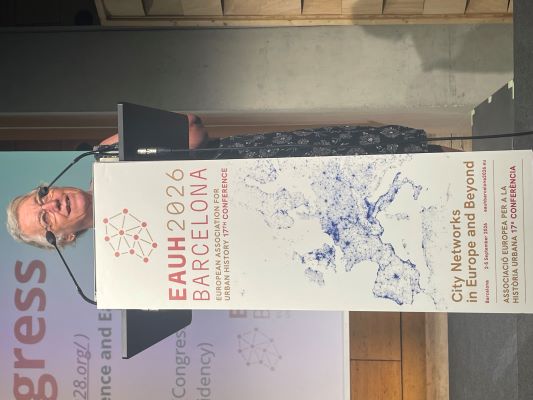
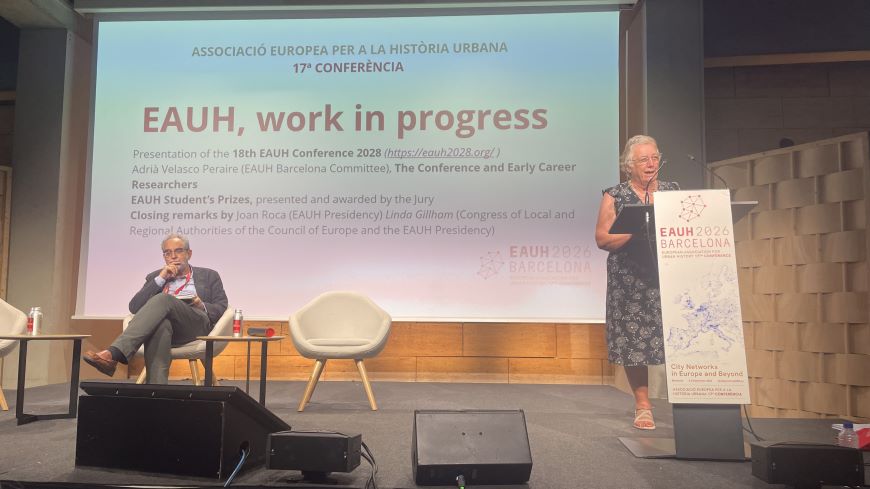
“It has been said that all politics is local, but so too is history. No-one knows this better than local politicians” Congress Governance Committee Vice-Chair Linda Gillham (United Kingdom, ILDG) told a conference of over one thousand urban historians in Barcelona, Spain, on 4 September 2026.
Closing the final plenary session of the European Association for Urban History 2026 Conference, Linda Gillham told attendees that local and regional politicians “live with the past, and the pride, opportunities and challenges that it presents for the communities that we represent”.
She explained that the Congress has recently focused on how sub-national authorities can help local communities to be “at ease with the past, to celebrate and take joy in the triumphs, to acknowledge and reconcile with the tragedies and to preserve all of this in memory and in physical form, so that current and future generations may learn in a way that unites people and communities and strengthens the cohesion of local democracies.”
Among other things, the Vice-Chair pointed to the Congress report “Squeezed out? bringing regional history teaching to the fore” (2026) which encourages authorities at all levels to support access to regional history, including city regions. This allows people whose regional identity is often their primary identity to relate that history to their present day lives.
She also spoke about the forthcoming report on “Contested Memories: how local and regional authorities can manage controversial cultural heritage”. She pointed to the need for careful, transparent and effective management of heritage, so that it honours the memory of victims, mitigates against extremism and the glorification of violence, and respects local community sensitivities, saying:
“So often, this responsibility falls to the cities and municipalities where that heritage is found. They take the decisions on monuments, street names, and commemoration practices, whether to preserve, contextualise or remove them. So how can they do this in a thoughtful, inclusive and democratic way?”
The report, which will address these questions with clear recommendations to local and regional authorities, will be debated at the next Session of the Congress, in October 2026.