


Official text and translations
 Treaty Office: English Second Additional Protocol
Treaty Office: French Second Additional Protocol
Treaty Office: Official and non-official languages

While cybercrime is proliferating and the complexity of obtaining electronic evidence that may be stored in foreign, multiple, shifting or unknown jurisdictions is increasing, the powers of law enforcement are limited by territorial boundaries. As a result, only a very small share of cybercrime that is reported to criminal justice authorities is leading to prosecutions or court decisions.
The Protocol responds to this challenge and provides tools for enhanced co-operation and disclosure of electronic evidence - such as direct cooperation with service providers and registrars, effective means to obtain subscriber information and traffic data, immediate co-operation in emergencies or joint investigations - that are subject to a system of human rights and rule of law, including data protection safeguards.
Tools of the Second Additional Protocol
- Direct requests to registrars in other jurisdictions to obtain domain name registration information
- Direct co-operation with service providers in other jurisdictions to obtain subscriber information
- More effective means to obtain subscriber information and traffic data through government-to-government co-operation
- Expeditious co-operation in emergency situations
- Joint investigation teams and joint investigations
- Video conferencing
- A strong system of human rights and rule of law safeguards, including for the protection of personal data



CyberSPEX project : Digital Evidence and Judicial Cooperation Training for Italian prosecutors
From 30 September to 2 October 2026, 150 prosecutors of the districts of Milan, Turin, Genoa, Bologna, Brescia, Trento and Venice have attended the training on “Digital Evidence and Judicial Cooperation: The EU E-evidence Package and the Second Additional Protocol to the Budapest Convention” ...

CyberSPEX project: EJCN masterclass on the Second Additional Protocol
On 25 September 2026 the CyberSPEX project contributed to the European Judicial Cybercrime Network (EJCN) masterclasses, by sharing insights on the Second Additional Protocol (2AP) to the Convention on Cybercrime (Budapest Convention) and by introducing the newly designed 2AP Model Training...

CyberSPEX and ULTRAXL projects: Workshop on the admissibility of electronic evidence
The CyberSPEX project, a joint initiative of the European Union and the Council of Europe, in co-operation with the UltraXL project, organised a workshop on the admissibility of electronic evidence in criminal proceedings in The Hague on 24–25 September 2026. The workshop brought together 25...

CyberSPEX project: EUROPOL Cybercrime conference on international co-operation
On 23-24 September 2026, the CyberSPEX project contributed to the EUROPOL Cybercrime Conference, supporting a dedicated session on “From legal frameworks to capacity building: which perspectives for law enforcement on international co-operation”. The contribution highlighted the relevance of the...

CyberSPEX: Training on the Second Additional Protocol for the General Prosecutor’s Office and other relevant authorities in Hungary
On 15-16 September 2026, following Hungary’s ratification of the Second Additional Protocol (2AP) to the Convention on Cybercrime (Budapest Convention) in February this year, the CyberSPEX project, a joint initiative of the European Commission and the Council of Europe, organised a dedicated...
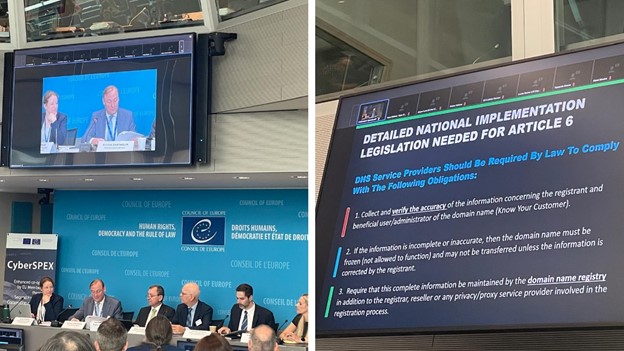
CyberSPEX: Third consultation with civil society stakeholders and service providers on the implementation of the Second Protocol to the Convention on Cybercrime
Following meetings held in December 2024 and November 2025, the Secretariat of the Cybercrime Convention Committee (T-CY), with the support of the CyberSPEX project, organised on 2 June 2026 the third consultation with civil society stakeholders and service providers on the implementation of the...
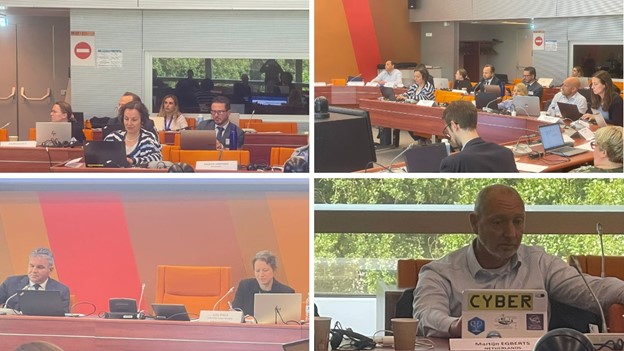
CyberSPEX: Fourth Steering Committee meeting
On 1 June 2026, the CyberSPEX joint project of the European Union and the Council of Europe organised its fourth Steering Committee meeting in Strasbourg, France, gathering representatives of the EU member states authorities and partners from EU agencies (EUROPOL, EUROJUST, SIRIUS project). The...
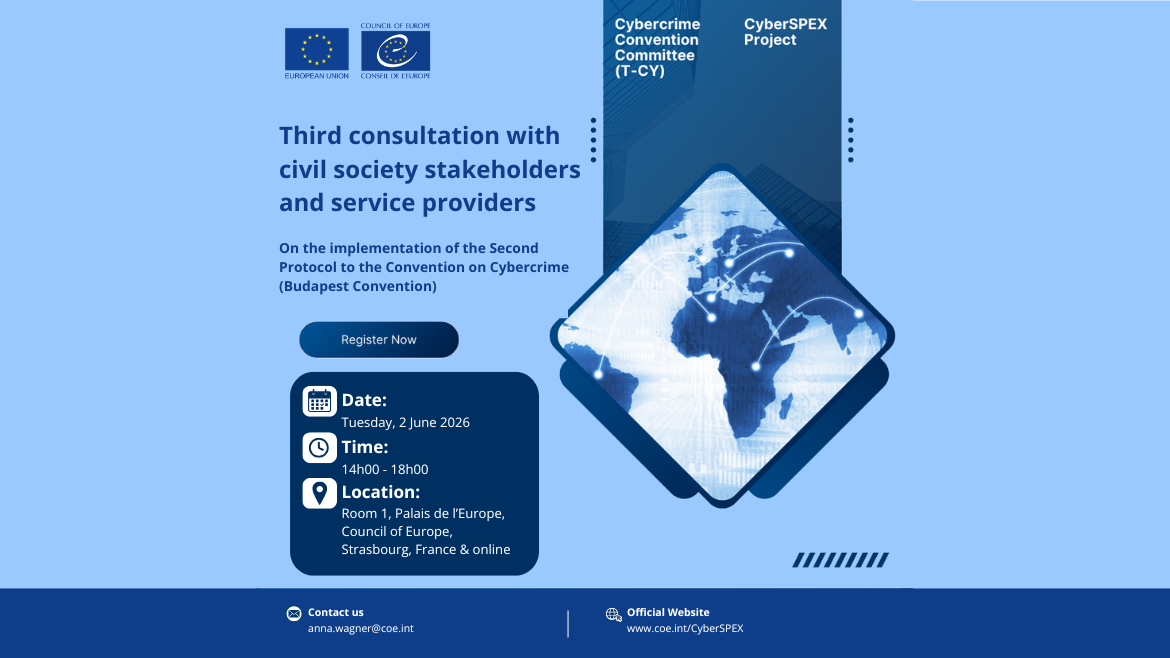
CyberSPEX and T-CY: Upcoming consultation with civil society stakeholders
The Cybercrime Convention Committee (T-CY) with the support of the CyberSPEX project, a joint project of the European Union and the Council of Europe, will host the third consultation with civil society stakeholders and service providers to strengthen public-private collaboration on cybercrime...

CyberSPEX: Workshop on facilitating co-operation under the Second Additional Protocol through the 24/7 Network established under the Budapest Convention in EU Member States
The implementation of the Second Additional Protocol (2AP) to the Convention on Cybercrime (Budapest Convention) was furthered through a workshop organised by the CyberSPEX project on 26 May 2026 in Bucharest, Romania. The event gathered EU m/s representatives from Ministries of Justice, law...
52
signatories in total*
4
countries have ratified the Protocol (out of the 52 signatories)*
 15 April 2026
5 February 2026
14 November 2025
9 July 2025
Norway becomes the 51st State to sign the Second Additional Protocol
5 June 2025
Fiji signs the Second Additional Protocol (becoming the 50th State)
27 March 2025
Latvia becomes the 49th State to sign the Second Additional Protocol
12 December 2024
Peru becomes the 48th State to sign the Second Additional Protocol
24 September 2024
Paraguay becomes the 47th State to sign the Second Additional Protocol
20 June 2024
Czechia and Sierra Leone become the 45th and 46th States to sign the Second Additional Protocol
17 June 2024
Georgia becomes the 44th State to sign the Second Additional Protocol