


Global Education

Global education is education that opens people’s eyes and minds to the realities of the globalised world and awakens them to bring about a world of greater justice, equity and Human Rights for all.
The Maastricht Declaration, 2002
 Global education is a pedagogical approach that fosters multiple perspectives and the deconstruction of stereotypes and builds on a learner centred approach to foster critical awareness of global challenges and engagement for sustainable lifestyles.
Global Education competences build on development education, human rights education, education for sustainability, education for peace and conflict prevention and intercultural education, all being the global dimension of education for citizenship.
The North-South Centre of the Council of Europe’s work for the development of Global Education started in 1991 with pioneer regional multistakeholder seminars on the issue. They led to the drafting of the Global Education Charter in 1997, which became its reference background document, later consolidated by the recommendations from European Global Education multistakeholder congresses and regional seminars, as well as a capacity building scheme for formal and non-formal educators.
Ever since, the North-South Centre of the Council of Europe has been contributing to global education advocacy and pedagogical support through a number of initiatives, at institutional and education levels.
It is fundamental for education to offer educators and learners the opportunity and the competences to understand the multiple interactions between political, economic, social, cultural and environmental issues, as well as to reflect on their own role and responsibility in a global and complex interconnected society.
Dealing with this growing interrelatedness between local and global realities, while stimulating a multi perspective approach, should be subjacent to education nowadays, as much as citizenship and social conscience cannot be dissociated from the collective and global dimensions of our lives.
Promoting new ways of thinking and acting towards a more engaged and critical citizenship, by equipping educators and learners with relevant competences, has been the purpose of many pedagogical theories: Global Education emerged as an attempt to systematise these pioneering pedagogies and bring them into the curriculum. Anyway, Global Education should not be presented as an approach accepted uncritically as there are tensions, doubts and different perceptions in education processes when dealing with global issue: it is rather an on-going and reflective process that follows evolving ethical, political, economic, societal, cultural and environmental movements and dilemmas.
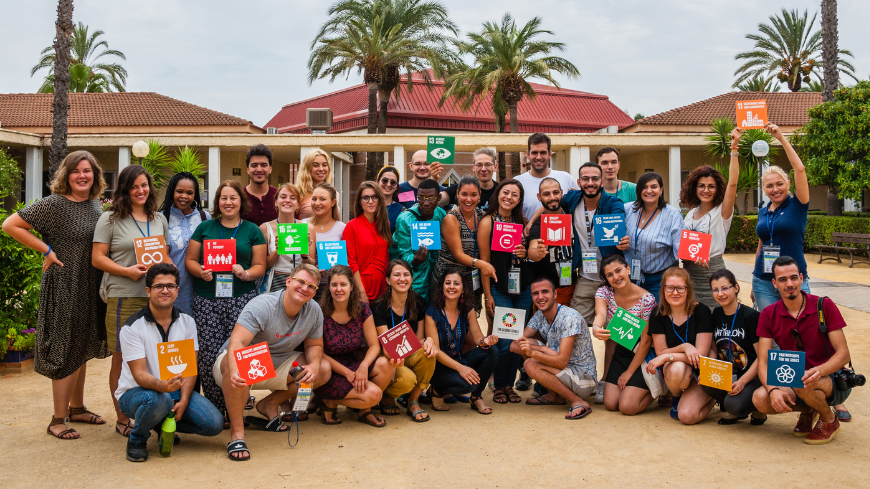
Global education echoes the priorities defined in the United Nations 2030 Agenda for Sustainable Development. Global education topics and priorities cover mainly Sustainable Development Goals:

During the Pan European Congress on Global Education 2022, five interviews were conducted with iLEGEND II beneficiaries working for the recognition of Global Education at international, european, regional, national, and local levels. While their action strategies reach different audiences, they all converge on one point: Global Education, when implemented at different scales, enables the development of education systems allowing everyone to address global challenges.
More on Global Education Perspectives
The North-South Centre promotes global education as an interdisciplinary approach where human rights, democratic citizenship and intercultural dialogue represent its main elements and where global education is intended as a dynamic concept evolving according to the contemporary political, economic, social, cultural and environmental developments and challenges of the global society. In this sense, it is particularly relevant to mention the 2030 Agenda of the United Nations and the Sustainable Development Goals (SDGs), not only because they are the main international reference framework linking human rights with sustainable development, but also because SDG 4 – Quality Education, in its target 4.7, mentions specifically that “by 2030, ensure that all learners acquire the knowledge and skills needed to promote sustainable development, including, among others, through education for sustainable development and sustainable lifestyles, human rights, gender equality, promotion of a culture of peace and non-violence, global citizenship and appreciation of cultural diversity and of culture’s contribution to sustainable development[1]”, applying as main indicator the “extent to which global citizenship education and education for sustainable development are mainstreamed in national education policies; curricula; teacher education and student assessment.”
Global educators emphasise that global education is a pedagogical approach, not just a new teaching technique, and they usually designate the fields of peace education, human rights education, development education and environmental education as the four content areas of Global Education - transversal among many teaching subjects. This is partially true but not enough for defining such a wide and complex perspective. Global Education is a paradigm, a starting point for understanding world issues and how they can be interconnected. Global education explores the four pillars of education: learning to know, learning to do, learning to live together and learning to be. The challenge is to focus on the concept of community, which embraces local, national, regional and international contexts where individuals live in and share a common destiny, rather than restricting to the concept of the nation-state. This involves issues relating to rights and duties, and notions of equality, diversity and social justice. There is a growing concern to include global issues in formal education curricula, with an increasing range of initiatives in intercultural education, peace and conflict resolution education, gender education, environmental education, development education, aboriginal studies, inter-religious education and pastoral care, and human rights education.
Broadly based global themes and educational attempts for addressing worldwide problems and explore collective solutions at all levels have been introduced and extensively experimented in non-formal education settings, influencing contemporary movements for curriculum innovation. However, global education is not yet reflected in consistent and accessible educational policies, though it is part of the political discourse, through covenants, declarations and campaigns promoted by international organisations and civil society increased commitment.
Global Education activities are co-funded by the European Union and the Council of Europe under the iLegend III "Intercultural Learning Exchange through Global Education, Networking and Dialogue" Joint Programme.
