


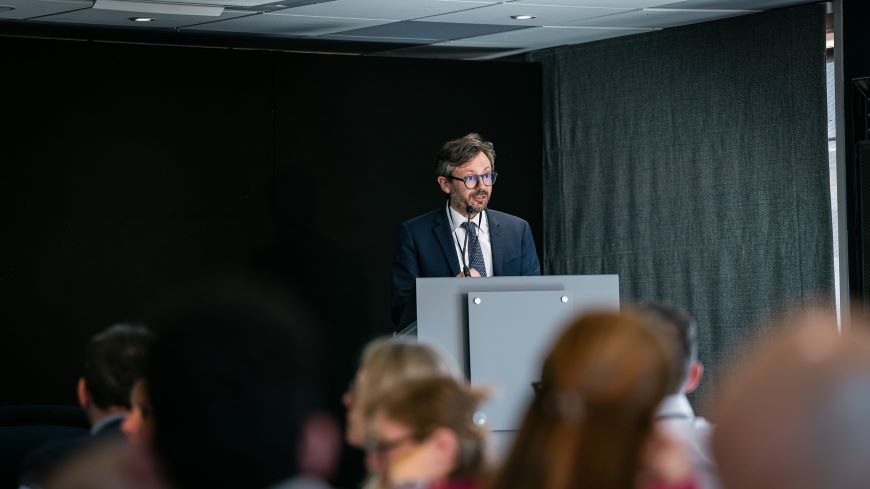
The following remarks were delivered on 13 December 2011 by FATF President Mr.Giancarlo Del Bufalo before the 37th Plenary Meeting of the Council of Europe Committee of Experts on the
Evaluation of Anti-Money Laundering Measures and the Financing of Terrorism
(MONEYVAL) in Strasbourg, France.
Introduction
Good morning Mr. Chairman, Executive
Secretary, distinguished delegates and colleagues.
I am very pleased to be here today at the Council of Europe in Strasbourg to address the 37th MONEYVAL Plenary
meeting, and I wish to sincerely thank you for the invitation.
This is the fourth FATF Associate Member Plenary meeting that I have attended since the start of the Italian Presidency.
I would like to take this opportunity to highlight the important role MONEYVAL
plays in the global AML/CFT network as one of the senior FATF associate members
and one of the consistently well-performing ones.
Review of the FATF Recommendations
As you all know, the Review of the FATF Standards is coming to a close, following a lot of hard work. MONEYVAL has
taken part in the in-depth discussions over the past two years both through the
participation of individual members and the active contribution of the MONEYVAL
Secretariat.
Many improvements can be found in the proposed revisions to the FATF standards; and, as MONEYVAL has been following
this work closely throughout the review process, I will simply outline how the
work will go from here.
Revisions to the texts of individual Recommendations are nearly finished. The complete text was presented to the
private sector in the context of a consultation meeting that took place in Milan
last week. The reactions were all in all positive, although there were many
remarks and comments on a broad range of issues, as well as some complaints on
the perceived additional burden that the revised Standards might put on the
private sector. As expected, the Risk-Based Approach was one of the main items
discussed. A detailed report on the private sector remarks will be circulated to
delegations before Christmas.
The next step will then be to discuss
the issues raised by the private sector, any remaining significant issues raised
by delegations, as well as the proposed “simplified” structure for the
Recommendations. This will take place at the extraordinary FATF Plenary session
scheduled for the week of the 9th of January 2012 in Paris. It is at this
meeting that we hope to finalise all major remaining issues.
The FATF Plenary will adopt the revised
text of the Recommendations in February 2012, and then begin work on revising
the assessment methodology and the mutual evaluation and follow-up processes. We
look forward to carrying out this revision work in close collaboration with
associate members and completing it by early 2013.
MONEYVAL has a great deal to contribute
to this process through the wealth of experience it has acquired from three full
rounds of mutual evaluations as well as from the fourth round currently
underway.
MONEYVAL experience in the evaluation
process is, in my view, essential to help us all to develop and refine a core of
common evaluation and follow-up procedures that future rounds will be able to
follow. I sincerely hope we can count on your support.
Global AML/CFT Network
As indicated by my predecessor last
year, not all FSRBs within the global AML/CFT network are currently operating at
the same level. For this reason, we have been looking for ways to identify and
address potential weaknesses in individual FSRBs with a view to ensuring the
strength of the global AML/CFT network as a whole.
The FATF has been considering ways to
further reinforce the global AML/CFT network throughout this year. In October,
we agreed on a new set of high level principles and objectives for both the FATF
and FSRBs/associate members, which now replace the confusing criteria and
obligations that previously applied.
It is important to stress that the newly
agreed objectives apply to all bodies – both FATF and the FSRBs – and thus form
a clearer and more balanced foundation for the global AML/CFT network.
Furthermore, while we have done away with the hierarchical distinction between
“FSRBs” and FATF “associate members”, we have decided not to get rid of the
terminology: We will thus use the term “FSRB” to describe regional bodies
recognised by the FATF as being similar in objectives and functions to the FATF
(“FATF-style regional bodies” as the name indicates). We will continue to use
the term “associate member” to describe the FSRB from the perspective of how it
collaborates with the FATF and within the larger global AML/CFT network.
Some FSRBs do not perform as well as the
FATF and other FSRBs would expect, while others face challenges in fully meeting
their objectives. This situation represents a problem not only for the FSRBs
concerned but also for the global AML/CFT network as a whole. The next phase of
our work on reinforcing the global network will be to establish a clear process
to ensure that all are able to meet their agreed objectives. We have been
calling this process a “peer review” system because it would be applicable to
both the FATF and to FSRBs.
The first aim of the peer review process
should, in my opinion, be to create a platform for best practice exchange which
can help all associate members -- with a priority on those which are
encountering difficulties -- to improve their functioning. The MONEYVAL
experience can provide a strong contribution to this end.
This process does not intend to
prescribe in detail how our respective objectives should be achieved, nor will
it be a cumbersome, intrusive or resource-intensive process, as this would not
be in our common interest. Instead, the FATF/FSRB “peer review” process should
provide a solid framework to reinforcing our best practices and strengthening
the global network.
We will begin this discussion at the
next FATF Plenary. I look forward to MONEYVAL’s continued active presence in
this initiative, as it is only through the participation of the stronger parts
of the global AML/CFT network that we will be able to help all to play their
respective part.
Mutual Evaluations and Follow-Up Procedures
MONEYVAL is the only FSRB to have started a fourth round of mutual evaluations of its members, aiming to monitor
the implementation of the current FATF Standards. The fourth round differs from
the previous round in focusing on those Recommendations not fully implemented
according to the third round. The MONEYVAL fourth round is therefore, as I
understand it, a sort of “follow-up” to the last round.
In addition, you are in the process of carrying out a first mutual evaluation of
the Vatican City State (the Holy See) for which the on-site visit has just taken
place. This is an important evaluation, as it brings in a State that has until
recently been outside the AML/CFT peer review process. I look forward to seeing
the results of this evaluation during the relevant discussion of the report next
year.
At the same time, MONEYVAL continues to
carry out robust mutual evaluation follow-up that includes clear “compliance
enhancing procedures”. The MONEYVAL process is designed to maintain the focus on
areas where a particular member may not have fully implemented the FATF
standards or where it might have failed to make meaningful progress in
addressing identified shortcomings.
This monitoring work is an essential
tool to ensure effective implementation of the FATF Standards and is the very
“raison-d’être” of an FSRB. I congratulate you on such effort and look forward
to hearing some of the lessons you have learned through your various processes,
as we all work to develop a core of common processes for the next round of
evaluation of the new FATF Recommendations.
International Co-operation and Review Group (ICRG)
As you are aware, an important function of the FATF is to identify and address, through its ICRG process, the risks
related to jurisdictions that insufficiently apply the FATF Recommendations.
The ICRG process is world-wide in scope
and can thus focus on jurisdictions in any region when they meet certain
criteria. Even FATF members have been or are currently subject to the ICRG
process.
It is important to note that the ICRG
process is not intended to replace follow-up or compliance enhancing procedures
carried out by FSRBs; rather it is intended to ensure a level playing field in
dealing with jurisdictional risks on a world-wide basis.
I am sincerely glad to see that MONEYVAL
takes strong action when implementation shortcomings are identified. I am
gratified as well that MONEYVAL’s own procedures also help to bring about
necessary remedial action when a MONEYVAL member falls under the ICRG process.
I once again thank you for the opportunity to be here today and address MONEYVAL, and I wish to congratulate
MONEYVAL on its effective functioning and valuable performance and contribution.
I rely on MONEYVAL’s continued support and participation in the FATF efforts to consolidate and enhance the AML/CFT global network.
I regret not to be able to attend the whole meeting as, unfortunately, I have to be necessarily in Rome by tomorrow due to other institutional engagements.
Thank you all for your kind attention.