


|
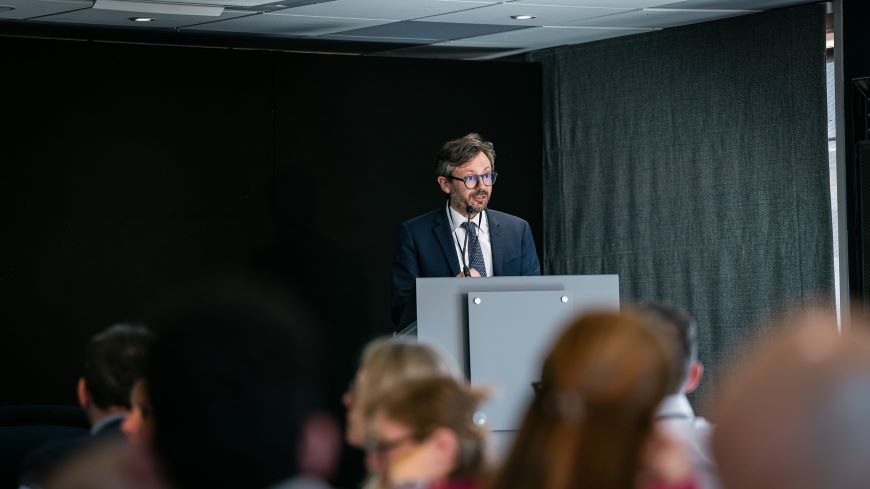
I would like to take a few minutes to outline some of the key
elements of work that the FATF is undertaking this year during the
Presidency of Norway.
THE FATF STANDARDS AND THE NEXT ROUND OF MUTUAL
EVALUATIONS
Since my predecessor addressed you last year, the FATF
completed the review of the FATF Recommendations which were adopted and
published in February of this year. I know that MONEYVAL has taken a keen
interest in following this process. The key role of the risk-based approach
is the most important feature of the revision. It should help us in using
our resources better, with more attention to high risk sectors and
activities and less where the risks are low. It should also help in
promoting financial inclusion, which should be of high priority in many
countries.
Implementing the revised Recommendations effectively and
efficiently will be a challenge for FATF members as well as for other
countries. The changes may, to varying degrees, require countries to amend
legislation and rules along with the practical organisation of their AML/CFT
effort. Information and training on the revised standards will be important
tasks over the coming year and beyond. The FATF will need to work with the
FSRBs to determine types of training needed (for assessed countries,
assessors, Secretariats, etc.). I am pleased to hear that MONEYVAL has
already held training on the new standards which was organised for MONEYVAL
and EAG members this past September.
It is the mutual evaluation process that gives the FATF
Recommendations their force. We must continue to strengthen our AML/CFT
systems through this process, and I expect therefore that all countries in
the global network will now be assessed for compliance with the revised
Recommendations. The FATF will begin its next round of assessments in the
4th quarter of 2013, and most FSRBs should start their next evaluation
rounds then or soon thereafter.
The new round of mutual evaluations will place a much
stronger emphasis on the assessment of effective implementation of the
revised FATF Standards and not only of technical compliance. The new
approach for assessing effectiveness is based on objectives and will be
fully integrated into the assessment methodology. As one important example,
I would like to mention the practical availability of information on legal
persons and beneficial ownership. The revised standards go into more detail
on what is required by countries in ensuring availability of this
information (to the banks, the public and so on), and the evaluation process
– from the effectiveness point of view – will look closely at whether this
information is indeed available to those that need it. We are currently
working to finish this new methodology, as well as to develop guidance on
issues where further advice on implementation may be useful. We are grateful
for the active contribution of MONEYVAL.
As we look forward to the next round of mutual
evaluations we must, however, not neglect the very important work of
follow-up on earlier evaluations. Indeed, MONEYVAL is in the process of
completing its “fourth” round of evaluations with the specific aim of
following up on the work of the previous round (as I mentioned in my earlier
intervention today). In my view, the MONEYVAL follow-up round will provide a
strong foundation on which to base the implementation of the revised FATF
Recommendations. Furthermore, the FATF hopes to work with MONEYVAL and other
FSRBs to develop a more common approach to assessment and follow-up
procedures that will increase the comparability of evaluations and help to
further strengthen our processes in the context of the global network.
FURTHER DEVELOPMENT OF THE GLOBAL NETWORK
The global network is under constant development. Our
ministers provided us with a mandate this April, strengthening the role of
the FSRBs as their right to take part in all FATF activities was made clear.
In October last year, we agreed on a new set of high level principles and
objectives. It is important to stress that these newly agreed objectives
apply to all bodies – both the FATF and the FSRBs; it is a mutual process –
and thus form a clearer and more balanced foundation for the global AML/CFT
network.
Based on the new FATF Mandate and these newly agreed
objectives, we also created the Global Network Coordination Group, a new
FATF working group, which met for the first time in June 2012 and then again
in October. The purpose of the group is to serve as a forum for raising –
and when necessary resolving – issues of interest to the FSRBs and the FATF.
In addition, the group will also serve as a mechanism for sharing good
practices and ideas relevant to such bodies. As a demonstration of our
commitment to involve FSRBs in this process, for the first time, we have a
working group co-chair who comes from an FSRB.
The work of this new group has had a good start, and I am
quite confident we shall see concrete results coming from the work of the
group. I hope that I can count on the continued and active support of all
FSRBs – including in particular MONEYVAL as a more experienced regional body
– to ensure that this initiative succeeds.
ENGAGEMENT WITH THE PRIVATE SECTOR AND CIVIL SOCIETY
Implementation of the revised FATF standards will
continue to require dialogue and consultation with the private sector and
representatives of civil society. Private institutions have a vital role to
play in the fight against money laundering and terrorist financing. It will
therefore be important to maintain and improve the mechanisms through which
we formulate new guidance and carry out research on money laundering and
terrorist financing. The FATF plans during this Presidency to convene
another consultative forum meeting to discuss further work relating to the
implementation of the new FATF Recommendations. There may also be other
forms of dialogue. Our dialogue with non-governmental organisations will
naturally also include how Recommendation 8 on non-profit organisations
should be followed-up in practice.
CONTINUED WORK ON IDENTIFYING AND ASSESSING THREATS
The FATF continues to study developments in markets and
economies, as well as to identify new threats to financial integrity. Of
special importance to this effort are general and special typologies
projects. Currently five general type research projects are underway and
expect to be completed under the Norwegian Presidency. In addition, since
tax crimes have now been included as a predicate offence for money
laundering under the revised Recommendations, the FATF has initiated a
special research project to compare experiences from countries where tax
crimes have been a predicate offence for some time. The inclusion of tax
crimes as a predicate offence will increase the basis for international
co-operation in this area, and it should be of interest to the many
governments who need to strengthen their revenues and tax systems.
REFINING ORGANISATION AND WORKING METHODS
In April of this year, the FATF Ministers met and adopted
a new 8-year Mandate for the task force. Furthermore, FATF has received
applications for membership recently from a couple of countries. There are
indications that others may follow. The question of FATF membership is not
easy, as a significant expansion may influence the working methods and
decision-making procedures which are now based on consensus of FATF (with
its 34 member countries). The FATF Plenary has thus agreed to undertake
careful considerations of a possible expansion of the FATF membership. In
these considerations, the further development of the role the FSRBs may play
in the global network should also be included.
Based on the new mandate along with the fact that the
FATF will soon begin its 4th round of mutual evaluations according to the
new standards, it seems to be the right time for the FATF to examine and as
necessary refine its internal working methods and structure. I have
initiated a process to look at the work of the FATF to try to better
prioritise and co-ordinate it and ensure that any unnecessary duplication
can be avoided. Though this process has started now, I expect that
implementing any new internal structures or working practices will likely
continue under my successor.
Dear colleagues, the present economic and financial
problems in many countries add to our challenges. At the same time,
effective implementation of the FATF Recommendations will contribute to the
confidence in our financial systems that is required if economic growth and
prosperity are to be rebuilt in Europe and elsewhere.
Mr Chairman, ladies and gentlemen, I am very happy to
have had the opportunity to speak to you today and to outline some of the
main initiatives of the current Presidency. I plan to remain for a couple of
days to listen to your Plenary discussions, and I wish you all the success
in your Plenary meeting this week.
Bjørn S. Aamo FATF President
|