


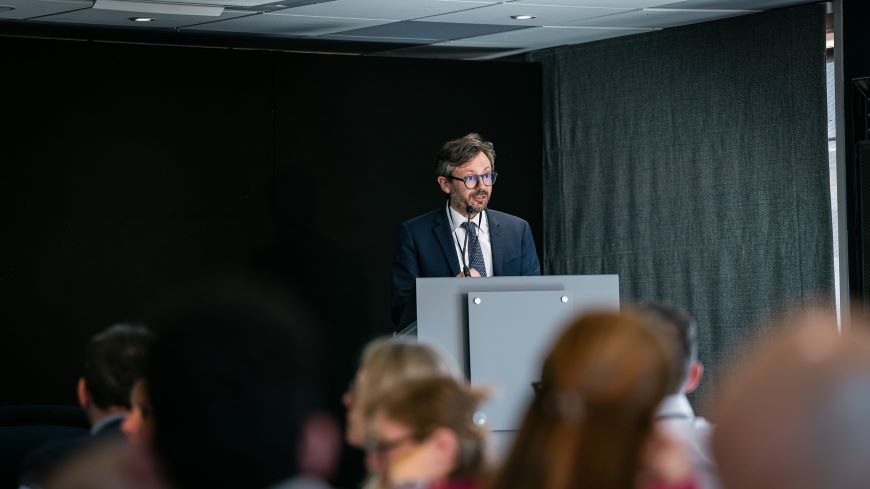
The following remarks were delivered on 7
December 2010 by FATF President Mr. Luis URRUTIA CORRAL before the 34th
Plenary Meeting of the Council of Europe Committee of Experts on the
Evaluation of Anti-Money Laundering Measures and the Financing of Terrorism
(MONEYVAL) in Strasbourg, France.
Good afternoon, Mr. Chairman, Executive Secretary, distinguished delegates
and colleagues.
I am very pleased to be in Strasbourg today to address the 34th MONEYVAL
Plenary meeting, and I would like to thank you for the invitation to attend
this meeting and be able to address you here at the Council of Europe.
In October, I had the pleasure of chairing the FATF Plenary meeting for the
first time. During that meeting, the FATF considered its mandate for this
year under the Mexican Presidency, which I have the honour of holding until
June 2011. The FATF Plenary adopted our proposed mandate, and I would like
to outline some of its key points in my remarks to you here today.
This new mandate covers a broad range of issues; however, there is one
recurrent theme that is both fundamentally important for my Presidency and
closely linked to the work of MONEYVAL and other regional bodies: It is the
need to reinforce the global AML/CFT network.
The FATF and the FSRBs are essential players in this network and thus have
an essential role in ensuring the effective implementation of AML/CFT
standards worldwide. We must recognise the progress made so far by the FATF
and its associate members.
At the same time however, we must be willing to seek out and put into place
improvements in the global AML/CFT network that will help us do our job
better.
In my view, we need to strengthen our work in a number of areas. Some of
these areas include improved and more effective implementation of the FATF
standards, finding ways to assist in the fight against corruption and
factoring in financial inclusion as part of our efforts. The FATF has taken
these issues on as objectives that will be pursued during the current
Presidency.
In order for us to meet these objectives however, the FATF must depend on a
well-functioning global AML/CFT system, which includes close co-operation
with its associate members. Looking ahead then, I believe that any future
improvements to the global AML/CFT network will likely mean moving into a
new stage in the relationship between FATF and its associate members.
Associate Membership
I would like to begin by saying a few words about associate membership. As
you know, a few years ago, the FATF established associate membership as a
new status for FATF-style regional bodies (FSRBs). This new status was
intended to give FSRB members access and input to FATF meetings, documents
and discussions on a level equivalent to that which FATF members themselves
have.
The FATF remains convinced that granting equivalent access to its
information and decision-making processes will strengthen the work of both
the FATF and FSRBs.
MONEYVAL was among the first three FSRBs to be granted associate membership
status in June 2006, along with the APG and GAFISUD. Then, at the June FATF
Plenary meeting this year, the last three FSRBs became associate members.
The FATF has now thus started looking at associate membership to evaluate
its impact on reinforcing the work of the FATF and its associate members.
To this end, I plan to begin a discussion at the next FATF Plenary meeting
in February 2011 on this issue and will therefore be consulting with and
seeking the input from all associate members.
As a key part of this discussion, I plan to focus on the expectations held
by the FATF for its associate members and, at the same time, what
expectations associate members have regarding the FATF. This will need to
be done while keeping in mind why the FATF and FSRBs were created in the
first place.
The FATF Presidents and the Secretariat have access to all eight associate
member meetings, as do some FATF members that participate in one or more
associate members as members, observers or COSUNs.
Through all of this co-operation, the FATF has gained a clearer
understanding of what associate members can be expected to achieve. It is
now time for us all to reflect on this, put our collective thoughts
together and consider what works well and what could be improved.
In this regard, I would like to touch on a couple of areas:
First, I would mention the mutual evaluation process – the principal
mechanism that the FATF and all associate members share for ensuring
effective implementation of the FATF Recommendations. The MONEYVAL
evaluation process is highly developed and has played a key role in helping
jurisdictions in the region to build AML/CFT systems.
MONEYVAL has in fact achieved a great deal in this area. Some other FSRBs
are not yet quite so far and will have a certain amount of work to reach the
level that MONEYVAL has.
I would add that, in further recognition of the importance of its work, the
Committee of Ministers of the Council of Europe has seen fit in the new
statute of MONEYVAL to raise its status as a monitoring body. It thus now
becomes directly answerable to the Committee of Ministers in assessing
compliance with AML/CFT standards and the effectiveness of implementation.
While recognising the success of MONEYVAL, I should also stress that there
are nevertheless particular challenges we all share in the conduct of mutual
evaluations. For example, we must all remain vigilant in ensuring that our
interpretation of the FATF standards is both current and consistent – not
only within each FSRB, but also between the FATF and across all FSRBs.
This is important because the overall strength of the global AML/CFT system
depends on a consistent approach in implementing the standards. Toward this
end, the FATF and MONEYVAL already share evaluators, participate in our
respective mutual evaluation discussions, organise joint assessor training
seminars, etc.
Nevertheless, the FATF and the FSRBs may need to look collectively at other
mechanisms to ensure that the FATF standards are applied in the same way by
the FATF and all of its associate members.
Second, I raise the issue of follow-up to mutual evaluations. MONEYVAL has
strong processes for monitoring the progress in implementing AML/CFT
measures (including its compliance enhancing procedures).
I am pleased to see that MONEYVAL not only applies these processes but also
continues to refine them over time. Moreover, MONEYVAL has certainly not
been afraid of indicating cases in which its individual members have not
made sufficient progress in establishing effective AML/CFT systems.
The follow-up processes of some other FATF associate members have not always
been consistent or achieved desired results however. In my view, the FATF
and all FSRBs will need to work together to ensure that follow-up procedures
across the whole global AML/CFT system work toward the same goals with
similar timeframes and similar consequences for inaction.
Third, as my predecessor mentioned in his remarks to you last year, the
Council of Europe makes a specific contribution to FATF work through its
role in monitoring implementation of the relevant Council of Europe
conventions (in particular, the Council of Europe Convention on the
Laundering, Search, Seizure and Confiscation of Proceeds from Crime and the
Financing of Terrorism). This work is unique and represents a critical link
between one of the key international legal instruments for fighting crime
and the global AML/CFT efforts we all share. It seems to me that it might
be useful to consider some more concrete ways that the practical experience
gained through implementation of measures in such international instruments
could be fed back into the work of the FATF in development of guidance.
Now, coming back to the planned discussions on FATF associate membership
status by the next FATF Plenary, I expect that these will result in a call
for an assessment of how associate members are living up to our
expectations, an assessment that might then be considered by the FATF
Plenary in June 2011.
Mr. Chairman, I encourage you to take a particular interest in this issue
and to participate in our February and June 2011 Plenary meetings to ensure
that MONEYVAL’s unique experience – as well as the particular challenges it
faces – can be heard.
I will continue to follow the work of all of the associate members with keen
interest throughout the remainder of my presidency, and I particularly look
forward to hearing MONEYVAL’s perspective regarding FATF associate
membership.
Standard setting
Let me now turn to another important issue – standard setting.
It is clear that money launderers and terrorist financiers quickly adapt
their ways to try to circumvent our improved efforts to detect, investigate,
prosecute, convict and confiscate.
The FATF therefore has no choice but to ensure that its standards remain a
comprehensive and up-to-date framework for combating money laundering and
terrorist financing. Since the revision of the standards adopted in June
2003, we have amended the FATF Recommendations as needed, and — with the end
of the FATF’s third round of mutual evaluations approaching — we have now
begun a focussed review of the Recommendations.
Individual member jurisdictions of associate members have made their voice
heard in this process. Some have provided comments directly to the FATF on
discussion and consultation papers. Others have spoken through their
respective Secretariats. Whatever model fits best, it is important to
realise that this is a rare chance for FATF and associate members —
including especially their individual member jurisdictions — to have an
influence on the FATF standards that will be later used to assess them.
As I have stated at other associate member meetings, I urge you as well to
take advantage of this opportunity. Even if your jurisdiction lacks the
resources to follow all aspects of this process, I encourage you to remain
informed of progress of these discussions and to have your experts begin
assessing the consequences that changes in the FATF standards will have for
your jurisdiction.
Staying informed at least will enable you to be pro-active in bringing your
AML/CFT system into line with the updated FATF standards when they are
agreed.
The review is ongoing, and at our last meeting in October, the FATF Plenary
discussed for the first time a consolidated report of three sub-working
groups on the various developments that have taken place over the previous
year. You can get a copy of this report through the MONEYVAL Secretariat.
Some of the issues raised include beneficial ownership, mutual legal
assistance, the risk-based approach, tax crimes as predicate offences for
money laundering, operational issues and the incorporation of certain issues
relating to corruption. More discussion on these issues will take place
over the next year, and there are still other issues that are to be dealt
with, such as the structure of the FATF Recommendations, data protection and
privacy issues and exchange of information within financial groups.
We also conducted a meeting with private sector representatives to get their
views on the aspects that the FATF is raising as part of the review process
that we are following. The meeting was held two weeks ago in Paris and
brought together approximately 100 participants representing the banking,
securities, insurance, legal, accounting and real estate sectors, and it
also included members from non-governmental organisations concerned with
anti-corruption, financial transparency and integrity, and other industries
involved in financial inclusion-related issues, such as mobile phone service
providers.
Issues discussed in that meeting were presented in the public document that
we posted on our website and reflect the main points contemplated in the
progress report reviewed by our Plenary last October. The main comments
discussed during the meeting with the private sector will be outlined in a
document that we will circulate to our members and observers soon.
Again, I encourage MONEYVAL member jurisdictions to take maximum advantage
of this opportunity to have your voice be heard as part of these
discussions.
Fighting corruption
I would finally like to spend a little time on two other important issues
for the Mexican presidency — fighting corruption and financial inclusion.
Fighting corruption is increasingly recognised as a global priority.
The G20 Leaders in the conclusions of their Pittsburgh meeting called on
the FATF to give higher priority to this issue. I would like to point out
what we are doing to respond to this call.
First, the FATF is taking corruption into account in its review of the 40+9
Recommendations. I should stress that this does not mean the FATF will
become the standard-setter for corruption. What it does mean is that
we are willing to adapt our AML/CFT standard if this might also benefit
the fight against corruption.
We are looking at incorporating certain aspects of the Merida Convention as
part of our review of the 40+9 Recommendations; however, we are also
looking at the existing measures on customer due diligence, beneficial
ownership and transparency from the perspective of how they might assist in
fighting corruption.
Second, the FATF is moving to build contact with anti-corruption experts.
As an initial step, FATF has just released an information note to raise
public awareness of how the FATF Recommendations help combat corruption. We
want to elaborate on this further, explain the AML/CFT Standard to
anti-corruption experts, learn what elements are useful and share this
knowledge with relevant stakeholders.
Third, the FATF is engaging in closer co-operation with anti-corruption
standard-setters. The added value that the FATF can bring to the
anti-corruption campaign is its experience with a unique enforcement
infrastructure (for example, its mutual evaluation process), which has a
positive effect on ensuring global compliance with international standards.
In addition, probably more than any other standard setter, the FATF has a
frequent interaction with and knowledge of the financial sector.
In our dialogue with standard setters, the FATF will be thus able to
share its best practices in this area.
Financial inclusion
Now let me turn to financial inclusion, which is another important topic for
the Mexican presidency of the FATF. Over the years, signals have reached
the FATF that its standards are in some ways an impediment to financial
inclusion. I would add that perhaps the FATF’s unique enforcement structure
has encouraged regulators and legislators to follow the FATF standard in an
overly strict manner and without taking into account the type of customers
envisaged by the term “financial inclusion”.
Nevertheless, it is important for FATF to ensure that AML/CFT measures do
not impede access to financial services for the low-income populations.
Many of the FATF Recommendations that are designed to be implemented taking
ML/FT risk into account focus on customer due diligence, transaction
monitoring and record keeping.
These measures can only be implemented for those sectors of the population
that have access to the financial sector. In this respect, efforts to
foster financial inclusion and AML/CFT measures can in fact reinforce each
other.
The FATF is increasing its efforts to take financial inclusion into account
in its work. It will also actively engage with other relevant bodies, such
as the World Bank, to further promote access to the financial sector for all
people. I have asked other FSRBs to share any relevant experience in this
area with FATF, and I would therefore invite MONEYVAL to do the same.
Conclusion
Mr Chairman, the mandate for the current FATF Presidency includes many other
initiatives that I hope will help reinforce the global AML/CFT structure,
but time is too short for me to outline them all here right now.
I would like to mention one further measure that I believe will also foster
closer co-operation between the FATF and the FSRBs. I have decided that the
meeting of FATF and all FSRB Presidents held in June 2010 should become a
permanent part of the annual FATF calendar. Therefore, the next such
meeting will be held in Mexico City in June 2011, and I hope that I will see
you there Mr Chairman.
The FATF must rely on MONEYVAL — as well as the other FSRBs — to support
effective implementation of the FATF standards on a global level. MONEYVAL
has traditionally had an important voice in FATF work as one of the older
and more established FSRBs.
I would therefore urge you to continue this participation and as necessary
to reinforce it. The FATF can only take into account the particular
challenges MONEYVAL countries face in implementing FATF standards if these
challenges are brought to the table.
Lastly, I look forward to increased dialogue between MONEYVAL and the FATF
on ways that we may be able to further strengthen the relationship between
FATF and its associate members.
Mr Chairman and delegates,
I thank you for giving me the opportunity to address you today. I wish you
all well for the remainder of this Plenary meeting and in your future work. |
|