


Spain: Promoting cyberjustice in Spain through change management

June 2020 – May 2022
SPAIN: PROMOTING CYBERJUSTICE IN SPAIN THROUGH CHANGE MANAGEMENT
(phase II)
SRSS/S2019/033 - "sUPPORT TO MEMBER STATES IN THE IMPLEMENTATION OF STRUCTURAL REFORMS"
This project is funded by the European Union via the Structural Reform Support Programme and in cooperation with the European Commission's DG Structural Reform Support.
Context of the project
As outlined in the findings of the previous cooperation project “SRSS/S2018/060 - Promoting cyberjustice in Spain through change management and improvement of data collection” (further referred to as “phase I Project”), Spain has a solid legal basis for the use of information and communication technologies in the administration of justice, which establishes the duty to use electronic means for professionals of justice and judicial offices. One of the biggest challenges, along the need to solve technical problems of pioneering such an ambitious reform, is driving change towards cyberjustice on the part of many involved actors. Another issue is the multitude of case management systems and related IT tools applied in different territories of Spain as well as their integration or interoperability.
Project's objectives
The general objective of the project is to increase the accessibility and the quality of justice in Spain by promoting the implementation of cyberjustice through strategic and knowledge-centred approach, comprehensive change management and unification or full interoperability of alternative IT systems deployed by the MoJ and the Autonomous Regions. The project will support the implementation of priorities designated by the MoJ on the basis of the recommendations of the phase I project.
Expected outcomes
- Component 1: Support is provided to the Spanish authorities to prepare a national audit of cyberjustice solutions (output 1: Toolkit for carrying out a national audit of cyberjustice solutions, conceived as a recommended common format of the audit of electronic systems at the service of the administration of justice throughout the entire territory of Spain).
- Component 2: Support is provided for a better management of cyberjustice projects in Spain (Output 2: Handbook for the implementation of cyberjustice projects in Spain which will include clear recommendations on the methodology for the management of projects focused on the digitalisation of justice and judicial services).
- Component 3: Support is provided as regards the development of Electronic Judicial Procedure Regulations in Spain (Output 3: Feasibility study for Electronic Judicial Procedure Regulations including advice and further information on the good practices in selected European countries)
Project beneficiaries and stakeholders
The final beneficiary of the action is the Ministry of Justice. Other stakeholders are the General Council of the Judiciary, the State Prosecutor General Office, the State Technical Committee on Electronic Judicial Administration, and the Autonomous Regions with devolved competences in the administration of justice. As in the previous phase, the General Bar Association and the General Council of Procuradores will also be invited to take part and contribute to the project’s activities.
The action shall finally benefit to the entire population of Spain, which will take advantage directly or indirectly from the improved efficiency and quality of the Spanish judicial system.
Project reports

Jovana Matic
Project coordinator

Sandrine Lutz
Project assistant

Online exchange between judiciaries of Mexico and Spain on digitalisation of justice organised by the European Cyberjustice Network
On 5th of May, the CEPEJ European Cyberjustice Network organises an exchange of experiences at the occasion of the presentation of the Spanish “Draft Bill on Digital Efficiency measures of the public Justice Service” and the implementation of technological tools in judiciaries in Mexico. The...

Official closing of the CEPEJ cooperation Project "Promoting cyberjustice in Spain through change management" on 23 May 2022
On 23 May 2022 the CEPEJ, in cooperation with the Ministry of Justice of the Kingdom of Spain and the European Commission’s DG REFORM, will present the achievements of the joint European Union and Council of Europe Cooperation Project "Promoting cyberjustice in Spain through change management",...

Presentation to Spanish authorities of the Feasibility Study on the regulation concerning Electronic Judicial Procedure Regulations and the Study on Judicial organisation in a digital context
In the framework of a cooperation programme, two major project outputs were presented by CEPEJ experts and discussed with Spanish authorities. Namely, a Feasibility Study on the regulation concerning Electronic Judicial Procedure which analyses and identifies good practices as well as...

The President of the CEPEJ at the hybrid Forum for Digital Transformation of Justice, Madrid
On 20 April 2022, Mr Ramin Garagurbanli, President of the CEPEJ will participate in this first high-level Forum for the Digital Transformation of Justice organised by Ministry of Justice of Spain in collaboration with the Confederation of Business Organizations and the Ministry of Economy. Mr...
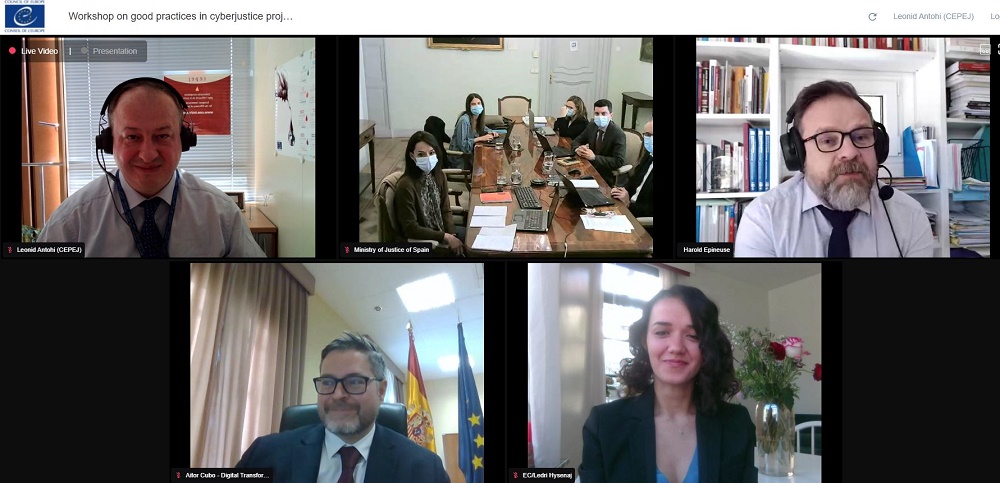
Exchanges of Good practices in cyberjustice project management between the Ministry of Justice of Spain and experts from other European countries
In the framework of the implementation of the programme for the digital transformation of justice, the Spanish Ministry of Justice wished to exchange information and experiences with international partners on how to rationalise the judicial organisation in a context of digitalisation, on the...

Launch of a new CEPEJ cooperation project: “Promoting cyberjustice in Spain through change management”
The CEPEJ, in cooperation with the Ministry of Justice of Spain and the Directorate General for Structural Reform of the European Commission, conducted on 25 June 2020 the first coordination meeting. The discussions carried out by videoconference, in presence of CEPEJ international experts, aimed...





 Collaborative workspaces:


