


Cyberjustice and AI


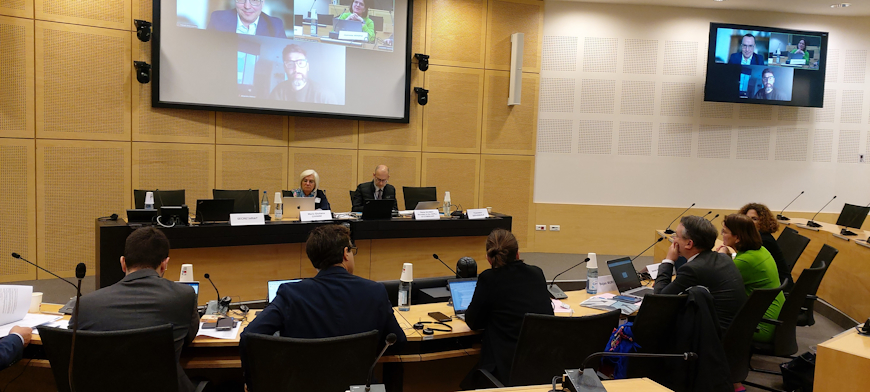


The Working Group on Cyberjustice and Artificial Intelligence (CEPEJ-GT-CYBERJUST), set up by the CEPEJ at its 33rd plenary meeting in December 2019, is entrusted by the CEPEJ with the task of "developing tools with a view to offering a framework and guarantees to member States and legal professionals wishing to create or use Information and Communication Technologies and/or artificial intelligence mechanisms in judicial systems in order to improve the efficiency and quality of justice". This work should be implemented in co-ordination with the work of other Council of Europe bodies in this field, in particular the European Committee on Legal Co-operation (CDCJ) and the Committee on Artificial Intelligence (CAI).
The tools developed by the Working Group concern topics as varied as quality criteria for videoconferencing, artificial intelligence used in alternative methods of dispute resolution or enforcement of court decisions or court proceedings in a digital context.
The group’s work is guided by the 2026 – 2029 CEPEJ Action plan: “Strengthening the Rule of Law by improving trust in justice systems”, emphasising the CEPEJ’s commitment to accompany States and courts in a successful transition towards digitalisation of justice in line with European standards and in particular Article 6 of the European Convention of Human Rights.
Composition of the Working Group
Members / Membres
Kata BENCZE
Senior Government High Counsellor, Head of Judicial Digitalisation and Artificial Intelligence Unit, Ministry of Justice, Deputy State Secretariat for International Judicial Cooperation, HUNGARY
Alejandro FERNÁNDEZ MUÑOZ
Head of the Office of the Director General, DG for International Legal Cooperation, Ministry of the Presidency, Justice and Relations with Parliament, Madrid, SPAIN
Marko LOISA
Judge, Director, Development department of the National Courts Administration, FINLAND
Bojan MURŠEC
Director, Centre of Information Technology, Supreme Court, SLOVENIA
Jan SPOENLE
Judge, Head of the Justice Cloud Unit Development Team at the Ministry of Justice and Migration of Baden-Württemberg, GERMANY
Jeannette VERSPUI
Head of the Strategy Department at the Council for the Judiciary, Senior judge at the District Court of Gelderland, THE NETHERLANDS
Deputy Working group members / Membres suppléants du Groupe de travail
Tural GOJAYEV
Judge at the Baku Court of Appeal, working group member on improving the “Electronic Court” information system established by the Judicial-Legal Council, AZERBAIJAN
Edmondo DE GREGORIO
Judge, Cabinet Office, Minister of Justice (International Affairs), ITALY
Scientific experts / Experts scientifiques
Ian BERNAZIUK
Judge at the Administrative Court of Cassation within the Supreme Court, UKRAINE
Maria-Giuliana CIVININI
Former Judge and President of the Tribunal of Pisa, ITALY
Ferdinand DELAGE
Chef des pôle stratégie, pilotage, accompagnement des projets & données, et projets numériques Européens, secrétariat général du ministère de la justice, FRANCE
Observers / Observateurs
- European Union institutions / Institutions de l’Union européenne
- Association of European Administrative Judges (AEAJ) / Fédération européenne des juges administratifs (FEJA)
- Council of the Bars and Law Societies of Europe / Conseil des Barreaux européens (CCBE)
- European Expertise and Expert Institute / Institut Européen de l’Expertise et de l’Expert (EEEI)
- European Union of Rechtspfleger / Union européenne des greffiers de justice et Rechtspfleger (EUR)
- International Union of Bailiffs / Union Internationale des Huissiers de Justice et Officiers Judiciaires (UIHJ)
Secretariat
|
|
|
|
Secretary of the Working group on cyberjustice and artificial intelligence (CEPEJ-GT-CYBERJUST)
|
Assistant
|


Working Group meeting reports
- 11th meeting, 17-18 October 2024, Strasbourg, France
Meeting report (CEPEJ-GT-CYBERJUST(2024)9) - 10th meeting, 4 - 5 March 2024, Strasbourg, France
Meeting report (CEPEJ-GT-CYBERJUST(2024)4) - 9th meeting, 19-20 October 2023, Lisbon, Portugal (hybrid)
Meeting report (CEPEJ-GT-CYBERJUST(2023)2Rev1) - 8th meeting, 13-14 April 2023, Strasbourg, France (hybrid)
Meeting report (CEPEJ-GT-CYBERJUST(2023)2Rev1) - 7th meeting, 13-14 October 2022, Strasbourg, France (hybrid)
Meeting report (CEPEJ-GT-CYBERJUST(2022)9) - 6th meeting, 17-18 March 2022, Pisa, Italy (hybrid)
Meeting report (CEPEJ-GT-CYBERJUST(2022)5 - 5th meeting, 24 January 2022, Videoconference
Meeting report (CEPEJ-GT-CYBERJUST(2022)1) - 4th meeting, 23-24 September 2021, Videoconference
Meeting report (CEPEJ-GT-CYBERJUST(2021)8) - 3rd meeting, 11-12 March 2021, Videoconference
Meeting report (CEPEJ-GT-CYBERJUST(2021)7 - 2nd meeting, 24-25 September 2020, Videoconference
Meeting report (CEPEJ-GT-CYBERJUST(2020)5) - 1st meeting, 27 April 2020, Videoconference
Meeting report (CEPEJ-GT-CYBERJUST(2020)2)
Tools
Model Technology Curriculum for Judges (06/2026)
Guidelines on the use of generative AI for courts (12/2025) [other language: Portuguese ]
Guide on the use and development of remote hearings (06/2025)
Guidelines on the online publication of judicial decisions (12/2024)
Information note on the Use of Generative AI by judicial professionals in a work-related context (2/2024)
Guidelines on online alternative dispute resolution (12/2023)
Guide on judicial e-auctions (6/2023)
Comparative Study on the use of judicial e-auctions in the Council of Europe Member States (6/2023)
Guidelines on electronic court filing (e-filing) and digitalisation of courts (12/2021)
Guidelines on videoconferencing in judicial proceedings (6/2021) and Selected National Good practices (6/2021)
Toolkit for the implementation of the Guidelines on Cyberjustice (6/2019)
Ethical Charter on the use of AI in judicial systems
A key tool remains the first European Ethical Charter on the use of artificial intelligence in judicial systems, adopted by the CEPEJ in December 2018. This innovative text, prepared by the CEPEJ Working Group on quality of justice (CEPEJ-GT-QUAL), sets out principles to guide the development of artificial intelligence tools in European judicial systems.
- Assessment Tool for the operationalisation of the European Ethical Charter on the use of artificial intelligence in judicial Systems and their environment (12/2023)
- European Ethical Charter on the Use of Artificial Intelligence in Judicial Systems and their environment (12/2018)
- Revised roadmap for ensuring an appropriate follow-up of the CEPEJ Ethical Charter on the use of artificial intelligence in judicial systems and their environment (12/2020)
- Link to ethical Charter Special file page
Other guidance on the use of Artificial Intelligence for legal professionals
- Guidelines governing the use of generative artificial intelligence (AI) by judges, The Court of Appeal, the Superior Court, the Court of Québec and the Municipal Courts, Canada (4/9/2026)
-
Updated position paper on the use of AI and algorithmic systems in the judiciary by the Presidents of the Higher Regional Courts, the Kammergericht, the Bavarian Higher Regional Court and the Federal Court of Justice, and Resolution, Germany (24/04/2026)
- CCBE technical guide on the use of AI tools and models by lawyers (3/2026)
- Charter for the use of artificial intelligence within the administrative jurisdiction, The Council of State, France (11/12/2025)
- Administrative Order of the Head of the Office of the Supreme Court on the Approval of the Regulation on the Use of Artificial Intelligence Technologies by Employees of the Office of the Supreme Court (Secretariat), The Supreme Court of Ukraine, Kyiv, No. 117, (8/12/2025)
- Ljubljana Statement on AI, Association of European Administrative Judges (16/05/2025)
- Guidelines for the development, use, and governance of artificial intelligence solutions within the Judiciary, National Council of Justice of Brazil, Resolution No. 615/2025, of March 11, 2025 (Unofficial translation)
- Statement of the Europäische Union der Rechtspfleger (EUR) on the topic of AI in the areas of responsibility of Rechtspfleger and similar professions (20/9/2024)
- International Association of Lawyers (UIA) Guidelines on the use of artificial intelligence systems by lawyers (30/10/2024)
- Guidelines for the respectful, responsible, safe and ethical use and exploitation of artificial intelligence in the Judicial Branch, Higher Council of the Judiciary of Colombia, Agreement PCSJA24-12243, of 16 December 2024 (Unofficial translation)
- Policy on the use of Artificial Intelligence in the Administration of Justice (State Technical Committee on the Administration of Justice, Spain, 2024)
- CCBE Statement on the use of AI in the justice system and law enforcement (25/05/2023)
- Guidance for Judicial Office Holders in relation to the use of Artificial Intelligence (AI) (Courts Tribunals Justice, United Kingdom, 2023)
- Council of Bars and Law Societies of Europe (CCBE) considerations on the Legal Aspects of AI (20/02/2020)
Resource Centre on Cyberjustice and AI
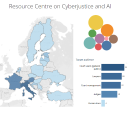
The Resource Centre on Cyberjustice and AI serves as a publicly accessible focal point for reliable information on AI systems and other key cyberjustice tools applied in the digital transformation of the judiciary. It shall help to gain an overview of such systems and tools, providing a starting point for further examination on their risks and benefits for professional and end-users in line with the “European ethical Charter on the use of AI in judicial systems and their environment“.
European Cyberjustice Network (ECN)
The European Cyberjustice Network (ECN) allows the exchange of good practices and helps to define future initiatives by the Council of Europe to support its member States in the digital transformation of their judiciary in line with Human Rights standards.
Artificial Intelligence Advisory Board (AIAB)
The CEPEJ Artificial Intelligence Advisory Body (AIAB) provides expert advice on Artificial Intelligence (AI) related issues in the judicial environment. It was established in 2022 to support the CEPEJ in monitoring the actual emergence of AI applications in the justice sector and to implement related strategies as well as to contribute to the reflection on the use of AI in justice systems with respect to fundamental rights.
Link to AIAB pageArtificial Intelligence Advisory Board (AIAB)





 Collaborative workspaces: