|
Created in November 1989, the European Centre for Global
Interdependence and Solidarity (more commonly known as
the "North-South Centre"), was set up in Lisbon1
in May 1990.
Lisbon was chosen following an
initiative of the Portuguese government, which had proposed
(after the European public campaign on North-South
interdependence and solidarity organised in 1988 by the
Council of Europe in co-operation with the European
Community) that a centre be set up to follow up the
proposals generated by the campaign. From the start, it has built on what,
until today, still constitutes its fundamentally pioneering
dimension and development potential.
Key
dates in the History of the North-South Centre
- 5 May 2011: Adoption of a
new Statutory Resolution
for the
NSC which entered into force on 1 June 2011.
- 2010 : Accession of Azerbaijan and Cape Verde, the second
non-European country to become a member ; Celebration of the
20th Anniversary of the North-South Centre.
- 2009 : Accession
of Morroco, first non European country to become a member – the NSC has
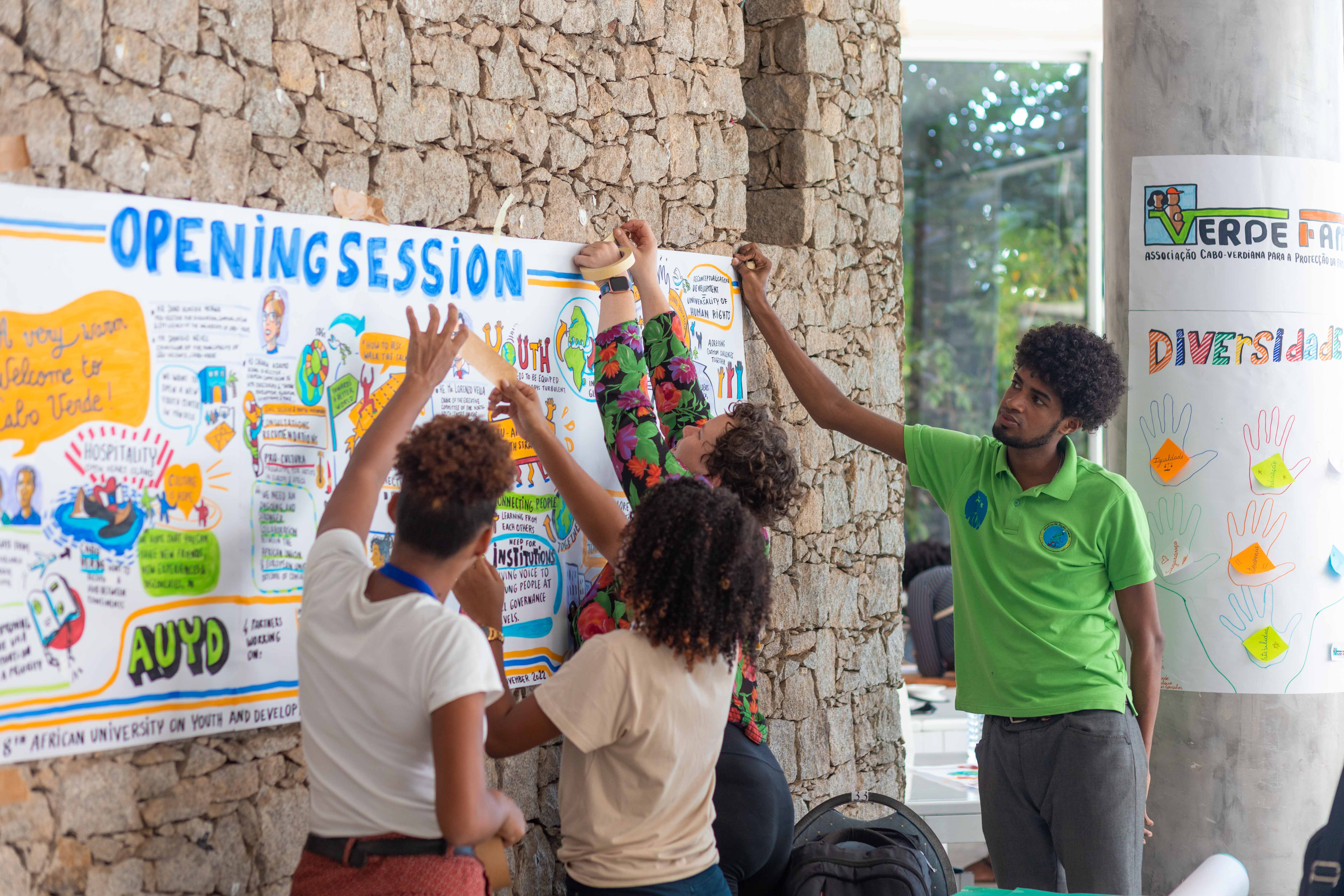
21 member States and 1st African University on Youth and Development
(Praia)
- 2007: 1st Africa-Europe Youth Summit
- 2001 :
Accession of Germany – the NSC has 20 member States.
- 2000: Launching of the University on Youth and Development
(Mollina)
- 1995: Launching of the North-South Prize of the Council of
Europe (Lisbon)
- 1994:
1st meeting of the Lisbon Forum “Human Rights in North-South
dialogue” Launching of the “Transmed Programme” (Rome)
- 1993 : Existence
of the North-South Centre confirmed by
Resolution (93)51 of the
Committee of Ministers of the Council of Europe (21 October) – the NSC
has 15 member States.
- 1990 : Set up of
the North-South Centre in Lisbon
- 1989 : Adoption
on 16 November 1989 of the
Resolution (89)14 adopted by the Committee of
Ministers of the Council of Europe endorsing the creation of the
North-South Centre following a proposition by the government of
Portugal, with 10 founding countries (16 November)1
- 1988 : European
public campaign on North-South interdependence and solidarity organised
by the Council of Europe in cooperation with the European Community.
It ended with a European conference of parliamentarians and non-governmental
organisations (Madrid, 1-3 June 1988), which issued
the Madrid Appeal.
- 1984 :
Conference organised in Lisbon held by the Parliamentary Assembly of the
Council of Europe on the theme, “North-South : Europe’s role” and
adoption of the “Lisbon Declaration” (9-11 April).
On 5 May,
the Committee of Ministers of the Council of Europe adopted
a new statutory resolution for the North-South Centre. This
crucial step positively concluded a process launched in
November 2009 by the Parliamentary Assembly, in connection
with the 20th Anniversary of the Centre. Through this
decision, the member States - and indeed all the
stakeholders of the North-South Centre - have confirmed its
relevance and importance, at a time when the Arab countries
- our neighbours - are facing historical changes.
The main lines of the Centre's new statute, which entered
into force on 1 June 2011, are the following :
- the Centre has kept its present legal nature, and
continues to function as an enlarged partial agreement of
the Council of Europe;
- an invitation is made to all member States of the Council
of Europe as well as to the European Union to join the
Centre as soon as possible;
- the Centre acts as an interface between the Council of
Europe and countries in neighbouring regions which are
interested in cooperating with the Organisation, by offering
them a platform for structured cooperation at different
levels (governments, parliamentarians, local and regional
authorities, civil society);
- the two former statutory organs of the Centre merged into
a new "Executive Committee", which is the single decision
making body of the North-South Centre : through this
important structural change, the "quadrilogue" functioning
of the Centre has been preserved, while full participation
of all member states in the decision making process is
ensured;
- the relationship with the European Union has been
reinforced, through the introduction of the EU Committee of
Regions as a new stake-holder of the North-South Centre;
- the priority areas of the Centre are confirmed (education,
youth, intercultural dialogue), with an increased focus on
the promotion of Council of Europe principles and values
beyond the European continent.
Aims and functions
The aims of the European Centre for Global Interdependence
and Solidarity (“the Centre”) are:
- to promote human rights, democracy and the rule of law
through intercultural dialogue and education, in particular
among the youth of Europe and its neighbouring regions;
- to provide a framework for European co-operation for the
purpose of increasing public awareness of global
interdependence and solidarity issues;
- to promote policies of solidarity in conformity with the
aims and principles of the Council of Europe, by fostering
dialogue and co-operation between Europe and non-European
countries in neighbouring regions.
The Centre pursues its aims in conformity with the values
and principles of the Council of Europe.
The Centre thus serves to:
a. improve education and information on human rights,
democracy and the rule of law and on the fundamental issues
of global interdependence and solidarity, and promote
liaison between the competent government departments and
services of the member States as regards their public
awareness work on the aforementioned issues, both directly
and in their support of NGOs;
b. promote intercultural dialogue between Europe and
non-European countries or neighbouring regions;
c. offer a platform for structured co-operation with the
Council of Europe, mainly for non-European neighbouring
countries which may be interested in acceding to the Centre;
d. maintain and further enhance the process of quadripartite
communication and co-operation between governments,
parliamentarians, local and regional authorities and
non-governmental organisations (“NGOs”), in particular:
- by strengthening co-operation and contacts between NGOs
from the North and the South, active in promoting a better
understanding of global interdependence and in pursuing
solidarity on the basis of universal principles and commonly
shared values;
- by encouraging similar contacts at parliamentary and local
and regional authorities level;
e. develop working relations and synergies with the European
Union prior to its accession, the United Nations and other
regional and international institutions and organisations
active in relation to global interdependence and solidarity
and sharing the values of the Council of Europe.
That is why the North-South Centre is often described as the
Council of Europe’s window to the world, because its purpose
is to assert the validity of the values upheld by the
Council beyond the European continent.
The Centre is under the administrative responsibility of the
Directorate General for Education, Culture and Heritage,
Youth and Sport.
This tutelage reinforces the “intercultural dialogue”,
“education” and “youth” dimensions in the Centre’s
activities.
The North-South Centre’s work is based on three principles:
dialogue, partnership and solidarity.
DIALOGUE:
this means a mutual learning process based on listening to
others and acquiring new knowledge - the approach that makes
the North-South Centre a platform for discussion between
North and South and between the partners in its quadrilogue.
It arranges conferences, debates and workshops, then takes
action to get their conclusions and recommendations adopted
by national and international institutions.
PARTNERSHIP:
the North-South Centre brings together players from
different countries and walks of life who are concerned with
common issues. It encourages them to set up networks so as
to increase their impact. It has close working relations
with the European Union and international organisations
other than the Council of Europe such as OECD, the UN and
the OAU.
SOLIDARITY:
the North-South Centre promotes the idea that only
globalisation based on solidarity will ensure universal
respect for the Council of Europe’s traditional values.
- Its
ability to act
in different dimensions and
mobilization
of relevant actors, allow the North-South Centre to bring
together the partners of the quadrilogue so that they may
compare their ideas, discuss, analyze, and compare their
experiences and policies in order to share best practices,
build consensus, provide information on topics related to
globalization and influence policy.
Its
expertise is recognized and used by its partners especially
in the areas of education, youth and intercultural dialogue.
|