Meeting Schedule with links to related documentation
  Human Rights (DH) meetings
  Sessions & Summits
 
  Latest documents
  Latest DH documents
  Documents A-Z index
  Adopted texts
  Bureau, Rapporteur & Working Groups
  CM Press Releases
  Statutory Report 2013
 
 
  Help
  Search by reference
  Multi-criteria search
  Full text search
 
  Member States Factsheets
  Other Organisations
 
THE COMMITTEE OF MINISTERS OF THE COUNCIL OF EUROPE

iGuide to procedures and working methods

Back to index

II. THE COMMITTEE OF MINISTERS

The Committee of Ministers (CM) is the Council’s executive organ whose role and functions are described in Chapter IV of the Statute. The CM meets at ministerial level and at Deputy level.

 
II.B. The Committee of Ministers at Deputy Level

In accordance with Article 14b. of the Rules of Procedure of the CM, the way in which the Deputies’ powers are exercised and the procedure for their meetings are determined by their own Rules of Procedure. The boxed text below reproduces the current edition.1

The rules of procedure of the CM apply, where appropriate, to meetings of the Deputies in respect of matters not provided for in their own rules.


1 The text was approved by the Deputies at their 69th meeting (March 1959) and amended at their 133rd meeting (June 1964), 182nd and 183rd meetings (September and October 1969), 201st meeting (September 1971) and at their 934th meeting (July 2005).

1. Appointment of the Ministers' Deputies

2. Powers of the Committee of Ministers meeting at Deputy Level

3. Meetings

3.1 Organisation of meetings

3.2 Attendance at meetings

4. Composition of delegations

5. Agenda

5.1 Guidelines for their preparation

5.2 Preliminary draft agendas/draft agendas

5.3 Order of business

5.4 Documentation for meetings

5.4.1 Presentation of documents supporting the decision process

5.4.2 Deadlines

5.4.3 Distribution of documents

5.5 Thematic monitoring procedure

6. Chair and the conduct of meetings

6.1 Guidelines for the conduct of meetings

6.1.1 The Chair

6.1.2 Delegations

7. Quorum

8. Languages

9. Voting

9.1 Opening of conventions and agreements for signature

9.2 CM Recommendations

9.3 Replies to the Assembly

9.4 Decisions authorising the creation of a Partial Agreement

9.5 Decisions concerning the Framework Convention on the Protection of National Minorities

9.6 Appointments to various functions and bodies

10. Method of voting

10.1 Silent procedures/adoption of decisions ad referendum

11. Partial Agreements

11.1 Partial and enlarged agreements – regulatory framework

11.2 Wording of decisions taken in the framework of partial/enlarged agreements

12. Order to be followed in the examination of proposals or amendments

13. Re-opening of a discussion

14. The Secretary General

15. Consultation of representatives of the Assembly or experts

15.1 Consultation of representatives of the Assembly

15.2 Exchanges of views with external personalities and various bodies

16. Conclusions of the meeting

16.1 Volume of Decisions adopted and Records

16.2 Adoption of Decisions

17. Amendments to the Rules of Procedure

18. Rules of Procedure of the Committee of Ministers

19. Human Rights (DH) meetings

19.1 Supervision of the execution of judgments and of the terms of friendly settlements

19.2 Standard and enhanced procedure

19.3 Agendas of DH meetings

19.4 Order of business of DH meetings

20. Bureau

20.1 Membership

20.2 Quorum

20.3 Decision making

20.4 Main Tasks

 
1. Appointment of the Ministers' Deputies

(Article 1)

In accordance with Article 14 of the Rules of Procedure of the Committee of Ministers, each Minister for Foreign Affairs shall appoint a Deputy to act on his behalf outside the meetings held at the level of the Ministers for Foreign Affairs.

 
2. Powers of the Committee of Ministers meeting at Deputy Level

(Article 2)

1. The Committee of Ministers meeting at Deputy level – hereinafter referred to as "the Deputies" – is empowered to deal with all matters within the competence of the Committee of Ministers and to take decisions on its behalf.
2. Decisions taken by the Deputies shall have the same force and effect as decisions taken by the Committee of Ministers meeting at the level of the Ministers for Foreign Affairs.
3. The Deputies shall, however, not take decisions on any matter which, in the view of one or more of them, should by reason of its political importance be dealt with by the Committee of Ministers meeting at ministerial level.

Matters within the competence of the CM are set out in Chapter IV of the Statute.

The Deputies apply Article 2, paragraph 3 above with the understanding that it requires that a member makes a request to that effect and that the Deputies agree on the basis of a decision taken by two-thirds majority of the representatives casting a vote and of a majority of the representatives entitled to sit on the CM, as provided for in Article 20.d of the Statute.

 
3. Meetings

(Article 3)

1. The Deputies shall meet for the purpose of transacting business and taking decisions on behalf of the Committee of Ministers.
2. The date of each meeting shall as a rule be fixed during the previous meeting.
3. Meetings shall be held at Strasbourg unless the Deputies decide otherwise by a simple majority.
4. When a meeting of the Deputies has been arranged in accordance with the provisions of this Article, any request for postponement shall be made at least fifteen days before the date fixed for the opening of the meeting; a decision to postpone the meeting shall be regarded as taken if two-thirds of the Members inform the Secretary General of their agreement at least seven days before the date originally fixed. A decision to advance the date of the meeting shall be regarded as taken only if all the Members inform the Secretary General of their agreement at least fifteen days before the new date which has been proposed.


3.1 Organisation of meetings

3.2 Attendance at meetings

3.1 Organisation of meetings

Meetings of the Deputies are organised along the following lines, whilst maintaining some flexibility:2

    · 3 Deputies’ meetings per month;
    · The Deputies’ Human Rights (DH) meetings, devoted to the supervision of the execution of judgments of the Court in compliance with Article 46 of the European Convention on Human Rights, take place at least 4 times a year for a duration of two or three days. They do not take place in the same week as other CM meetings;
    · extraordinary meetings may be convened by the Chair on urgent matters following proposals by one or more delegations or the SG;3
    · the Deputies in principle meet on a Wednesday.

In practice, the schedule of the Deputies’ meetings is adopted in the autumn before the start of the year.

3.2 Attendance at meetings

Article 21 of the Statute provides that, unless the Committee decides otherwise, meetings of the CM shall be held in private. A decision not to hold a meeting in private requires a unanimous vote of the Deputies casting a vote and a majority of the Deputies entitled to vote (Cf. Article 9.1c. Voting below).

During normal private meetings of the Deputies, the SG or the DSG may be present at all times. The SG is responsible for ensuring that presence of Secretarial staff during such sessions is limited to the minimum necessary.4

When greater privacy is envisaged, the Deputies may hold discussion in a more restricted session (“in camera”). Any delegation has a right to propose that an item be discussed in camera. The proposal may be made in a written note to the Chair, who in that case announces it without identifying the delegation concerned. The meeting will go into restricted session immediately upon this announcement, following which the requesting delegation is given the floor to justify its request. The decision as to whether to maintain a restricted session or to ask specified members of the Secretariat to be present during the discussion of the item concerned or to revert to normal session is taken by a simple majority of votes cast, in accordance with Article 9.3 of the Rules of Procedure.5

The EU participates in meetings of the Deputies and subsidiary groups6.

Observer States may observe regular meetings of the Deputies. Nevertheless, member States may hold in camera discussions if they deem it appropriate7.

The Chair should be able to invite, for discussions of special importance in the CM, high-ranking representatives from non-member States and from international organisations following consultation with the Bureau and the Committee.8


2 First approved at the Deputies’ 951st meeting (CM/Del/Dec(2005)951/1.5), revised at the 1098th meeting (17 November 2010) (Cf. CM(2010)154 final) and at the 1134th meeting (15-16 February 2012) (Cf. CM(2011)96 final).
3 Cf. CM/Del/Dec(99)668/1.5
4 Cf. CM/Del/Dec(75)243/XL, decision 9
5 Cf. CM/Del/Dec(75)243/XL, decision 9
6 Cf. CM/Del/Dec(96)579/2.1
7 Cf. CM/Del/Dec(2006)971/1.6
8 Cf. CM(99)64 - Approved at the 668th Deputies’ meeting (CM/Del/Dec(99)668/1.5), amended by CM/Del/Dec(2012)1145/1.9

Top Top

4. Composition of delegations

(Article 4)

1. A Deputy may be aided by one or more assistants whose names and titles shall be notified to the Secretary General. An assistant may represent the Deputy and vote in his absence at meetings of the Deputies.
2. A Deputy may also be accompanied by advisers or experts who may speak at his request and with the Chairman's permission.

 
5. Agenda

(Article 5)

1. At each meeting of the Deputies, the Secretary General shall present a preliminary draft agenda for the following meeting which shall comprise:
a.
Opinions of the [Parliamentary] Assembly;
b.
Recommendations of the [Parliamentary] Assembly
9;
c.
Other texts adopted by the [Parliamentary] Assembly
10;
d.
Subject to the provisions of Article 13, items whose inscription has been requested by any member;
e.
Reports of committees of experts set up under Article 17 of the Statute;
f.
Items whose consideration is requested by the Secretary General.

2. On the basis of the preliminary draft so established, the Deputies agree on the draft agenda for their next meeting. The agenda shall be adopted at the beginning of each meeting. Any supplementary items may be added only if the Deputies so decide. Decisions about the agenda shall be taken by a simple majority.


5.1 Guidelines for their preparation

5.2 Preliminary draft agendas/draft agendas

5.3 Order of business

5.4 Documentation for meetings

5.4.1 Presentation of documents supporting the decision process

5.4.2 Deadlines

5.4.3 Distribution of documents

5.5 Thematic monitoring procedure

5.1 Guidelines for their preparation

The guidelines for the preparation of agendas are11:

The CM should be concerned primarily with the strategic and political orientation of the Council. To this end, agendas should mainly include items of a political nature and/or items requiring a decision.

The draft agendas are prepared by the Chair and the Secretariat.

The Chair, with the support of the Bureau, ensures that draft agendas for meetings contain items ready for decision and take into account the time available. It should avoid including items that are not urgent or which could usefully be prepared by the relevant subsidiary body.

To enhance the role of the CM as a political forum, substantial discussions on topical questions of pan-European significance are in principle held on a regular basis (total of 4-6 per year). Member States suggest topics for discussion and may provide documents to introduce a thematic discussion.

CM statements on major events are encouraged.

5.2 Preliminary draft agendas/draft agendas

Preliminary draft agendas are examined by the Bureau, prior to their approval by the Deputies. The preliminary draft agendas indicate the items to be prepared by Rapporteur Groups/Thematic coordinators/working parties. In practice, the Deputies approve the preliminary draft agendas for the month to come, a couple of weeks before the beginning of that month.

The draft agendas are regularly up-dated on the website and one paper copy is published just before the meeting with the most up-to-date information possible.12

Items proposed by the Directorates General for examination are generally only included definitively on agendas once the Secretariat of the CM had received and distributed the necessary working documents.13

The titles of Assembly recommendations and written questions are quoted inside inverted commas within CM's documentation14.

The reports of Conventional Committees and other such bodies are not automatically placed on the Deputies’ agenda, unless action by the CM is required or unless a delegation so requests.15 The reports are circulated to all delegations and marked to the effect that they will not be placed on the agenda unless a delegation so requests.

5.3 Order of business

After adopting the agenda, the Deputies adopt the order of business based on a draft proposed by the Chair.

The order of business indicates, in a separate block (“in the box”), items for which draft decisions are proposed for adoption without debate.

Meetings are organised along the following lines while maintaining some flexibility:16

- the morning session begins with political issues and allows for a brief report from the SG and/or the DSG. The afternoon session generally should not exceed 3 hours, and is devoted to the remaining items as necessary;

- hearings and exchanges of views on topics of strategic and political orientation of particular significance to the Council, in principle, take place at the beginning of the afternoon (not more than one per meeting);

- items prepared by Rapporteur Groups are placed "in the box" for adoption without debate in cases where they were approved without objection at subsidiary group level. Delegations might make an explanatory statement without reopening discussion;

- use of silent procedures/adoption of decisions ad referendum is encouraged. The normal deadline is one and a half working days. (Cf. below 10. Method of voting)

Any delegation could request that an item be removed from the box, even on the day of the meeting, under the item 'Adoption of the Agenda'. However, in order to provide all delegations with appropriate notice of this fact, it is highly recommended that two working days' notice be provided in writing to the Chair. If an item is removed from the box on the day of the meeting, the item should be postponed to the next meeting of the Deputies.17

5.4 Documentation for meetings

5.4.1 Presentation of documents supporting the decision process18

The SG assembles the material required by the representatives on the CM and distributes it to them.19 Documents are distributed in the two official languages.20

The documentation includes basic documents required for discussion and Notes on the agenda setting out the draft decisions. The Secretariat prepares Notes on the agenda only when they give added value to the Deputies' discussions and/or when they are necessary for preparing the Deputies' decisions.21

The presentation of documents should be standardised according to the following principles: concise, clear, and short. They should include at the beginning a summary, clearly defined recommendations for action to be taken, resource implications (financial and human) and a contact point.

Steering and expert committee reports and reports from conferences should be presented in the first instance to the competent Rapporteur Groups/Thematic coordinator within one month of the meeting, it being understood that the work of the Steering Committees will not be duplicated.

5.4.2 Deadlines

Documents should be presented within the deadlines set by the CM. In very exceptional and urgent cases, documents should be submitted no later than 24 hours before their consideration.

CM Documents: 4 weeks before the meeting;22
Notes on the agenda: the Friday before the week preceding the meeting;23
Decisions: to be distributed within three working days after the end of the meeting;24
Information documents for DH meetings: one month before the meeting.25

5.4.3 Distribution of documents

- prior to the meeting: one paper copy of each language of documents is sent to delegations on the 'navette'.26
- in the meeting room: access to documents is provided electronically on “CM Direct”. This also applies to amended decisions and to documents made available during the course of meetings. Paper copies are not provided in the meeting room.27
- for DH meetings: all documents are distributed in electronic form only.
- documents distributed at the request of delegations: the following procedure applies:28

The Secretariat of the CM distributes documents for discussion in the meetings of the CM and its subsidiary groups.

A delegation may request the Secretariat to distribute a working document for an item on the agenda of the meetings of the Deputies or their subsidiary groups or for an item which will appear on the draft agenda.

A request for the distribution of such a document shall be accompanied by a covering letter of the Permanent Representative. This applies in all cases except for written texts of oral statements made during a meeting and draft amendments formulated during a debate.

The Secretariat will distribute the document with the following mention on each page of the document:

“Documents distributed at the request of a Representative shall be under the sole responsibility of the said Representative, without prejudice to the legal or political position of the Committee of Ministers.”

If documents do not fall into the above category, delegations may make their own arrangements for their distribution.

Documents distributed by the Secretariat will be accessible in the electronic database of the CM.

5.5 Thematic monitoring procedure

The 1994 CM Declaration on compliance with commitments undertaken by member States is the legal basis for the CM's monitoring, including the thematic monitoring exercise.

Since July 2007, thematic monitoring exercises take place on an ad hoc basis, on a theme chosen by the CM. The modalities currently in force for the CM’s thematic monitoring procedure are set out in CM/Del/Dec(2007)999/2.2 app2.29


9 By Recommendation is meant a proposal by the Assembly addressed to the CM, the implementation of which is beyond the province of the Assembly, but within that of governments.
10 A Resolution embodies a decision by the Assembly on a question of substance which it is empowered to put into effect, or an expression of view for which it alone is responsible. An Order is concerned with a question of form, transmission, execution or procedure. It must relate to a question already placed on the Assembly's Register and may not deal with the substance of that question. Nevertheless, the examination of such texts may on occasion lead the Deputies to take up a position.
11 Cf. CM(2011)96 final – Approved CM/Del/Dec(2012)1134/1.6
12 Cf. CM/Bur/Del(2001)21 – Approved CM/Del/Dec(2001)769/1.4
13 Cf. CM/Bur/Del(2001)26 – Approved CM/Del/Dec(2001)776/1.4
14 Cf. CM/Del/Dec(2002)797/11.1 and CM/Del/Dec(2007)996/1.4
15 Cf. CM/Del/Dec(94)506/ADM3 which contains a list of the other bodies
16 Cf. CM(2011)96 final
17 Cf. CM/Bur/Del(2007)15 - Approved CM/Del/Dec(2007)1010/1.4
18 Cf. CM(2011)96 final
19 Cf. Article 21 of the Rules of procedure of the Committee of Ministers
20 Cf.Article 12 of the Statute
21 Cf. CM/Bur/Del(2001)4
22 Cf. CM/Del/Concl(56)40/II
23 Cf. CM/Del/Dec(75)243/XL
24 Cf. Rules of procedure for the meetings of the Ministers’ Deputies, Article 16, paragraph 3
25 Cf. CM/Inf/DH(2010)37, paragraph 31
26 Cf. CM/Del/Dec(2009)1073/1.4
27 Cf. CM/Del/Dec(2010)1091/1.4
28 Cf. CM/Del/Dec(2012)1147/1.10
29 The original modalities were adopted in 1995 (CM/Del/Dec(95)535/2.4 app7), modified in 2004 (CM/Del/Dec(2004)893/2.4 app6) and again in 2007 (CM/Del/Dec(2007)999/2.2 app2). No thematic monitoring exercise has yet been undertaken under the 2007 revised rules.

Top Top

6. Chair and the conduct of meetings

(Article 6)

1. The Deputy to the Chairman of the Committee of Ministers shall be the Chairman of the Deputies.
2. The Deputy who will next succeed to the Chair shall be the first Vice-Chairman of the Deputies. The outgoing Chairman will become the second Vice-Chairman. If the Chairman is absent, the Chair shall be taken by the first Vice-Chairman or, in his absence, by the second Vice-Chairman, then by the next full member present, in the alphabetical order adopted for the signature of the Statute of the Council of Europe, then by the last Chairman but one.
3. The Chair shall pass to a new Chair immediately following the transfer of the Chair of the Committee of Ministers.

The Chair is occupied by a Permanent Representative.30

The Chairperson shall guide the discussions, put proposals to the vote and announce decisions.31

6.1 Guidelines for the conduct of meetings

6.1.1 The Chair

6.1.2 Delegations

6.1 Guidelines for the conduct of meetings:32

6.1.1 The Chair

The Chair acts in a neutral way and ensures that the rules and guidelines are respected.

He/she discourages the removal of items from “the box” for discussion without sound justification. Delegations wishing to do so are encouraged to inform the Chair two working days before the meeting. If the question is not urgent and having consulted with the relevant Chair as appropriate, the item may be referred back to the competent subsidiary group.

To open an item, the Chair may give a short introduction and indicate the maximum length of time available. Three minutes speaking time is allocated to each intervention, on the understanding that the Chair uses flexibility, depending on the agenda item. The Chair should announce the number of delegations asking for the floor and give the names of at least the next two on the list.

The Chair guides the discussions towards an operational result, in particular by requesting delegations to react to compromise texts or specific proposals. When it appears that a consensus is emerging, the Chair may ask if there are any delegations which do not share the same position, with a view to concluding the discussion.

With regard to the time available, the Chair may close the speakers’ list or the discussion, requesting further contributions in writing for the record.

At the end of an item and/or meeting, the Chair should conclude briefly on the outcome (substance and/or procedure).

The Chair avoids opening drafting exercises during the Deputies’ meetings. If the issue is not ready for a decision the Chair postpones the item. If the item concerns only a small number of delegations the Chair may invite them, with the assistance of a mediator and the Secretariat, as appropriate, to resolve the question in the margins of the meeting.

Between meetings, the Chair takes the necessary steps, especially when there is disagreement on the substance, to advance work in hand by conducting consultations with delegations. The results are presented by the Chair, whenever possible, in writing.

6.1.2 Delegations

Whenever appropriate, delegations are encouraged to communicate to the Chair the positions they are likely to take in a forthcoming meeting. When that includes proposals for amending texts, delegations are encouraged to suggest specific wording in writing beforehand.

Delegations are encouraged to limit the use of courtesies during meetings.

When formal statements of some length have to be made, they should ideally be summarised briefly drawing attention to highlights and conclusions, the full written text being distributed separately as early as possible before the meeting and included, if appropriate, in the records of the meeting.

As far as modalities of conducting exchanges of views with different personalities are concerned, delegations are encouraged to submit questions in writing in advance, which will enable the personalities to answer them in their introductory comments.


30 Cf. CM/Del/Dec(92)472/44 and Appendix 19, item 3 "Other considerations"
31 Article 9 of the Rules of procedure of the Committee of Ministers
32 Cf. CM(2011)96 final

Top Top

7. Quorum

(Article 7)

The Deputies shall not deliberate or decide with full effect unless two-thirds of the Deputies are present or represented in accordance with the provisions of Article 4, paragraph 1 of these Rules of Procedure.

 
8. Languages

(Article 8)

1. English and French shall be the official languages, in accordance with Article 12 of the Statute.
2. A Deputy may speak in any other language, but in that case he himself shall provide for interpretation into one of the official languages.

 
9. Voting

(Article 9)33

1. The following decisions shall require a unanimous vote of the Deputies casting a vote, and a majority of the Deputies entitled to vote:
a.
Recommendations to governments under Article 15.b of the Statute;
b.
Decisions on the inclusion of information about the activities of the Committee in the reports made by the Committee of Ministers to the Assembly in pursuance of Article 19 of the Statute;
c.
Decisions to derogate from the rule that meetings are held in private or concerning the publication of information relating to the conclusions and decisions of the Deputies on the basis of the provision of Article 21 of the Statute;
d.
Decisions on holding sessions of the [Parliamentary] Assembly elsewhere than in Strasbourg;
e.
Recommendations for the amendment of the Statute;
f.
Decisions on the admission of new Members;
g.
Decisions on matters which the Deputies may, under the conditions provided for in paragraph 4 of this Article, decide to subject to a unanimous vote on account of their importance.

2. Resolutions concerning the adoption of the budget shall be taken by a two-thirds majority.
3. Questions arising under the Rules of Procedure or under the Financial or Staff Regulations shall be decided by a simple majority.
4. All other decisions of the Deputies, including, in case of doubt, the decision as to which paragraph of this Article applies, require a two-thirds majority.


9.1 Opening of conventions and agreements for signature

9.2 CM Recommendations

9.3 Replies to the Assembly

9.4 Decisions authorising the creation of a Partial Agreement

9.5 Decisions concerning the Framework Convention on the Protection of National Minorities

9.6 Appointments to various functions and bodies

9.1 Opening of conventions and agreements for signature

Decisions on the opening for signature of conventions and agreements concluded within the Council shall be taken by a two-thirds majority of the Representatives casting a vote and a majority of the Representatives entitled to sit on the CM, as set out in Article 20.d of the Statute.34

9.2 CM Recommendations

In 1994, the Deputies agreed upon a “gentleman’s agreement” amongst themselves to the effect that no delegation should request the application of the rule of unanimity provided for under Article 20.a (i) of the Statute to block the adoption of recommendations to the governments of member States, if the majority foreseen in Article 20.d of the Statute has been attained (i.e. a two-thirds majority of the Representatives casting a vote and a majority of the Representatives entitled to sit on the CM).35

9.3 Replies to the Assembly

In 1994, the Deputies, noting that no binding decision on this subject exists in the Statute, agreed to adopt replies to the Assembly then on by a two-thirds majority of the Representatives casting a vote and a majority of the Representatives entitled to sit on the CM, as set out in Article 20.d of the Statute, considering that every effort will be made to reach a consensus within a reasonable period of time. They also agreed to specify, at the beginning of the text of an answer of the CM to the Assembly, if a delegation should request it, that this answer was adopted by a majority as provided by Article 20.d of the Statute.36

This 1994 agreement is not applied to replies to written questions from members of the Assembly, which are adopted by the unanimous vote of the representatives casting a vote and of a majority of the representatives entitled to sit on the CM. (Cf. also II.E Chapter 1.4 and 1.5 on procedure for dealing with recommendations and written questions of the Assembly)

9.4 Decisions authorising the creation of a Partial Agreement

In accordance with the Statutory Resolution on Partial and Enlarged Agreements, decisions authorising certain member States to pursue an activity as a Partial Agreement are taken by a two-thirds majority of the Representatives casting a vote and a majority of the Representatives entitled to sit on the CM, as set out in Article 20.d of the Statute.37 (Cf. also §11 below.)

9.5 Decisions concerning the Framework Convention on the Protection of National Minorities

Decisions pursuant to Articles 24.1 and 25.2 of the framework convention shall be considered to be adopted if two-thirds of the representatives of Contracting Parties casting a vote, including a majority of the representatives of the Contracting Parties entitled to sit on the CM, vote in favour. This rule may be revised whenever the CM deems it appropriate.38

9.6 Appointments to various functions and bodies

For the Chairs of Rapporteur groups/Ad hoc working parties and Thematic coordinators see II.C Chapter 1.2.1 Selection procedure.

For the SG, DSG and SG of the Assembly, the Commissioner, other functions and bodies: see II.D Chapter1 on the regulations relating to the appointment to various functions and bodies.


33 Statute of the Council of Europe - Article 20
a. Resolutions of the Committee of Ministers relating to the following important matters, namely:
      i. recommendations under Article 15.b;
      ii. questions under Article 19;
      iii. questions under Article 21.a.i and b;
      iv. questions under Article 33;
      v. recommendations for the amendment of Articles 1.d, 7, 15, 20 and 22; and
      vi. any other question which the Committee may, by a resolution passed under d below, decide should be subject to a unanimous vote on account of its importance, require the unanimous vote of the representatives casting a vote, and of a majority of the representatives entitled to sit on the Committee.
b. Questions arising under the rules of procedure or under the financial and administrative regulations may be decided by a simple majority vote of the representatives entitled to sit on the Committee.
c. Resolutions of the Committee under Articles 4 and 5 require a two-thirds majority of all the representatives entitled to sit on the Committee.
d. All other resolutions of the Committee, including adoption of the budget, of rules of procedure and of financial and administrative regulations, recommendations for the amendment of articles of this Statute, other than those mentioned in paragraph a.v above, and deciding in case of doubt which paragraph of this article applies, require a two-thirds majority of the representatives casting a vote and of a majority of the representatives entitled to sit on the Committee.
34 Statutory Resolution Res(93)27 on majorities required for decisions of the Committee of Ministers
35 519bis meeting of the Ministers’ Deputies, (4 November 1994) – Item 2.2 para. C. (CM/Del/Dec(94)519bis/2.2)
36 519bis meeting of the Ministers’ Deputies, (4 November 1994) – Item 2.2 para. C. (CM/Del/Dec(94)519bis/2.2)
37 Statutory Resolution Res(93)27 on majorities required for decisions of the Committee of Ministers
38 Cf. CM/Del/Dec(97)601/4.5

Top Top

10. Method of voting

(Article 10)

1. In every vote it shall be open to a Deputy:
a.
to record his approval, opposition or abstention, which may be accompanied by an explanatory statement;
b.
to agree a text or decision ad referendum; in that case he shall inform the Secretariat at a later date whether he is able to give his final agreement. Should his vote have been necessary in order to obtain the statutory majority or to achieve the required unanimity, the adoption of the text or the application of the decision shall be suspended; once the final agreement had been given, the text or decision shall take effect as of the date on which the vote was taken in the meeting of the Deputies;

2. Where unanimity is required, a Deputy may:
a.
record his opposition, in which case the proposal shall be rejected;
b.
require that the decision be deferred; in that case the question is included in the agenda of a subsequent meeting;
c.
approve the adoption of a text but reserve the right of his government to comply with it or not;
d.
record his abstention which may be accompanied by an explanatory statement, which shall not prevent the Deputies from reaching a decision in accordance with the provisions of Article 9 of the present Rules.

3. A two-thirds majority is obtained if two-thirds of the Deputies casting a vote and the majority of the Deputies entitled to vote, vote in the same sense39.
4. A simple majority requires the votes of half of the number of the Deputies entitled to vote, plus one40.
5. Only affirmative and negative votes shall count in calculating the number of votes cast.
6. After the result of a vote has been announced a Deputy may, with the agreement of his colleagues expressed by a simple majority, change the position which he adopted during the vote.
7. Before proceeding to a vote, the Chairman may ask the Deputies to express their views on an indicative basis.

The Deputies agreed upon a “gentleman’s agreement” amongst themselves to the effect that their delegations would endeavour, whenever possible, not to abstain when voting on the inclusion of activities in the intergovernmental programme of activities.41

10.1 Silent procedures/adoption of decisions ad referendum

Use of silent procedures/adoption of decisions ad referendum should be encouraged. The normal deadline is one and a half working days.42

The following rules apply to the ad referendum procedure43:

- where, in accordance with Article 10, paragraph 1.b of the Rules of Procedure for the Meetings of the Ministers’ Deputies, a Deputy agreed a text or decision ad referendum, the Chair shall ascertain whether that Deputy’s vote is necessary in order that the decision may be regarded as having been taken according to the relevant voting rules;

- if so, the Committee shall fix a time-limit, normally within one and a half working days if it is not possible before the end of the meeting, within which the Deputy having voted ad referendum shall be asked to inform the Secretariat of his government’s final position;

- if, on expiry of this time-limit, the Deputy in question has given his/her final agreement or has not contacted the Secretariat, the decision shall be deemed to have been taken at the date on which the vote was taken in the meeting of the Deputies;

- if, before the expiry of the time-limit, the Deputy in question informs the Secretariat that he/she is unable to give his/her final agreement, the matter shall again be placed on the agenda of the CM, for consideration at the next meeting of the Deputies. The procedure for "informing" the Secretariat should be oral during meetings of the Deputies and in writing thereafter.


39 The Council of Europe membership from 11 May 2007 being 47, a minimum of 24 votes in favour is necessary for a proposal to be adopted. Different possibilities concerning a 2/3 majority of votes cast and majority of the representatives enabled to sit on the Committee of Ministers are set out in CM/Inf(2007)22.
40 The Council of Europe membership from 11 May 2007 being 47, a minimum of 24 votes in favour is necessary for a proposal to be adopted.
41 Cf. CM/Del/Dec(90)443/8
42 Cf. CM(2011)96 final
43 Cf. CM/Del/Dec(2002)808/1.4

Top Top

11. Partial Agreements

(Article 11)44

11.1 Partial and enlarged agreements – regulatory framework

11.2 Wording of decisions taken in the framework of partial/enlarged agreements

11.1 Partial and enlarged agreements – regulatory framework

By virtue of Statutory Resolution Res(93)28 on partial and enlarged agreements, the CM may authorise some member States to carry out activities in the framework of a partial agreement or, together with non-member States, in an enlarged partial agreement. The decision is taken by a two-thirds majority of the Representatives casting a vote and a majority of the Representatives entitled to sit on the CM, as set out Article 20.d of the Statute.

The Statutory Resolution also sets out the applicable rules with regard to the budget and functioning of the agreement as well as admission of members, observers and the EU. For financial and administrative arrangements see II.F Chapter 2.2 on partial and enlarged agreements.

Criteria for establishing partial and enlarged agreements are set out in Resolution Res(96)36 establishing the criteria for partial and enlarged agreements of the Council and as amended by Resolution CM/Res(2010)2.

The detailed modalities governing a state’s accession to and withdrawal from agreements are set out in CM(96)151.

11.2 Wording of decisions taken in the framework of partial/enlarged agreements

The Deputies use the wording “the Committee of Ministers/the Deputies in its/their composition restricted to the representatives of the states members of [a partial agreement]” in their decisions relating to such agreements.45


44 Article 11 of the Rules of Procedure of the meetings of the Ministers' Deputies is obsolete following the adoption of Statutory Resolution Res(93)28 on Partial and Enlarged Agreements (92nd Session, 14 May 1993).
45 Cf. CM/Del/Dec(2007)1011/10.7
12. Order to be followed in the examination of proposals or amendments

(Article 12)

1. When several proposals relate to the same subject, they shall be put to the vote in the order in which they were tabled. In case of doubt as to the degree of priority the Chairman shall give a ruling.
2. When an amendment is moved to a proposal, the amendment shall be voted on first. When two or more amendments are moved to a proposal, the Deputies shall first vote on the amendment furthest removed in substance from the original proposal and then on the amendment next furthest removed therefrom, and so on, until all the amendments have been put to the vote. Where, however, the adoption of one amendment necessarily implies the rejection of another amendment, the latter amendment shall not be put to the vote. The proposal shall then be put to a final vote subject to any amendments which may have been carried. In case of doubt as to the degree of priority the Chairman shall give a ruling.
3. The parts of a proposal or of an amendment may be put to the vote separately.
4. In the case of proposals of a budgetary nature, the highest total shall be put to the vote first. Each vote relating to a particular sub-head entails the final grant of the corresponding appropriations.

 
13. Re-opening of a discussion

(Article 13)

On a proposal which has been rejected, a Deputy may subsequently ask for the re-opening of the debate and for a second and final vote. The Deputies shall decide thereon by a simple majority.

 
14. The Secretary General

(Article 14)

The Secretary General or his representative may, at any time, make a written or oral statement on any subject under discussion.

It is customary for the SG to make a communication at the beginning of each meeting of the Deputies (except DH meetings) at which he/she is present under the item 1.3 – Dialogue with the SG and the DSG.46

The communication is divided into two parts:

- a short written communication to inform of the main official visits and activities since the last communication, together with the list of future visits. This is distributed one or two days in advance of the Deputies’ meeting and links to speeches and relevant documents included as appropriate. This should not give rise to discussion, unless a delegation specifically requests. However, protocol matters, such as expressions of gratitude for official visits or attendance at various events, should not be raised during the meeting; if necessary they could be dealt with in a letter;

- an oral communication for the SG to broach matters of particular political relevance or staff matters to allow him to get reactions from delegations. Depending on the aspects the SG wishes to raise, discussions could be held in camera, as appropriate.

The above applies mutatis mutandis to the DSG.


46 Cf. CM/Bur/Del(2009)27
15. Consultation of representatives of the Assembly or experts

(Article 15)

With the agreement of the Deputies, the Chairman may request the attendance of a representative of the Assembly, an expert or any qualified person to make a statement on particular aspects of any question on the agenda. Unless otherwise decided, anyone so invited shall take no part in the discussion and shall withdraw after making his statement and answering any questions.


15.1 Consultation of representatives of the Assembly

15.2 Exchanges of views with external personalities and various bodies

15.1 Consultation of representatives of the Assembly

Cf. II.E. Chapter 1 on relations with the Assembly.

15.2 Exchanges of views with external personalities and various bodies47

The exchanges of views are divided into the following categories:

- External personalities: this category includes personalities from varied backgrounds, such as heads of state of member or non-member States, members of governments of such states, Chairs or high officials of international organisations or bodies. The present arrangement is for such personalities, depending on rank and/or subject matter, to be received either by the Deputies themselves, or in a special meeting of the Deputies48, or by one of the subsidiary bodies.49

- The Commissioner presents his annual report, but may also wish to exchange views with the Deputies, on specific subjects. The President of the Congress, the President of the Conference of INGOs and the External Auditor present annual reports.

- The President of the Court: in principle two times per year (at the end of January (before the opening of the judicial year) and early July), without duplicating the work in the framework of the GT-REF.ECHR. The Court would distribute an information document shortly before each meeting, so that Deputies can have an informed exchange of views. Either party could request additional exchanges of views if necessary.50

- Chairs of conventional committees: there is an annual hearing of the CPT and of the Advisory Committee on the Framework Convention for the protection of national minorities. The chairs of other conventional committees are normally heard in the appropriate subsidiary body.

- Chairs of Council bodies established by the CM presenting an annual report to the Deputies: There is an annual hearing of the: ECRI, CEPEJ, CAHDI and GRETA. There is a hearing every other year with the Consultative Councils of European Judges (CCJE) and of European Prosecutors (CCPE). There is a hearing with the Budget Committee in the GR-PBA and to the Deputies as appropriate, in the framework of the Budget meeting.

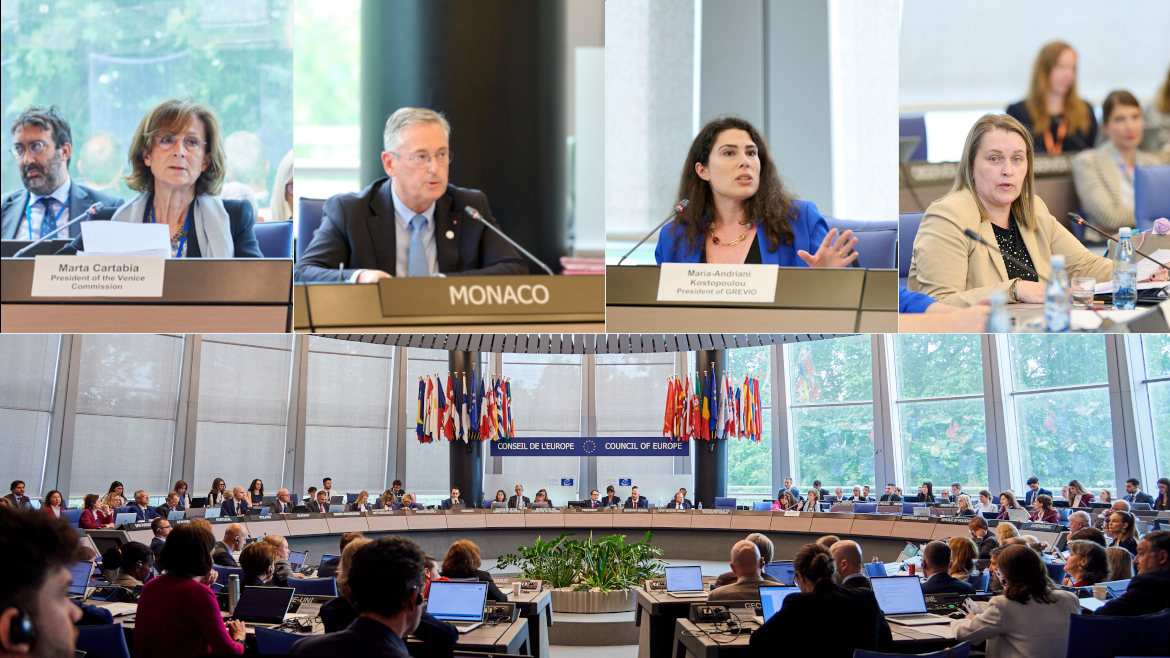
- Chairs of partial agreements: the practice consists in inviting the chairs of partial agreements, ie currently the President of the Venice Commission and of GRECO to meetings of the Deputies.

- Chairs of steering and expert committees: the chairs of expert committees are normally heard, when necessary, in the appropriate subsidiary body.


47 Cf. CM/Bur/Del(2008)2 rev - Approved CM/Del/Dec(2008)1021/1.4
48 Prior to 2008, in a meeting of the enlarged Bureau.
49 Representatives of non-member states without observer status to the Council of Europe are allowed to participate, on an ad hoc basis, in meetings of the Rapporteur Groups, if the topic to be discussed directly concerns those countries, upon invitation by the Chair of the relevant Group and with the prior agreement of the Committee of Ministers, in accordance with Article 20.a. of the Statute of the Council of Europe. (CM/Bur/Del(2007)13 and CM/Del/Dec(2007)1009/1.7).
50 Cf. CM(2011)96 final

Top Top

16. Conclusions of the meeting

(Article 16)

1. At the end of each meeting the draft conclusions shall be submitted by the Secretary of the Committee of Ministers for approval of the Deputies. This report shall record the conclusions reached by the Deputies and shall not constitute a summary report of the discussions or of the views expressed. Nevertheless, when the Deputies are unable to reach agreement on a question for which unanimity is required the majority and minority views shall be recorded in the conclusions.
2. The point of view expressed by a Deputy during a meeting shall be recorded if a specific request is so made. The same applies to statements by the Secretary General or his representative.
3. The final text of the conclusions shall be distributed within three working days after the end of the meeting.


16.1 Volume of Decisions adopted and Records

16.2 Adoption of Decisions

16.1 Volume of Decisions adopted and Records

Since 1993, the conclusions of the meeting are contained in two documents: 1. Decisions adopted and 2. Records containing statements by Delegations or by the Secretariat if requested and the results of formal votes. In certain cases, summings-up of the Chair could enable the drafting of records to be avoided. The Deputies’ meetings are recorded, and the recordings kept for a period of six months, so that Delegations or the Secretariat may consult them if need be.

The Deputies agreed in 2001 that verbatim transcriptions should be used only very exceptionally.51

16.2 Adoption of Decisions52

In accordance with standing instructions, the Secretariat prepares, whenever possible, draft decisions for each item on the agenda of a meeting of the Deputies. The draft decisions are appended to the Notes on the Agenda.

When an item is dealt with without debate ("in the box"), the draft decisions are adopted together with the order of business.53

When an item has been discussed, the draft decisions are approved, amended or replaced.

In the event of amendment or replacement, the draft decisions are formally approved at the end of the meeting during the “adoption of decisions”. If no change is made to the draft decisions, they are considered adopted.

At the end of the meeting, the Secretary to the CM lists orally those items for which there are no decisions and the items where decisions had been adopted as in the Notes on the Agenda. He/She then draws attention to the draft decisions which have been amended or those which have been redrafted with a view to their formal adoption.


51 Cf. CM/Bur/Del(2001)26 – Approved CM/Del/Dec(2001)776/1.4
52 Cf. CM/Bur/Del(2004)25 - Approved CM/Del/Dec(2004)900/1.4
53 CM/Del/Concl(77)265 and CM(77)25

Top Top

17. Amendments to the Rules of Procedure

(Article 17)

Subject to the provisions of the Statute, these Rules of Procedure may be amended by the Deputies by a two-thirds majority, except in the case of Articles 2 and 9 the amendment of which shall require a unanimous vote.

 
18. Rules of Procedure of the Committee of Ministers

(Article 18)

The Rules of Procedure of the Committee of Ministers shall apply, where appropriate, to meetings of the Deputies in respect of matters not provided for in these Rules.

 
19. Human Rights (DH) meetings

19.1 Supervision of the execution of judgments and of the terms of friendly settlements

19.2 Standard and enhanced procedure

19.3 Agendas of DH meetings

19.4 Order of business of DH meetings

19.1 Supervision of the execution of judgments and of the terms of friendly settlements

DH meetings are Deputies’ meetings which are devoted to the supervision of the execution of judgments and decisions of the Court.54

The exercise of the powers of the CM is governed by the Rules of the CM for the supervision of the execution of judgments and of the terms of friendly settlements.

The rules of procedure governing the Deputies’ meetings apply to DH meetings, unless otherwise provided (see below).55

The Deputies have further agreed additional and specific working methods for the DH meetings to deal with the ever increasing workload. The latest system for the supervision of the execution was adopted by the Deputies in December 2010.56

19.2 Standard and enhanced procedure

This system sets a twin track supervision system: a standard and simplified procedure as the norm and an enhanced procedure for certain cases.

The indicators for the classification of cases under the enhanced supervision procedure are the following:

    - judgments requiring urgent individual measures;
    - pilot judgments;
    - judgments disclosing major structural and/or complex problems as identified by the Court and/or the CM;
    - interstate cases.

In addition, the CM may decide to examine any case under the enhanced procedure following an initiative of a member State or the Secretariat.

19.3 Agendas of DH meetings

All cases are deemed to be on the agenda of each DH meeting. The Deputies have access at all times to the list and status of the pending cases in the website of the Department for the execution of the judgments and decisions of the Court or of the CM. Accordingly no agenda is drawn up for the DH meetings.

19.4 Order of business of DH meetings

A draft order of business is prepared for each DH meeting, under the responsibility of the Chair.

It includes a section on cases proposed for consideration under enhanced procedure with or without debate and a section on case management. Only the cases under enhanced procedure, or proposed for enhanced procedure, are examined. A request for debate can be made by any member State or the Secretariat.

The draft order of business is issued one month before the meeting. Delegations may propose amendments up to 10 calendar days before the meeting. After expiry of this time-limit, a revised draft order of business is issued, on the basis of comments received.

Under the enhanced procedure, for the cases proposed without debate, a draft decision is in principle prepared and distributed with the draft order of business. For those proposed with debate, the Secretariat is instructed to prepare as a rule preliminary draft decisions for all the cases under Article 34 of the Convention, appearing on the order of business, to be circulated with the revised draft order of business, unless the State or States under examination object(s). In case of an objection, the Secretariat will prepare points for consideration to guide the debate.

For case management, the draft order of business includes a number of draft decisions, in principle taken without debate, such as the classification of new judgments and new decisions of the Court, the supervision of the payment of just satisfaction, the transmission of action plans and the adoption of resolutions closing the examination of certain cases.

The Deputies approve the order of business at the opening of the meeting.


54 The Deputies decided in January 1994 (CM/Del/Dec(94)506/Item ADM3, C.) to hold DH meetings starting in 1995.
55 Cf. paragraph 27 of CM/Inf/DH(2010)45 final
56 Cf. 1100th (DH) meeting, item E. The practical modalities of these procedures are contained in the attached document.

Top Top

20. Bureau

20.1 Membership

20.2 Quorum

20.3 Decision making

20.4 Main Tasks

20.1 Membership

The Bureau consists of six members in the English alphabetical order (the present Chair, the two previous Chairs and the three future Chairs).57

20.2 Quorum

For the Bureau to deliberate and take decisions validly, four of its six members must be present or be represented as provided for in Article 4, paragraph 1 of the Rules of Procedure for the Meetings of the Ministers' Deputies.

20.3 Decision making

The Bureau’s decisions are generally taken by consensus. If however consensus cannot be reached, decisions are taken by a simple majority, the Chair having a casting vote58.

The Bureau has no decision-making power on questions of substance and may not substitute itself for the full Committee.

20.4 Main Tasks59

- providing guidance to the Chair and Secretariat on handling Committee business;
- preparation of the meetings of the CM, including proposals for draft agendas of items to be prepared by Rapporteur groups/thematic coordinators/working parties, and indication of items where no debate is envisaged;
- contacts with the Assembly, in particular, representing the CM at the Joint Working Party with representatives from the Bureau of the Assembly, and the preparation of the Joint Committee;
- representing the CM in some other meetings and exchanges of views;
- at the request of the Chair or the CM receiving visitors on behalf of the CM and, if appropriate, holding an exchange of views with the visitors;
- advising the Chair at his/her request on urgent political statements to be issued by the Chair in his/her own name;
- carrying out consultations about the nominations of Chairs of Rapporteur Groups and Working Parties and submit relevant proposals to the CM for decision;
- examination of requests for the use of the CM meeting room and foyer.


57 Resolution Res(92)6 and CM(2001)72, paragraph 12, as confirmed at the 108th Session of the CM (CM(2001)PV1, item 6)
58 Cf. CM/Del/Dec(92)472/44 and Appendix 19, item 3 "Other considerations"
59 Cf. CM/Del/Dec(75)243/XL, CM/Del/Dec(92)472/44, CM/Del/Dec(94)506/ADM3 decision 12, as amended by CM/Del/Dec(2012)1145/1.9

Top Top