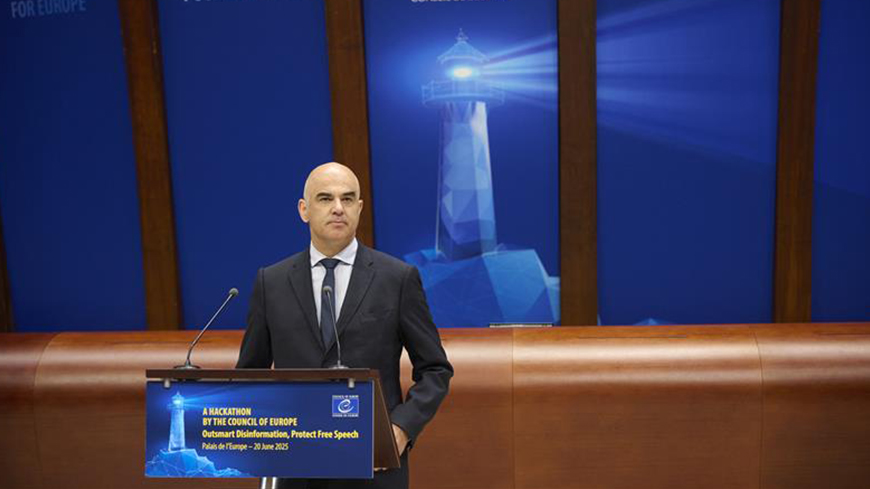
Welcome and opening address by Alain Berset, Secretary General of the Council of Europe
At the opening of the Council of Europe Hackathon, Secretary General Alain Berset lit the room with urgency and hope. In a powerful speech, he challenged participants to reject silence and take action. Disinformation, he warned, isn’t just noise—it’s a strategy designed to divide, distract, and dismantle democracy. But the voices in the room—young, diverse, determined—are ready to push back. Berset called on Europe to draw clear lines between truth and manipulation, launching a bold vision for a new Convention on Disinformation. His message was clear: democracy isn’t broken, but it’s under attack—and it’s up to all of us to defend it.
(done) Keynote Speeches
At the Hackathon’s opening, keynote speakers set a powerful tone: defending democracy in the digital age means rethinking how we deal with information, truth, and power. PACE President Theodoros Rousopoulos urged participants not to be “observers lost in the digital sphere,” reminding us that more content doesn’t mean more clarity. Gill Phillips highlighted the danger of over-controlling disinformation and the risk of censoring legitimate dissent, while Danela Arsovska called for ethical leadership and vigilance. From legal nuance to the role of AI, the message was clear: we need law, literacy, tech, and trust. Democracy depends on how we rise to this challenge.
(done) Introduction of Participating teams and Mentors of the Hackathon
Meet the Hackathon Teams: 11 Bold Ideas, One Mission: From AI tools to civic campaigns, these 11 teams from across Europe brought sharp minds and fearless energy to the Council of Europe Hackathon. Each one tackled the challenge of disinformation with creativity, purpose, and a commitment to democratic values. Hailing from Italy to Georgia, Norway to Albania, they built real solutions in real time—proving that innovation thrives where collaboration meets conviction. These aren’t just teams. They’re the frontline of digital democracy.
(done) Introduction of the challenge
The Council of Europe Hackathon was no ordinary competition—it was a fast-paced, high-stakes challenge to reimagine democracy for the digital age. What made it unique? The brief was as ambitious as it was urgent: expose hidden disinformation networks, crack open black-box algorithms, boost access to trustworthy information, and build tools to empower critical, resilient citizens. Teams had just one day to co-create bold, rights-based solutions grounded in the Reykjavík Principles. What stood out was the mix: coders worked alongside creatives, youth activists with policymakers, technologists with philosophers. The result? A rare fusion of tech and democratic imagination—ready to scale.
(done) ‘Ensemble’ by London Adavu
Grace in motion: London Adavu’s dancers wove rhythm and tradition into a powerful pause for truth, beauty, and democracy.
(done) First Democratic Debate:
DISINFORMATION AND GENDER EQUALITY
The first democratic debate— Disinformation and Gender Equality—uncovered how disinformation is used to attack women in public life, fracture societies, and weaken democracy from within. Speakers called out the “fire starters”—powerful actors fuelling division—and demanded bold, gender-sensitive digital governance. Media literacy isn’t enough, they warned; we must expose the source of manipulation and defend freedom with clarity and courage. From Europe to Sub-Saharan Africa, harmful narratives are spreading—so our response must be sharp, united, and deeply human. The message was clear: democracy must be rebranded to resonate. If we want people to believe in it, we must communicate like we mean it.
(done) Second Democratic Debate:
DISINFORMATION AND ELECTIONS
At the second democratic debate—Disinformation and Elections—speakers delivered a powerful warning: if we lose our shared information space, we risk losing democracy itself. As traditional media weakens and online platforms dominate, harmful content spreads faster than facts, eroding trust and warping elections. Panellists called for stronger protections for journalists, smarter regulation, and a new right to access reliable information. But this wasn’t just about problems—it was a call to act. From young digital defenders to international watchdogs, the message was clear: democracy needs more than free speech—it needs truth, transparency, and bold leadership to thrive in the digital age.
(done) Third Democratic Debate:
DISINFORMATION AND CULTURE
At the third democratic debate, “Disinformation and Culture,” speakers made one thing clear: culture isn’t just entertainment—it’s democratic infrastructure. Whether through museums, theatre, or art education, culture creates space for dialogue, empathy, and complexity—the very things disinformation seeks to erase. From “Pinocchio in Schools” in Portugal to new models like “contrats de résonance,” the message was strong: the arts help us learn to disagree, imagine alternatives, and stay human in a fractured information space. Culture must remain free, fearless, and well-funded. As one speaker put it, culture should be political—but never politicised. It’s democracy’s quiet, creative force.
(done) ‘Ensemble’ by London Adavu
Grace returned in motion, as London Adavu’s dancers closed the day with power, purpose, and a pulse for democracy.
(done) A Council of Europe Hackathon Satellite Event at the EYC Budapest – Presentation of the outcomes
At the Budapest satellite event of the Council of Europe Hackathon, young innovators delivered bold, hands-on solutions to fight disinformation—no hype, just action. From tools that burst echo chambers and flag fake news, to classroom kits that teach critical thinking and storytelling spaces that reveal real-life impact, their ideas were smart, grounded, and scalable. These youth aren’t just reacting to digital threats—they’re designing the tools to overcome them. Their message is loud and clear: democracy needs defenders, and they’re ready. From Budapest, a new wave of digital resilience is rising—led by those who will shape its future.
(done) Winners’ announcement and closing remarks by Alain Berset, Secretary General of the Council of Europe
At Europe’s first democracy hackathon, The Fact-Checking Foxes (Italy) took top prize for a fun, classroom tool that helps teens outsmart fake news—no AI, just sharp thinking. EchoBreaker (Georgia) earned a special mention for bursting filter bubbles, and Sunflower (Italy) for making open data easy to access and understand. With 11 youth-led teams, bold ideas, and non-stop creative energy, the event lit a fire under Europe’s fight against disinformation. As Secretary General Alain Berset said, democracy was always a hack—and this generation is ready to upgrade it. The spark is lit. Let’s keep it burning.
Ce n'est qu'un début
Laissez-nous votre courriel !
Vous recevrez les résultats, des informations sur les projets de suivi et de nouvelles façons de rendre la démocratie plus résiliente à l'ère numérique.