Citizens of the Republic of Moldova largely perceive the decision-making process of local and central authorities as inaccessible, formal, and involving only symbolic public participation. They rarely feel involved in the process, while local public authorities often mistake the publication of draft decisions for actual consultation. These are some of the conclusions of a Report on the practical aspects of ensuring transparency in the decision-making processes of central and local public authorities, developed by the Congress of Local and Regional Authorities (Congress) of the Council of Europe.
To draw these conclusions, the Congress experts conducted a survey on a sample of 1,102 respondents. Almost half of them (40%) admitted that they perceive the transparency of local authorities (municipalities) as “low.” In rayons, decision-making transparency of the authorities seems to be viewed more positively by citizens, with only a third (33%) considering it “low”. At the government level, 25% perceive it as “very low.”
39% of the respondents believe that citizens are “rarely” involved in the decisions made by municipalities, while another 39% say that participation is “non-existent” at the government level.
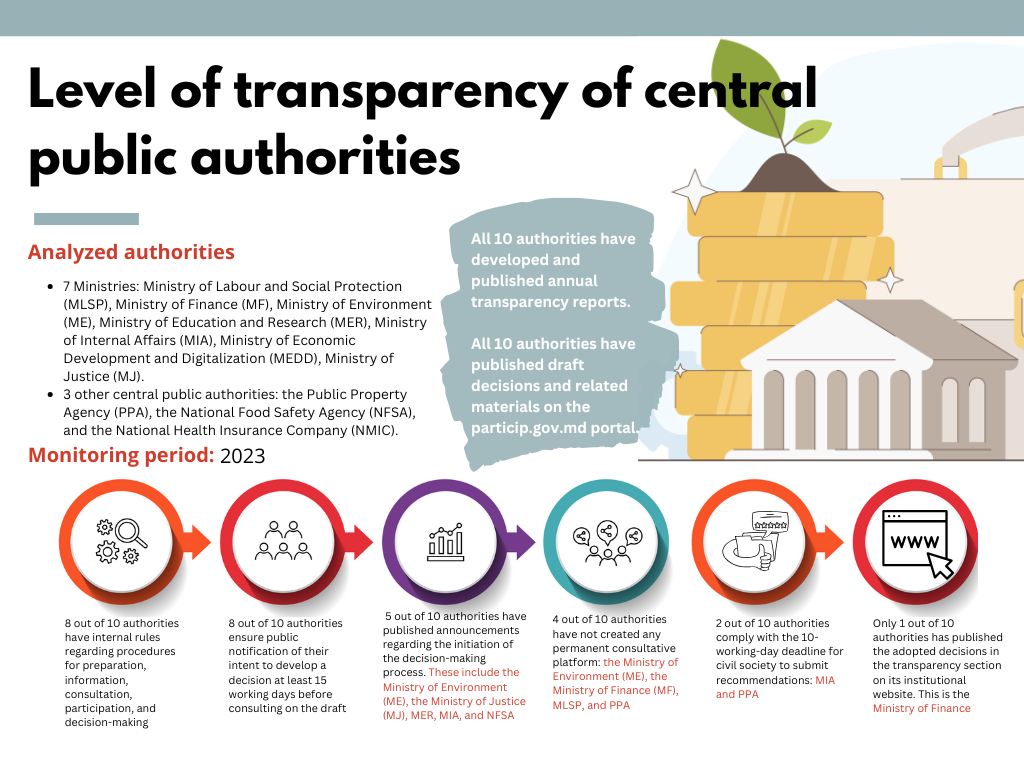
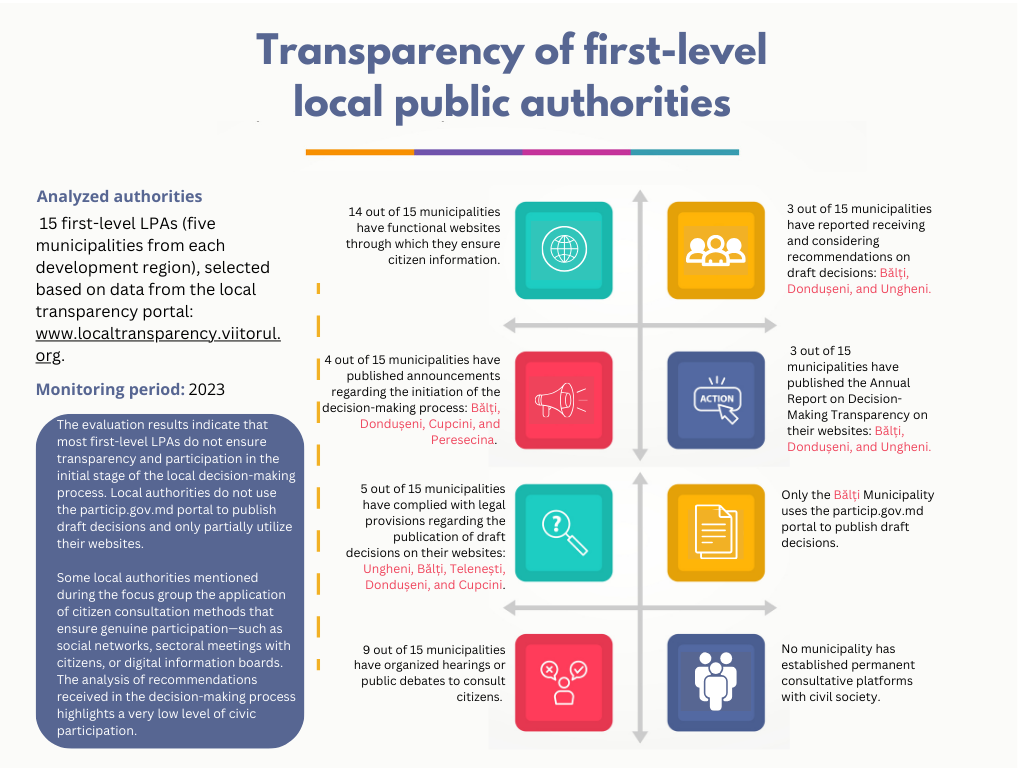
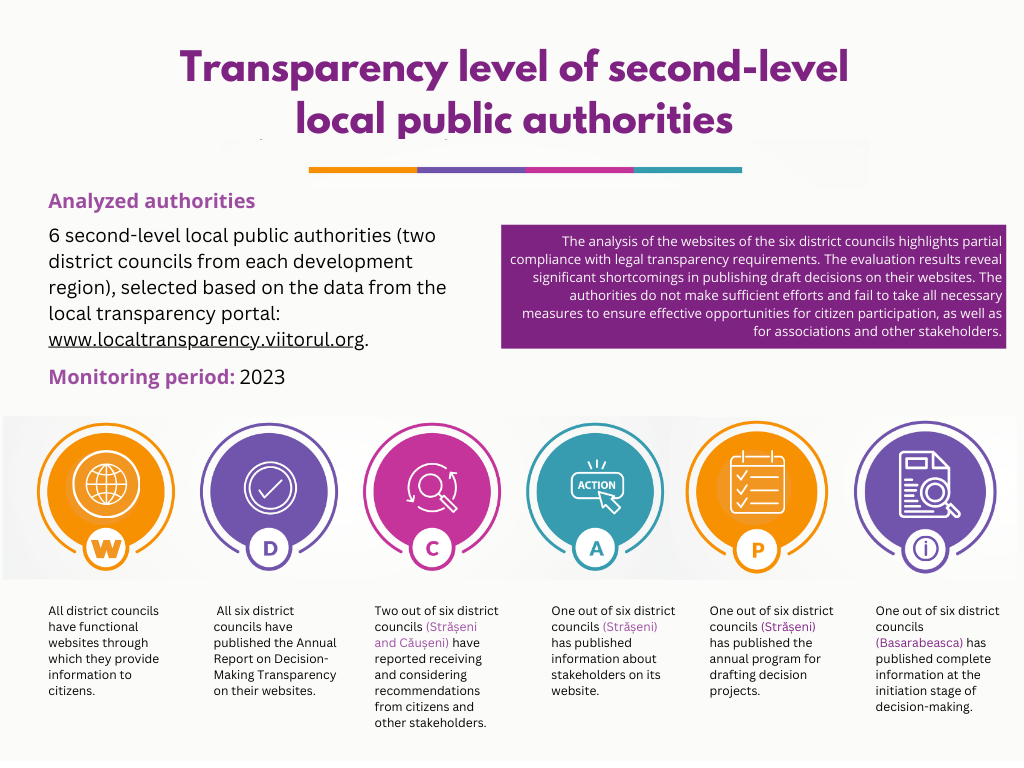
The Report found that although the situation has significantly improved comparing to few years ago, citizens’ access to information and to the decision-making process is still often difficult.
One example is the publication of draft decisions on the portal particip.gov.md, which remains problematic. The Report shows that central authorities frequently fail to make all draft normative and administrative acts public, even though the law requires so. Moreover, there is a discrepancy between the number of documents reported as published and those actually made public.
While the Report includes a variety of recommendations for authorities at all levels, it also includes some specific recommendations regarding the particip.gov.md portal. For example, it recommends embedding the portal into the websites of all public authorities, ensuring proper document labeling, and clearly indicating publication dates to improve access and the traceability of draft decisions. A simplified guide and stronger promotion of published documents would increase citizens’ participation, while centralising recommendations on the platform would make public consultations more efficient.
Based on the Report’s recommendations, a working group, set up at the government level, has developed a new draft Law on public participation in the decision-making process. The draft Law aims at improving the consultation and decision-making process both at the central and local levels, which is an important step to ensuring sustainability of undertaken actions.
Therefore, the Congress stands ready to further provide its support and expertise to local and central authorities in the Republic of Moldova to embed open government principles in day-to-day work under the framework of the new multi-year project.
This Report was produced within the framework of the project “Strengthening the culture of dialogue and open and ethical governance in the Republic of Moldova”, implemented by the Congress of Local and Regional Authorities of the Council of Europe under the Council of Europe Action Plan for the Republic of Moldova (2021–2024).


 CONTACT US