


Welcome to the GRECO website

Ever since antiquity, corruption has been one of the most widespread and insidious of social evils. When it involves public officials and elected representatives, it is inimical to the administration of public affairs. Since the end of the 19th century, it has also been seen as a major threat in the private sphere, undermining the trust and confidence which are necessary for the maintenance and development of sustainable economic and social relations. It is estimated that hundreds of billions of Euros are paid in bribes every year. (more)
A word from the President of GRECO
Welcome to this window on GRECO’s world! 
I invite you to use it to look into the work we do with our 48 member States. We use the dynamics of collective expertise and peer pressure to accomplish action by individual governments that will build durable barriers against corruption and bring to justice those who misuse their position for personal gain to the detriment of society as a whole.
Whether inspired by GRECO’s work, that of others with an anti-corruption agenda or our own experiences and principles, each one of us has a role to play in changing the mind-set to zero tolerance of corruption.
Members of GRECO Bureau
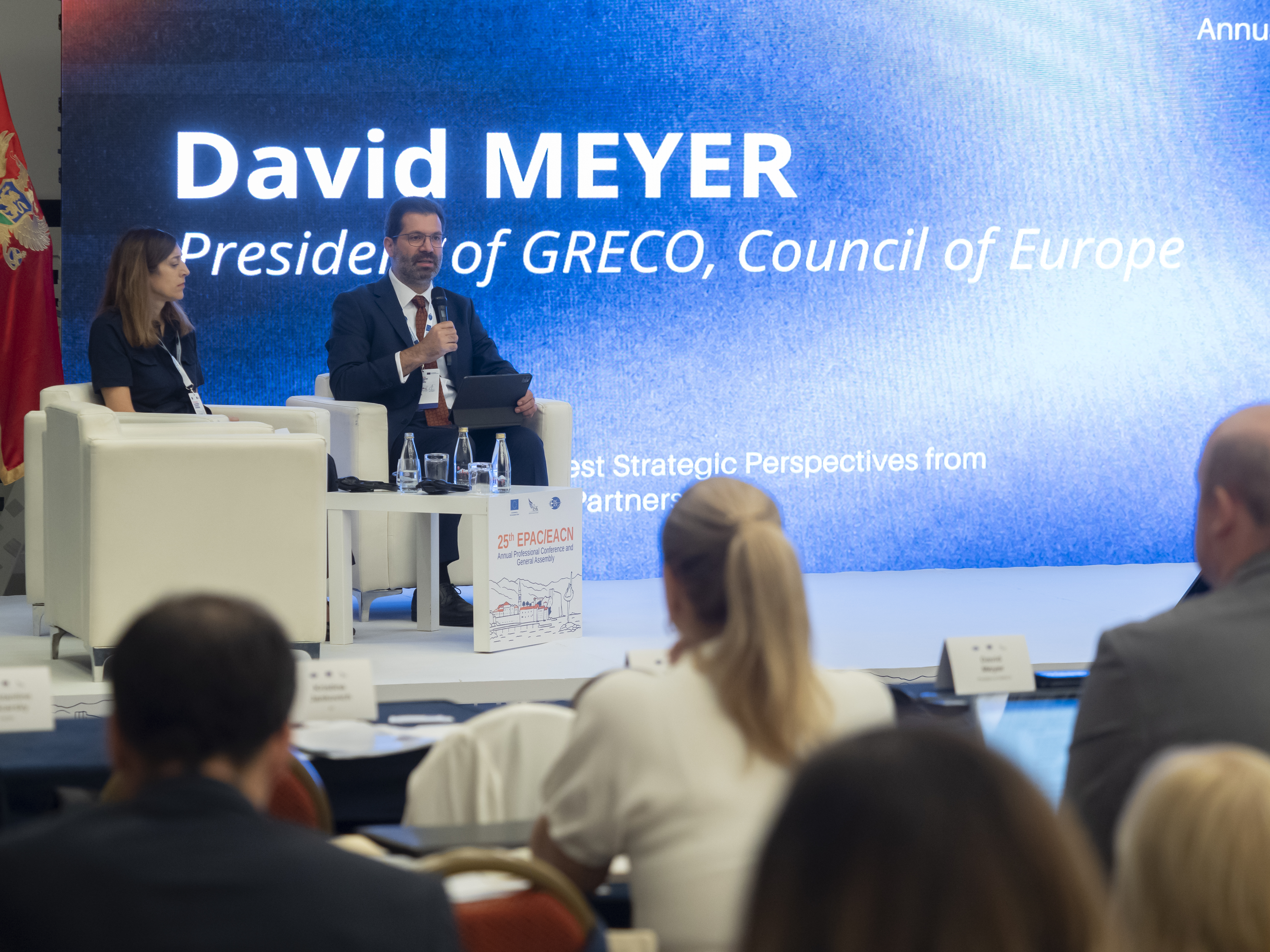
The composition of GRECO's Bureau is the following: Olivier GONIN (Switzerland), Panagiota VATIKALOU (Greece), Vice-President António DELICADO (Portugal), President David MEYER (United Kingdom), Lise CHIPAULT (France), Sorin TĂNASE (Romania) and Alexia KALISPERA (Cyprus).

Legal instruments adopted by the Council of Europe
- Criminal Law Convention on Corruption (ETS 173)
- Civil Law Convention on Corruption (ETS 174)
- Additional Protocol to the Criminal Law Convention on Corruption (ETS 191)
- Twenty Guiding Principles against Corruption (Resolution (97) 24)
- Recommendation on Codes of Conduct for Public Officials (Recommendation No. R(2000)10)
- Recommendation on Common Rules against Corruption in the Funding of Political Parties and Electoral Campaigns (Recommendation Rec(2003)4)
 BEWARE OF SCAMS
It has been brought to our attention that the name of GRECO is being used for fraudulent purposes. These scams may appear to use letterhead with the GRECO logo, or contain the signatures of actual or fictitious senior GRECO officials, aiming to give the appearance of a legitimate GRECO correspondence. Sometimes they may include legitimate website addresses to give a veneer of credibility to the scam.
Typically, the solicitations asked potential victims to provide personal information such as signatures or bank account information, and to pay certain advance fees, often described as "processing fees." In return, the potential victim was promised sums of money that the person soliciting the "fees" had no intention of paying. In some cases, those seeking the funds used the names of actual GRECO staff members to sign the letters in order to bolster their credibility.
GRECO, the Council of Europe's anti-corruption body, monitors the way in which its member countries implement the Council of Europe conventions and other instruments at national level. GRECO does not contact members of the public directly by email, telephone, Whatsapp or any other means about specific financial transactions or personal information.
We caution the public to be very wary of these and other similar solicitations that falsely claim to be affiliated with the GRECO. If you have received such a communication, we advise you to immediately terminate that contact. If you have already paid them money, please contact your local law enforcement without delay.


 GET THE LATEST UPDATES


Web resources
 National Anti-Corruption Authorities
European and International organisations
Non-governmental organisations
Research Institutes and Centres
Anti-corruption platform (PACE)
Elections: the Council of Europe’s role
Action against economic crime (Council of Europe)
Events (Council of Europe)


