Nature
European Diploma of Protected Areas

The European Diploma of Protected Areas is a prestigious international award granted since 1965 by the Committee of
Ministers of the Council of Europe to natural and semi-natural areas and landscapes of exceptional European importance
for the preservation of biological, geological and landscape diversity and managed in an exemplary way.
The Diploma is awarded to protected areas because of their outstanding scientific, cultural or aesthetic qualities, but
they must also be the subject of a suitable conservation scheme.
Presentation of the European Diploma of
Protected Areas (side event at the 32nd
meeting of the Standing Committee to the Bern
Convention)
Why award a Diploma?
Europe’s biological and landscape diversity, or in other words the variety of its flora, fauna, ecosystems and landscapes,
is one of European citizens greatest treasures. European nature is of an importance which extends well beyond the
frontiers of the continent and forms a living bond between peoples.
However, precious natural habitats and landscapes shaped by nature and the human hand are deteriorating and disappearing.
Plant and animal species are endangered and so our common heritage is diminishing and is in danger of vanishing.
Who awards the Diploma?
Applications for the European Diploma are sent to the Council of Europe by the governments of the member States and
submitted to a group of specialists which shall state whether it considers that the area in question is of exceptional
European interest. If the interest has been sufficiently well established, an on-the-spot appraisal is decided.
Following an on-the-spot expert appraisal, whose purpose is to examine in detail the characteristics of the area, the
effectiveness of the protection measures, the management quality, the problems, the group of specialists decides
whether to recommend that the Committee of Ministers should award the European Diploma to the area concerned. In most
cases, the proposal to award the Diploma is accompanied by recommendations and, where appropriate, conditions to improve
the management of the area or the system for protecting it.
Regular review
The Diploma has a unique supervisory mechanism. An annual report has to be sent to the Council of Europe by the
authorities responsible for the management of each award-winning site.
The Diploma is awarded for five years. It may be renewed for a period of 10 years, renewable for successive 10 year period.
A new expert report aimed primarily at checking whether the requirements formulated when the Diploma was awarded have
actually been fulfilled.
In the event of a serious threat to an area or a substantial deterioration of the site, an exceptional appraisal may be conducted.
A stimulus and an inspiration
The award of the European Diploma provides an invaluable stimulus for the efficient protection and management of
landscapes, reserves or natural monuments and sites with special European significance. In the European Diploma,
the authorities responsible for protected areas have, under Council of Europe auspices, an international instrument
capable of helping them in their task of management and protection.
The unique nature of the Diploma also lies in the fact that it is awarded for a limited duration; the threat that
it may be withdrawn has a deterrent effect in respect of dangers liable to cause harm to the area and acts as a
stimulus for the preservation and improvement of the site.
Who has been awarded the European Diploma?
The European Diploma has been awarded to
71 areas
spread across 26 European countries. Applications are received regularly from many European countries as interest
grows in this prestigious international award.
The first areas to be awarded the Diploma were the Camargue National Reserve (France), the Peak District National
Park (United Kingdom) and the Hautes Fagnes Nature Reserve (Belgium).
The Diploma now covers a wide variety of geographical areas extending from the Fair Isle in the Shetlands north-east
of Scotland to the Teberda National Park in the Russian Caucasus and from the Portuguese Salvage Islands off Madeira
to the Kuscenneti Bird Reserve in Turkey.
Award winners include sites of widely differing size with a great variety of habitats.
Examples are the Krimml Waterfalls in Austria, the peat bog area of the Wurzacher Ried Nature Reserve in Germany, the
huge National Parks of Sarek and Padjelanta in Sweden, virgin forests such as the Bialowieza National Park in Poland,
islands such as the Italian Montecristo Nature Reserve, the palaeontological site of Ipolytarnóc in Hungary, the
wetlands of the Doñana National Park in Spain, and high mountain landscapes such as the Ecrins National Park in France.
What rules govern the award of the Diploma of Protected Areas?
The European Diploma was created in 1965 by Resolution (65) 6 of the Committee of Ministers of the Council of Europe.
The Regulations for its award and appraisal were adopted in 1973 (Resolution 73/4) and amended later.
The Regulations of the European Diploma of Protected Areas are now contained in Resolution
CM/ResDip(2008)1,
adopted on 20 February 2008.
The network of managers of the European Diploma of Protected Areas
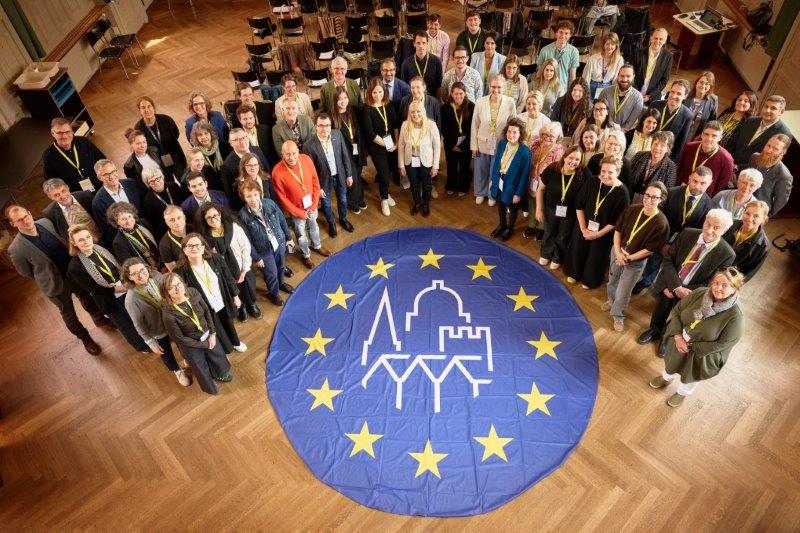
The managers of the various award-winning areas of Europe meet regularly at colloquies held by the Council of Europe.
Over the years this has given rise to a veritable international co-operation network.
The network of managers is an invaluable asset for the preservation of biological and landscape diversity in Europe
and an effective means of promoting the principles upheld by the Council of Europe to protect Europe’s natural heritage.
The Diploma provides a recognised standard for the conservation of the heritage and the promotion of models of
sustainable development. It brings together many samples of the extraordinary diversity of Europe’s natural and
cultural heritage and a material significance in that it helps to promote work to protect nature in all the countries
where the protected areas are located. It also provides a tangible opportunity for the managers of these areas to
exchange views and pool experiences.
|