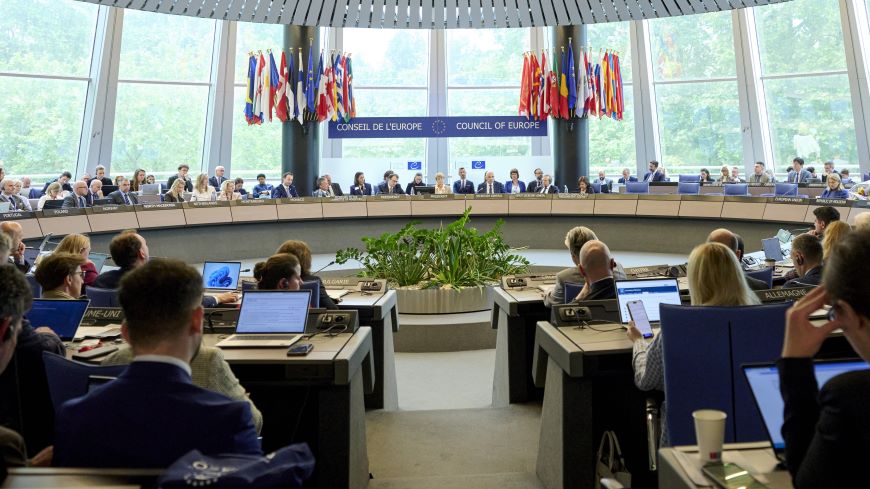
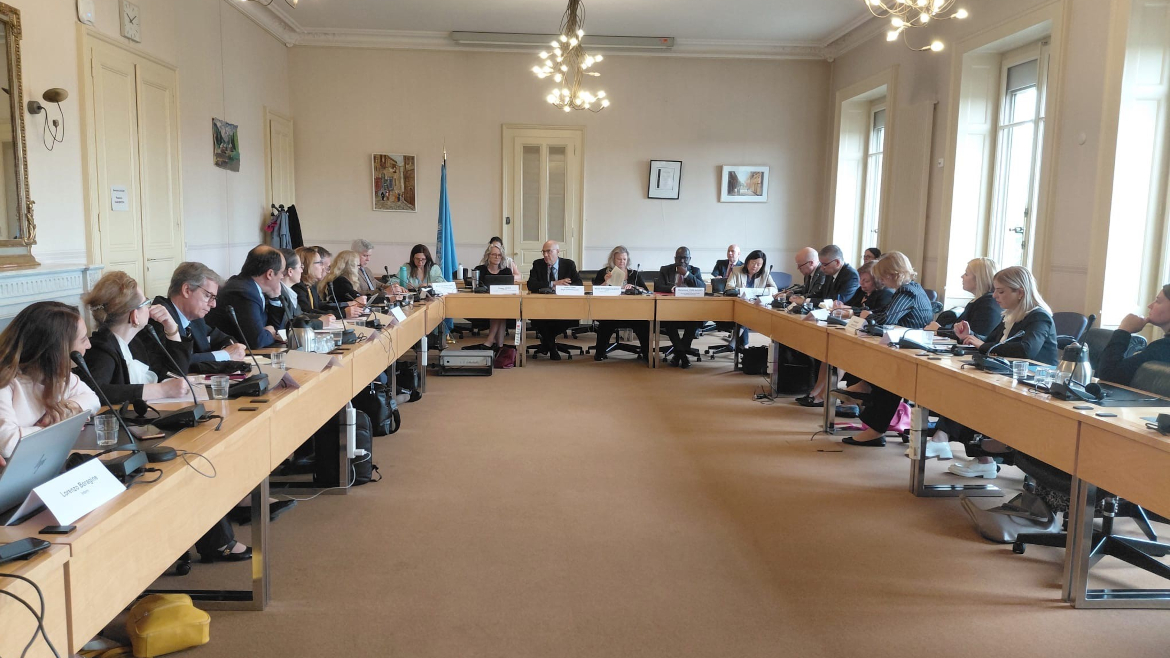
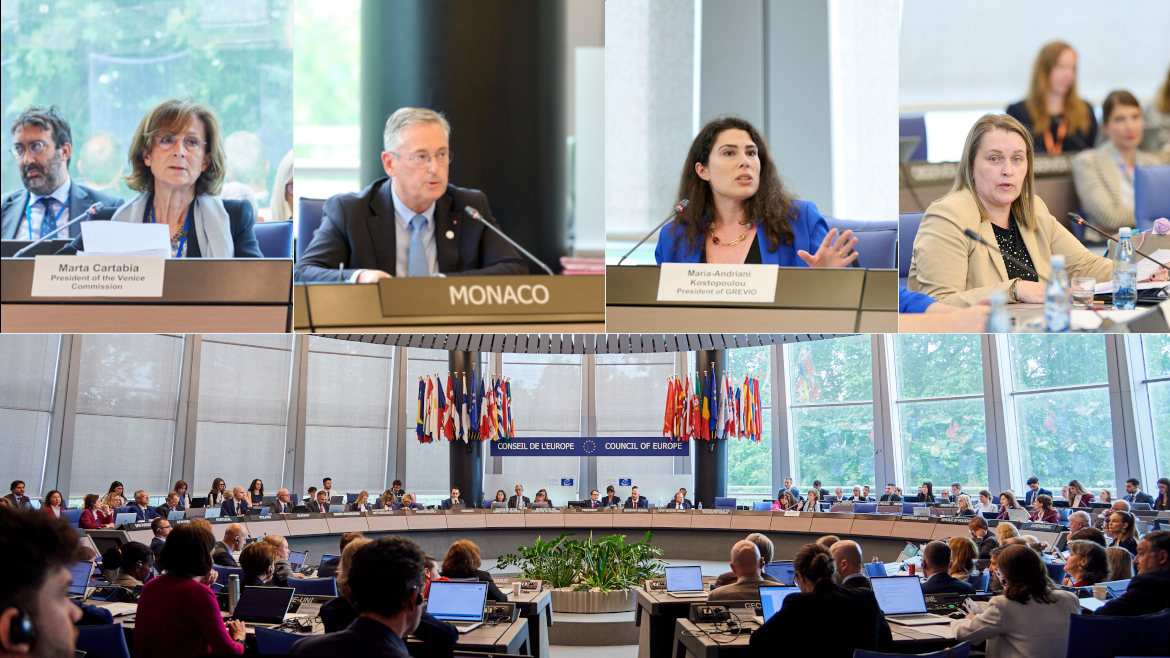
The Deputies adopted Guidelines for the organisation of ministerial sessions.
4.1 Format
4.2 Agenda
4.3 Participation
4.4 Speaker’s list
4.5 Interpretation
4.1 Format
Ministerial sessions are comprised of two parts: a formal session and informal discussions (often during a working lunch/dinner). The arrangements concerning the format – including the sequence of formal session and informal discussions – are decided on a case-by-case basis for each session by the outgoing and incoming chairs, in consultation with member States.
4.2 Agenda
The outgoing and incoming chairs have the initiative for proposing subjects, in close consultation with member States, in particular the country representing the EU Presidency, and with the SG. In order for ministerial sessions to attract the interest of ministers, political topics of current concern and of some urgency - on which a discussion at the pan-European level of the Council would be of added value - should be chosen for discussion.
The agenda of the formal ministerial session generally includes:
- institutional matters linked to the handover of the chairmanship (stocktaking of the achievements of the outgoing Chair and presentation of the priorities of the incoming Chair);
- general or specific topics which ministers would like to raise during a statement which would be limited in time;
- items requiring a decision at the ministerial level following the work carried out during the six-months' period of the outgoing chairmanship, which would be dealt with without debate (they would be included in the list of decisions and would only be discussed at the specific request of a member State).
On this basis, a provisional draft agenda is prepared by the SG, in consultation with the outgoing and incoming Chairs, for consideration by the Deputies. A member State or the SG may ask for a question to be included in the provisional draft agenda. The final decision on the draft agenda is taken by the Deputies.
The agenda is formally adopted at the beginning of the session.
During the informal discussions, the Foreign Affairs Ministers have the possibility to address a political topic of current concern directly linked with their mandate and in a strictly pan-European frame. The theme retained is generally introduced by the Chair. Again, depending on the topic, a leading personality to introduce the theme of discussion or voice some personal sentiments may be invited. The discussions lead to the preparation of conclusions by the Chair.
4.3 Participation
Participation in the formal session:
- the President of the Assembly is invited to all Ministerial sessions.3 In view of the themes, the President of the Court, the President of the Congress, the President of the Conference of INGOs, as well as the Commissioner for Human Rights, may also be invited.
- the EU High Representative for Foreign Affairs and Security Policy is invited, as are the Ministers for Foreign Affairs of the observer countries.
- the other participants from outside the Council are invited on an ad hoc basis.
Participation in the informal discussions is decided on a case-by-case basis by the Chair following consultations with member States.
4.4 Speaker’s list
During the formal session, the speaker’s list is drawn up under the responsibility of the Chair. Speaking time is allotted to Ministers and political figures. Member States may present national position papers containing detailed statements in writing on the topics under discussion, either to provide a more detailed statement on an issue than the time allocated for an oral statement would allow, or for delegations not represented at ministerial/political level to be able to give their views. Documents should be submitted in one of the official languages.
There is no speaker’s list for the informal discussions.
4.5 Interpretation
During the formal Session, besides the two official languages, simultaneous interpretation is provided in German, Italian and Russian, as well as Spanish (passive).
During the informal working lunch/dinner, simultaneous interpretation is provided in English and French.4 |