|
|
Chairmanship
of the Committee of Ministers (CM)
|
|
|
|
|
|
|
|
|
Activities
of the Committee of Ministers
|
|
|
The
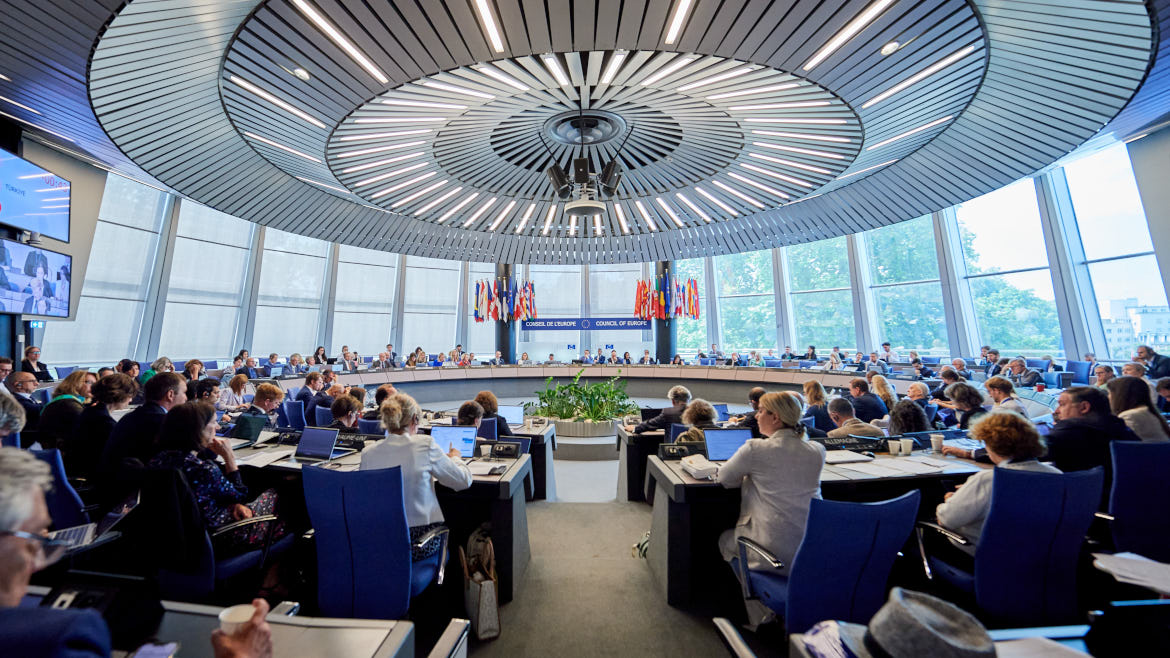
Committee of Ministers is the
Council of Europe's decision-making body. It is composed of the
Ministers for Foreign Affairs of the 47 member states or their
permanent representatives in Strasbourg (more...).
|
|
|
|
|
|
Committee
of Ministers: Who's
Who
|
|
|
|
|
|
|
Human
Rights leads the UK priorities for chairmanship, UK Europe Minister
tells Assembly
[24/01/2012]
Addressing
the Parliamentary Assembly on 24 January, the British Minister for
Europe, Mr David Lidington, focused on the United Kingdom's priorities
for its chairmanship and gave an update on the Committee of Ministers'
activities since October.
Speech
Video of the speech
Report
by the Chair of the Committee of Ministers (November 2011 - January
2012)
The
United Kingdom and the Council of Europe
Statement by the
Committee of Ministers on death sentences in Belarus
The Committee of
Ministers reiterates its appeal to establish a formal moratorium with a
view to abolition of the death penalty
[08/12/2011]
"While firmly condemning the bombing of the Minsk
Metro on 11 April and deploring the numerous deaths and injuries caused
by this terrorist attack, the Committee of Ministers deeply regrets the
sentencing to death of Dzmitry Kanavalaw and Uladzislaw Kavalyow on 30
November. Justice will not be achieved through the death of further
human beings. The Committee of Ministers calls on the authorities of
Belarus to commute these sentences and reiterates its appeal to
establish a formal moratorium with a view to abolition of the death
penalty. The creation of a death-penalty free zone in Europe is a
powerful contribution to the ongoing global efforts at the UN level to
this end."
Council of Europe alerts
against pressure and attacks on Internet
Freedom of expression is threatened by political
pressure on whistleblowers and human rights defenders websites
[08/12/2011]
The Council of Europe Committee of Ministers
alerted, on 8 December 2011, its member states about the risks to the
rights to freedom of expression and association that may be created by
politically motivated pressure on Internet platforms and online service
providers. It also expressed concern about the threat to these rights
caused by cyber attacks against websites of independent media,
whistleblowers, human right defenders and dissidents. In a Declaration the
Committee of Ministers stressed the need to affirm the roles of these
actors as facilitators of the exercise of the rights to freedom of
expression and freedom of assembly and association. It also stated that
human rights standards should be applied in situations were there is
interference with Internet content and with access to websites hosting
it, as well as with online community interactions.
Committee of
Ministers: decisions on execution of European Court of Human Rights
judgments
[07/12/2011]
The Committee of Ministers of the Council of
Europe published the decisions and resolutions
adopted at its fourth special human rights meeting for 2011.
More information on the execution process and on the state of execution
in cases pending for supervision as well as important reference texts
(including the new working methods) can be found here on the
website of the Committee of Ministers, on the special website of the Department for the execution
of the judgments of the European Court of Human Rights, and
in the Committee of Ministers’ Annual Reports on
its execution supervision.
Media, Beliefs and Religions
[29/11/2011]
The 2011 Council of Europe
Exchange on the religious dimension of intercultural dialogue,
organised by the Committee of Ministers, took place at the invitation
of the Luxembourg government at the Centre Culturel de Rencontre Abbaye
de Neumünster in Luxembourg City, on 28 and 29 November. This 4th
edition expanded on the theme launched in 2010 in Ohrid ("the former
Yugoslav Republic of Macedonia"), on the role of the media in fostering
intercultural dialogue, tolerance and mutual understanding: freedom of
expression of the media and respect towards cultural and religious
diversity.
Documents
Intercultural
and interreligious dialogue
Council of Europe 2012-2013
first biennial Programme and Budget adopted
[24/11/2011]
The Committee of Ministers of the Council of
Europe has approved the Organisation’s Programme and Budget for the
biennium 2012-2013. This completes the move of the Council of Europe to
a biennial programme and budget cycle in order to allow better planning
and resource management, in line with other international organisations
such as the United Nations and the OECD. The Programme and Budget
2012-2013 is geared towards a strict control of expenditure, including
significant reductions in staff and the redeployment of resources to
priority sectors in the area of Human Rights, Rule of Law and Democracy
with greater emphasis on field activities and the effectiveness of the
monitoring mechanisms to achieve better co-ordination of activities,
increased efficiency and higher impact.
Human Rights Commissioner:
shortlist announced
[24/11/2011]
The Committee of Ministers
has submitted a shortlist of three candidates for the post of Council
of Europe Human Rights Commissioner to the Organisation’s Parliamentary
Assembly. He will take over from present Commissioner Thomas Hammarberg
at the end of his mandate (31 March 2012). The candidates are
Pierre-Yves Monette (Belgium), Nils Muiznieks (Latvia) and Frans
Timmermans (Netherlands).
Pierre-Yves Monette is a former advisor to King Baudouin and King
Albert II of Belgium, Federal Ombudsman of Belgium and Attorney at the
Brussels' Bar. He is currently Professor at the College of Europe.
Nils Muiznieks is currently President of the European Commission
against Racism and Intolerance (ECRI) of the Council of Europe. Former
Minister of Social Integration in Latvian government, he has 17 years
professional experience in human rights (international, government,
academic, civil society).
Frans Timmermans is a Dutch MP and former Minister of Foreign Affairs
with responsibility for European cooperation. He was advisor to High
Commissioner on National Minorities for the Organization for Security
and Co-operation in Europe, Max van der Stoel, as well as the
Parliament representative in the European Convention.
The Commissioner for Human Rights is an independent institution within
the Council of Europe, mandated to promote the awareness of and respect
for human rights in 47 Council of Europe member states.
Mandate of the Commissioner
for Human Rights
The
Council of Europe takes action with regard to persons with disabilities
in Europe
[17/11/2011]
The Committee of Ministers
has just adopted a Recommendation whose objective is to propose to
member States principles and measures to increase the participation of
persons with disabilities in political and public life at all levels −
local, regional, national and international.
The 47 member states of the Council of Europe account for 80 to 100
million people with disabilities. Often they do not take part in the
decision-making process, faced with barriers of a legal, physical, and
societal nature. The Committee of Ministers wishes to change this
situation. The Recommendation aims to remove barriers and create
conditions for active citizenship, without discrimination, for all and
in all life settings. The Recommendation stresses that all persons with
disabilities should be able to express their views. No person should be
deprived of the right to vote or stand for election on the grounds of
disability.
Link to the Recommendation
Roma eviction, "aggravated"
violation of the European Social Charter
[10/11/2011]
The Committee of Ministers
took note, on 9 November, of the report including the decision of the
European Committee of Social Rights taken on 28 June 2011 and decided
to make it public immediately. In its Resolution, the Committee of
Ministers invited France to report at a forthcoming meeting on the
measures taken or foreseen in order to deal with the situation
described in the complaint and to report on co-operation with other
countries concerned.
The European Committee of Social Rights had concluded unanimously, in
its decision on the merits, that the forced evictions of Roma of
Romanian and Bulgarian origin in the summer 2010 constituted a
violation of Article E (non discrimination) taken in conjunction with
Article 31§2 (Right to housing – Reduction of homelessness) and that
the de facto collective expulsion of Roma of Bulgarian and Romanian
origin from France during the summer 2010 constituted a violation of
Article E (non discrimination) taken in conjunction with Article 19§8
(guarantees concerning deportation).
United Kingdom chairmanship
[07/11/2011]
The Committee of Ministers
chairmanship transferred from Ukraine to the United Kingdom on 7
November. The meeting of the Ministers’ Deputies reviewed the Ukrainian
chairmanship and looked at the United Kingdom priorities for the coming
six months.
UK Chairmanship website
Priorities
of the United Kingdom Chairmanship of the Committee of Ministers
United
Kingdom and the Council of Europe
Reforms to
human rights “overarching” theme for Europe, says UK Foreign Secretary
[07/11/2011]
On 7 November, UK Foreign
Secretary William Hague stressed the determination and political
commitment of his government to drive forward essential reforms of the
Court of Human Rights during the British chairmanship of the Council of
Europe Committee of Ministers.
Speaking shortly before the official handover from the outgoing chair
Ukraine, Mr Hague said that human rights were central to UK foreign
policy and an overarching theme for the chairmanship. The UK – a
founding party to the European Convention on Human Rights - would
broker a wide consensus on reform of the Court of Human Rights.
"We have a long tradition in the UK of protecting fundamental rights
and freedoms, therefore we want the court to operate effectively and
concentrate on the most serious human rights violations," he said,
adding his concern that the court had been too ready to substitute its
own judgments for those of national courts.
He also stressed his support for the principle of EU accession to the
European Convention of Human Rights, but warned that negotiations
within the EU would be needed to get it right from the start.
Photo Gallery
Press conference - audio
Interview
with UK ambassador
[07/11/2011]
The UK's Permanent
Representative to the Council of Europe, Ambassador Eleanor Fuller,
says that reform of the European Court of Human Rights is the UK's
leading priority. Ambassador Fuller's comments came as the United
Kingdom took over the chairmanship of the Committee of Ministers of the
Council of Europe for six months until May 2012.
Video
|