• There would be no violation of Article 3 (prohibition of torture or inhuman or degrading treatment) of the European Convention on Human Rights;
• There would be no violation of Article 5 (right to liberty and security) of the Convention; but that
• There would be a violation of Article 6 (right to a fair trial), given the real risk of the admission of evidence obtained by torture at his retrial.
• The Court also held, unanimously, that there had been no violation of Article 13 (right to an effective remedy).
This is the first time that the Court has found that an expulsion would be in violation of
Article 6, which reflects the international consensus that the use of evidence obtained
through torture makes a fair trial impossible.
At its last meeting on 23rd November 2011, the Group of Parties to the Council of Europe Convention on the Prevention of Terrorism [CETS No. 196] adopted provisionally the Rules of
Procedure of the Group of Parties to the Convention CETS No. 196. Final adoption of these Rules by silent procedure has been finalised on 2 January 2012.
On 7 July 2010, the Committee of Ministers of the Council of Europe adopted the abridged report of the CODEXTER meeting (Strasbourg, 7-8 April 2010) and the follow-up mechanism for the effective use and implementation of the Council of Europe Convention on the Prevention of Terrorism (CETS No 196).
1st July 2010, Mr Andrea CANDRIAN, Chair of the CODEXTER, held an exchange of views with the Rapporteur Group on Legal Co-operation of the Ministers' Deputies (GR-J). Mr Candrian has outlined recent activities of the CODEXTER and, in particular, those related to the follow-up of the CoE Convention on the Prevention of Terrorism (CETS No. 196)
On 4 June 2010, the Venice Commission adopted, at its 83rd Plenary Session, the Report on Counter-Terrorism Measures and Human Rights
The Committee of Experts on Terrorism (CODEXTER) held its 18th meeting in Strasbourg, France, from 7 to 8 April 2010. The main part of this meeting was devoted to the discussion on the regular follow-up mechanism to the Council of Europe Convention on the Prevention of Terrorism (CETS No. 196). Moreover, the Committee approved the analytical study on false identity information as a challenge to immigration authorities as well as the updated version of the Progress Report on future priority areas for the work of the Council of Europe against terrorism. The CODEXTER also authorised the publication of the country profiles on counter-terrorism capacity as submitted by Serbia and as updated by Albania, Germany and “the former Yugoslav Republic of Macedonia”.
On 17 December 2009, addressing the Counter-Terrorism Committee’s meeting in New-York, Mr. Manuel Lezertua, CoE’s Jurisconsult and Director of Legal Advice and Public International Law emphasised the key role that regional organisations, such as the Council of Europe, have to play in implementing the UN tools against terrorism. It also explored areas for future cooperation between the CoE and the UN relevant bodies involved in counter-terrorism related issues. The intervention of Mr Lezertua has been followed by a lively debate with the participation of all delegations. In the course of this debate the possibility of joint activities was also suggested.
High level seminar on the protection of Human Rights within the Framework of the Fight against Terrorism
On October 8th and 9h 2009, the Counter-terrorism Task-Force of the Council of Europe and the Ministry for Foreign Affairs of Spain organised in Málaga, with the support of the University of Málaga and of the Foundation ValsaĂn, a high level seminar on the protection of Human Rights within the Framework of the Fight against Terrorism.
The seminar was opened by Mr. Cándido Conde Pumpido, Public Prosecutor of Spain, Mr. Francisco de la Torre Prados, Mayor of Málaga, Mr. Alvaro Gil-Robles, first Commissioner for Human Rights of the Council of Europe, Ambassador Juan Manuel of Barandica y Luxán, Ambas/sador of Spain for Strategic Affairs, Ambassador Fernando Perpiñá, Secretary of the Club of Madrid and Mrs. Adelaida de la Calle MartĂn, Rector of the University of Málaga.
The participants - coming from diplomatic, ministerial, judicial and academic circles and also from civil society - discussed consecutively the integration of Human Rights in national counter-terrorism policies, the tools available for this purpose at national and international level and legal challenges faced by States in this field
Participation in Eminent Jurists Panel on
Terrorism, Counter-Terrorism and Human Rights
[29/04/09] On 28 April 2009, the Council of Europe hosted a
lunchtime briefing on “Assessing Damage, Urging Action: The way
forward for counter-terrorism in Europe. Eminent Jurists Panel on
Terrorism, Counter-Terrorism and Human Rights”. This event,
organised by the International Commission of Jurists (ICJ) and
sponsored by Dick Marty, Chairperson of the Sub-Committee on Crime
Problems and the Fight against Terrorism, highlighted some of the
key findings of the Eminent Jurists Panel report; one of the most
comprehensive inquiries into the impact of counter-terrorism
measures on human rights. The briefing was attended by Dick Marty
and Gerald Staberock, Director of the Global Security and Rule of
Law Initiative (ICJ), and moderated by the Council of Europe
Anti-Terrorism Co-ordinator, Mr Alexandre Guessel.
(more)
[20/02/09] The Council of Europe participated in the 6th
Worldwide Security Conference organised by the EastWest
Institute (EWI) and co-sponsored by the World Customs Organization
(host) and Italy in its role of Chair of the G8. The Conference
brought together experts from all over the world with the aim to
establish relations between governments, businesses, civil society
and mass media representatives in order to consider joint action to
combat terrorism. The Conference took place on 18-19 February 2009
in Brussels, Belgium, at the World Customs Organization
headquarters.
Agenda
Joint CoE/OSCE/UNODC Workshop on Enhancing
International Legal Co-operation related to Terrorism
[29/01/09] On 28-29 January 2009, the Council of Europe, the UNODC
and the OSCE organized a Workshop on Enhancing International Legal
Co-operation related to Terrorism, including the Drafting of
Requests for Extradition and Mutual Legal Assistance in Neum (Bosnia
and Herzegovina). The workshop focussed on the analysis of legal and
technical instruments to enforce the international co-operation on
mutual legal assistance and extradition in terrorism-related
criminal cases.
Agenda
Council of Europe, OSCE and UN discuss terrorism
prevention in the context of intercultural dialogue
[11.07.08] On the occasion of the annual High-level Tripartite
meeting on 7 July 2008, the Council of Europe, the Organisation for
Security and Co-operation in Europe, the United Nations and partner
organisations discussed different aspects of intercultural dialogue
and their collaboration in this area.
In the Joint Communiqué adopted at the end of the meeting, the
participating organisations stressed the role of international
instruments to combat terrorism and called upon states to encourage
inter-religious and cross-cultural dialogue with a view to reducing
tensions and, in this manner, help to prevent terrorist offences.
They underlined the continuing need to address the conditions
conducive to radicalisation and the spread of terrorism, while
seeking to intercept and prosecute terrorists and counter terrorist
networks.
Joint Communiqué
CoE organised a Counter-Terrorism Training
Workshop in Pristina
[26/05/08] At the invitation of the United Nations Interim
Administration Mission in Kosovo (UNMIK), the Council of Europe
organised a Counter-Terrorism Training Workshop in co-operation with
the UNMIK/Kosovo Special Prosecutor’s Office (KSPO) which took place
in Pristina on 3 and 4 June 2008. The aim of this two-day event was
to provide training on the international legal framework for
co-operation on counter-terrorism issues, with an emphasis on
questions of mutual legal assistance and extradition, as well as
existing technical assistance tools for facilitating such
international co-operation. Moreover, participants examined key
issues regarding the protection of human rights while fighting
terrorism.
Council of Europe convention against terrorist
financing enters into force
[30.04.2008] “Following the money trail is one of the most important
ways of fighting terrorism and organised crime. Quick access to
information on assets held by criminal organisations, including
terrorist groups, is vital to successful prevention and prosecution
of terrorism”, said Terry Davis, Secretary General of the Council of
Europe.
Workshop on Enhancing International Legal
Co-operation related to Terrorism, including the Drafting of
Requests for Extradition and Mutual Legal Assistance
[22.2.08] The Council of Europe, the UNODC and OSCE organised a
Workshop on Enhancing International Legal Co-operation related to
Terrorism, including the Drafting of Requests for Extradition and
Mutual Legal Assistance on 1-2 April 2008 in Ankara (Turkey).
The aim of this two-day national workshop was to provide training on
the international legal framework for co-operation on mutual legal
assistance and extradition in terrorism-related criminal cases, and
on existing technical assistance tools for facilitating such
international co-operation in criminal matters.
Agenda
First International Conference on Radicalisation
and Political Violence, London, 17-18 January 2008
[17.1.08] Terry Davis, Council of Europe Secretary General,
delivered a keynote
speech at the first International
Conference on Radicalisation and Political Violence held in
London, 17-18 January 2008.
"A really effective fight against terrorism is one which respects
and protects human rights and fundamental freedoms rather than
sacrificing them in the short-sighted hope that terrorism can be
defeated by undermining the very foundations of the society which
the extremists are set to destroy." said the Secretary General.
Council of Europe joins OSCE to discuss
protection of victims of terrorist acts
The High-Level Meeting on Victims of Terrorism followed an
initiative of the Spanish Chairmanship of the OSCE and was organised
by ODIHR in Vienna, 13-14 September 2007.
Combating racial discrimination in the fight
against terrorism
On 29 June 2007, the European Commission against Racism and
Intolerance (ECRI) adopted General Policy Recommendation N° 11 on
combating racism and racial discrimination in policing. The
Recommendation results from ECRI's concerns that cases of racism and
racial discrimination in policing, including racial profiling, have
intensified and taken on a new dimension, particularly as a result
of the fight against terrorist crime.
Second parliamentary report on secret detentions
On 27 June 2007, the Parliamentary Assembly of the Council of Europe
backed the second report on Secret
detentions and illegal transfers of detainees involving Council of
Europe member states prepared by Senator Dick Marty.
In its Recommendation 1801 (2007)
adopted after the report, the Assembly called upon European
governments to look into the need for democratic oversight of
military intelligence services and foreign intelligence services
operating on their territory.
See also the
special file.
Intelligence and Accountability
On 2 June 2007, the European Commission for Democracy through Law
(Venice Commission) adopted a
Report on the Democratic oversight of the security services.
Acknowledging that intelligence is an inescapable necessity for
modern governments and that security services, by their very nature,
impinge on individual rights, the report examines the need for
limits to their activities, ways to make security services
accountable and complaints mechanisms for individuals adversely
affected by security or intelligence services.
European Union supports the Council of Europe
Convention on the Prevention of Terrorism
On the occasion of the entry into force of the Council of Europe
Convention on the Prevention of Terrorism on 1 June 2007, the EU
Presidency issued a
statement endorsing the Convention.
Human Rights Commissioner voices concern over
methods of terrorist profiling
Strasbourg, 29.05.2007 - In an
opinion article available copyright-free, the Council of
Europe's Commissioner for Human Rights voices concern that new forms
of terrorist profiling have led to unacceptable discrimination
against Muslims and people who appear to be of Middle-Eastern
origin. Thomas Hammarberg argues that European governments should
rather encourage community policing and draw up long-term measures
with a view to preventing the causes of terrorism.
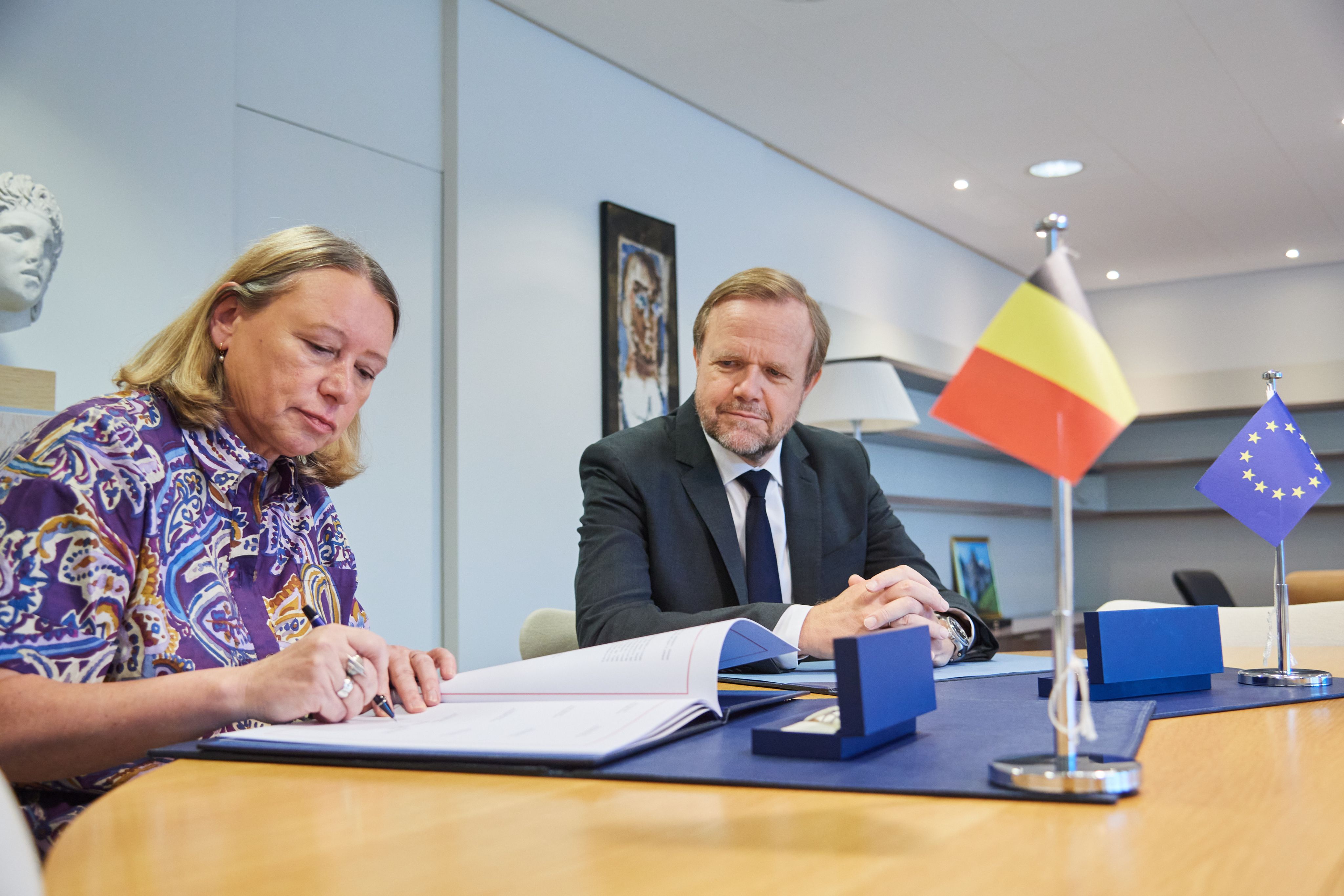
Council of Europe and the European Union sign an
agreement to foster mutual co-operation against terrorism
Gunter Gloser, German Minister of State for Europe and Benita
Ferrero-Waldner, the Commissioner for External Relations, on behalf
of the European Union and Council of Europe Secretary General Terry
Davis, signed a Memorandum of Understanding on May 23 in Strasbourg.
The agreement creates an institutional framework to reinforce
partnership in areas of common interest including the fight against
terrorism. (more…)
The Council of Europe organised a series of Anti-Terrorism and Human Rights Training Seminars for Turkish law-enforcement authorities, in Ankara between March and November 2007. The seminars were addressed to governors, officials and police officers. They dealt with ECHR standards with a special focus on the different mechanisms for supervising law enforcement bodies, the fight against terrorism and the exercise of fundamental freedoms. (more).
European Prosecutors discuss terrorism
The Council of Europe organised a European Conference of Prosecutors
in Warsaw on 4 and 5 June 2007 on the subject of "International
Co-Operation in the Criminal Justice Field". Prosecutors from the
Council of Europe's 47 member states discussed ways of intensifying
co-operation between prosecution services in the criminal justice
field, to target more effectively serious crime, including
terrorism.
Press release
Advancing the United Nations Global
Counter-Terrorism Strategy
The United Nations Office on Drugs and Crime (UNODC) has published
the
proceedings of the Symposium on “Advancing the United Nations
Global Counter-Terrorism Strategy”, which took place in Vienna on 17
and 18 May 2007. The Council of Europe, an active supporter of the
Strategy, took part in the Symposium to contribute its experience
and legal expertise.
Council of Europe and OSCE encourage all levels
of society to prevent terrorism
The Council of Europe contributed its vision and experience as a
pan-European organisation in the Political Public-Private
Partnership Conference on “Partnership of State Authorities, Civil
Society and the Business Community in Combating Terrorism” organised
by the Organisation for Security and Co-operation in Europe (OSCE)
in Vienna on 31 May–1 June 2007.
Contribution of the Council of Europe
Russian Federation: Council of Europe organised a
Counter-Terrorism Workshop for public prosecutors in Moscow, 1-2
March 2007.
Co-organised by the Council of Europe and the General Prosecutor’s
Office of the Russian Federation, the workshop focused on
international co-operation against terrorism in the light of the
legal framework for the prevention and suppression of terrorism.
The Annual High-level meeting between the Council of Europe, the
OSCE and the UN to discuss the implementation of the UN Global
Counter-Terrorism Strategy took place in Vienna on 13-14
February 2007
Joint Communiqué
Council of Europe and Interpol step up
co-operation
On 17 January 2007, the Council of Europe adopted Recommendation Rec
(2007) 1 to member states regarding co-operation against terrorism
between the Council of Europe and its member states, and the
International Criminal Police Organization (ICPO - Interpol).
Explanatory memorandum
OSCE supports Council of Europe Convention on the
Prevention of Terrorism
On 5 December 2006, OSCE Ministerial Council adopted a Decision
calling on participating States to consider becoming party to and to
implement their obligations under the existing international and
regional legal instruments, including the Council of Europe’s
Conventions on Cybercrime (2001) and on the Prevention of Terrorism
(2005).
Council of Europe joins international
organisations to discuss protection of human rights in the fight
against terrorism
The Council of Europe participated in the Technical workshop on
Human Rights and International Cooperation in Counter-Terrorism
which the OSCE Office for Democratic Institutions and Human Rights (ODIHR)
and the United Nations Office of the High Commissioner for Human
Rights organised together with the Government of Liechtenstein in
Vaduz, 15 - 17 November 2006.
Agenda
Council of Europe teams up with UN and OSCE
against terrorism
The Council of Europe participated in the Second Sub-regional Expert
Workshop on International Co-operation on Counter-Terrorism,
Corruption and the Fight against Transnational Organised Crime which
the United Nations Office on Drugs and Crime (UNODC) and the
Organisation for Security and Co-operation in Europe (OSCE)
organised, in co-operation with the Stability Pact for South-Eastern
Europe, in Bucharest, 13-15 November 2006.
Agenda
Council of Europe and UN co-operate on the fight
against terrorism in Bosnia and Herzegovina
The Council of Europe and UNODC organised a meeting on Technical
assistance on Legislative Implementation and International
Cooperation in combating terrorism together with the Government of
Bosnia and Herzegovina in Sarajevo on 1 November 2006. It resulted
in the adoption of a Plan of Action for Bosnia and Herzegovina.
Agenda -
Plan of Action
Joint OSCE-Council of Europe Expert Workshop on
Preventing Terrorism
The Organization for Security and Co-operation in Europe (OSCE)
organised a joint Expert Workshop on Preventing Terrorism: Fighting
Incitement and Related Terrorist Activities in Vienna (Austria) on
19 and 20 October 2006.
Agenda - Summary