


Bienvenue sur le site web du GRECO

Depuis l’Antiquité, la corruption est l’un des maux de société les plus répandus et les plus insidieux. Lorsqu’elle implique des agents publics et des représentants élus, elle nuit à l’administration des affaires publiques. Depuis la fin du XIXe siècle, elle est également perçue comme une menace majeure pour le secteur privé, car elle sape la confiance nécessaire au maintien et au développement des relations sociales et économiques. Selon les estimations, le montant des transactions liées à la corruption serait de l’ordre de centaines de milliards d’euros chaque année. (suite...)
Le mot du Président du GRECO
B ienvenue devant cette fenêtre sur le monde du GRECO!
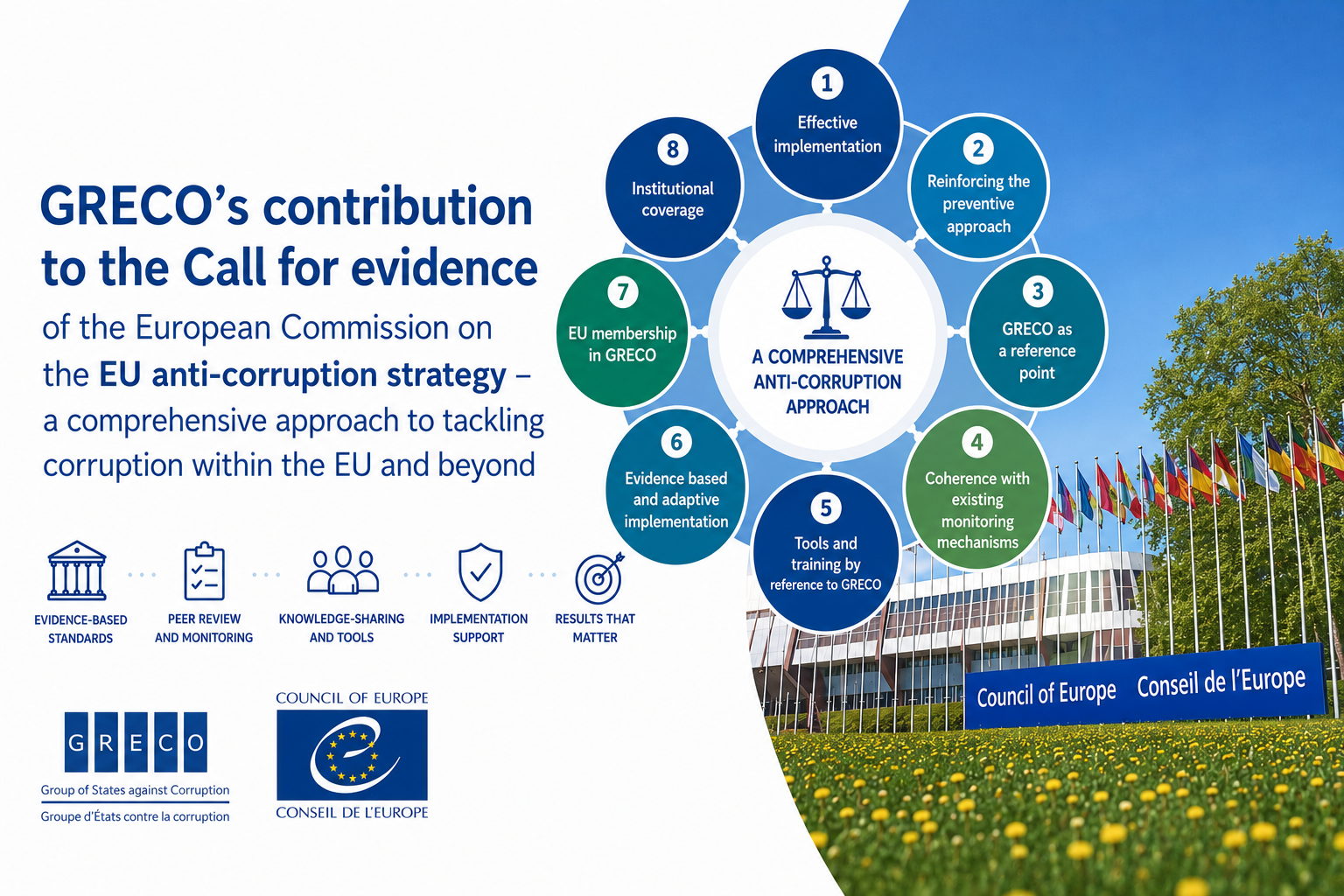
Je vous invite à l’utiliser pour y découvrir le travail que nous faisons avec nos 48 Etats membres. Nous employons une dynamique d’expertise collective et de pression par les pairs pour obtenir de chaque gouvernement qu’il dresse des barrières durables contre la corruption et traduise en justice ceux qui exploitent leur position à des fins d’intérêt personnel au détriment de la société dans son ensemble.
Que l’on soit inspiré par les travaux du GRECO, par ceux d’autres acteurs de l’anti-corruption ou par nos propres expériences et principes, chacun de nous a un rôle à jouer pour changer les mentalités en faveur d’une tolérance zéro pour la corruption.
Membres du Bureau du GRECO
Le Bureau du GRECO est composé de : Olivier GONIN (Suisse), Panagiota VATIKALOU (Grèce), Vice-président António DELICADO (Portugal), Président David MEYER (Royaume-Uni), Lise CHIPAULT (France), Sorin TĂNASE (Roumanie) et Alexia KALISPERA (Chypre).

Instruments juridiques adoptés par le Conseil de l'Europe
- Convention pénale sur la corruption (STE 173)
- Convention civile sur la corruption (STE 174)
- Protocole additionnel à la Convention pénale sur la corruption (STE 191)
- Vingt principes directeurs pour la lutte contre la corruption (Résolution (97) 24)
- Recommandation sur les codes de conduite pour les agents publics (Recommandation n° R (2000) 10)
- Recommandation sur les règles communes contre la corruption dans le financement des partis politiques et des campagnes électorales (Recommandation Rec(2003)4)
 ATTENTION AUX ESCROQUERIES
Il a été porté à notre attention que le nom du GRECO est utilisé à des fins frauduleuses. Ces escroqueries peuvent sembler utiliser du papier à en-tête portant le logo du GRECO, ou contenir les signatures de hauts fonctionnaires du GRECO, réels ou fictifs, dans le but de donner l'apparence d'une correspondance légitime du GRECO. Elles peuvent parfois inclure des adresses de sites web légitimes pour donner un vernis de crédibilité à l'escroquerie.
En règle générale, les sollicitations demandent aux victimes potentielles de fournir des informations personnelles telles que des signatures ou des informations bancaires, et de payer certains frais anticipés, souvent décrits comme des "frais de traitement". En retour, la victime potentielle se voyait promettre des sommes d'argent que la personne sollicitant les "frais" n'avait aucunement l'intention de payer. Dans certains cas, les personnes sollicitant les fonds utilisaient les noms de véritables membres du personnel du GRECO pour signer les lettres afin de renforcer leur crédibilité.
Le GRECO, l'organe anti-corruption du Conseil de l'Europe, surveille la manière dont ses pays membres mettent en œuvre les conventions et autres instruments du Conseil de l'Europe au niveau national.Le GRECO ne contacte pas directement les membres du public par courriel, téléphone, Whatsapp ou tout autre moyen au sujet de transactions financières spécifiques ou d'informations personnelles.
Nous conseillons au public de se méfier de ces sollicitations et d'autres sollicitations similaires qui prétendent faussement être affiliées au GRECO. Si vous avez reçu une telle communication, nous vous conseillons de mettre immédiatement fin à ce contact. Si vous avez déjà versé de l'argent, veuillez contacter sans délai les autorités policières locales.


 RESTEZ INFORMÉS


Ressources web
 Autorités anti-corruption nationales
Organisations européennes et internationales
Organisations non-gouvernementales
Instituts et centres de recherche
Plateforme contre la corruption (APCE)
Les élections : le rôle du Conseil de l'Europe
Agir contre la criminalité économique (Conseil de l'Europe)
Agenda (Conseil de l'Europe)
 Suivre


