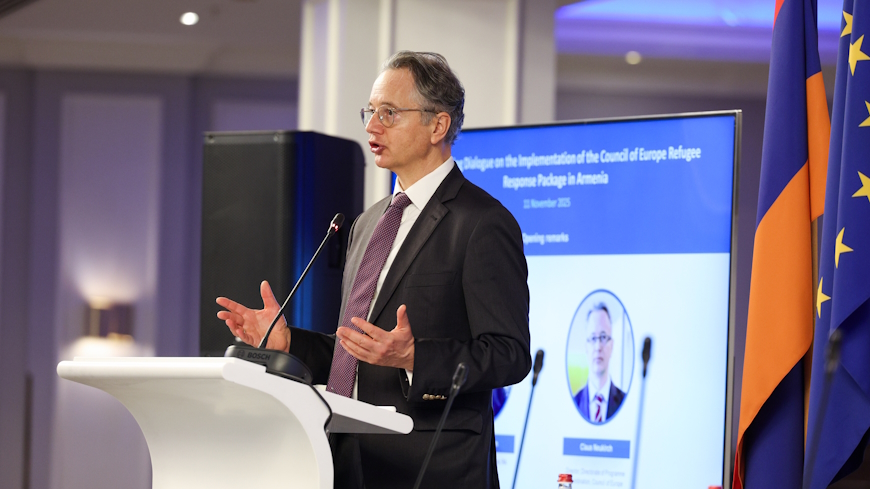
Today the Council of Europe presented, jointly with the Ministry of Foreign Affairs of the Republic of Armenia, the key achievements of the Council of Europe Comprehensive Response Package to the Refugee Influx in Armenia.
The Response Package with a total budget of €2.8 million was launched in 2023 in the framework of the Council Europe Action Plan for Armenia 2023-2026 to support Armenia in addressing the urgent needs arising from the large influx of refugees. The Council of Europe supported hosting communities in integrating refugees, enhanced the institutional capacity of the Migration and Citizenship Service to provide improved services, reinforced national human rights institutions, empowered refugee women, trained more than 200 refugee healthcare professionals, and strengthened the capacity of over 200 civil servants and professionals working directly with children affected by migration and conflict.
“This is a demand-driven package which has become a cornerstone of the timely response of the Council of Europe to enormous pressure on authorities and social services after the huge refugee influx. This collaboration ensures aligning with the local authorities in addressing all immediate and mid-term needs and supporting Armenia in preparing the long-term integration of refugees into the society”, underscored Samvel Mkrtchyan, Head of the European Department of the Ministry of Foreign Affairs of Armenia.
“The Council of Europe joined the international efforts in 2023 to support Armenia in addressing the refugee crisis to safe-guard the human rights of these refugees, in particular the vulnerable groups. Today’s event is meant to guide us in developing the next steps we need to take to this end,” stated Claus Neukirch, Director of Programme Co-ordination of the Council of Europe.
“The Council of Europe response package included a number of urgently needed and very practical steps to assist the Armenian authorities and the refugee population in understanding and accessing their rights,” added Clare Ovey, Director of Human Rights, DGI of the Council of Europe. Underlining that the goal of Council of Europe co-operation activities, is always to leave behind strengthened institutions — ones that can independently safeguard the rights of refugees and displaced persons in line with the European Convention on Human Rights she explained what is needed now: “The next steps will be focused on further integrating the refugee population including the most vulnerable people and also assisting the authorities for preparing the EU visa liberalisation process.”
“Congress support to local authorities has built the preparedness of local authorities to respond to future challenges and helped transform refugees from beneficiaries of assistance to actors of local economic development. Effective decentralisation and good democratic governance will enable communities to better respond to diverse challenges they face in the future”, emphasised Claudia Luciani, Director of Congress of Local and Regional Authorities of the Council of Europe.
“Supporting women’s empowerment and the protection of children is at the heart of building stronger, more resilient communities. Through our initiatives within the Refugee Response Package, we have worked, for example, to promote the social and economic inclusion of refugee women - hand in hand with local women - with great results for local communities”, highlighted Caterina Bolognese, Head of the Gender Equality Division of the Council of Europe.
Deputy Minister of Internal Affairs, Armen Ghazaryan, Deputy Minister of Labour and Social Affairs, Anna Zhamakochyan, Secretary General of the Human Rights Defender’s Office Adranik Yeghoyan, the Director of Human Rights of the Council of Europe Clare Ovey, the Director of Congress of Local and Regional Authorities of the Council of Europe Claudia Luciani, and the Head of Gender Equality Division of the Council of Europe Caterina Bolognese presented the main results, lessons learned and plans for the way forward at the high-level opening panel.
The package of measures and specific areas for support were jointly identified with the national authorities in autumn 2023. The package is part of the Council of Europe’s Action Plan for Armenia (2023-2026) and the Action Plan on Protecting Vulnerable Persons within the context of migration and asylum (2021-25).
 Council of Europe’s comprehensive response package to the refugee influx in Armenia
Council of Europe Action Plan for Armenia 2023-2026
 Web page on the co-operation between the Council of Europe and Armenia