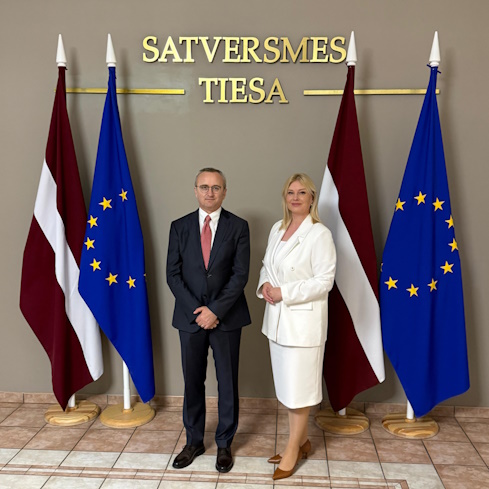
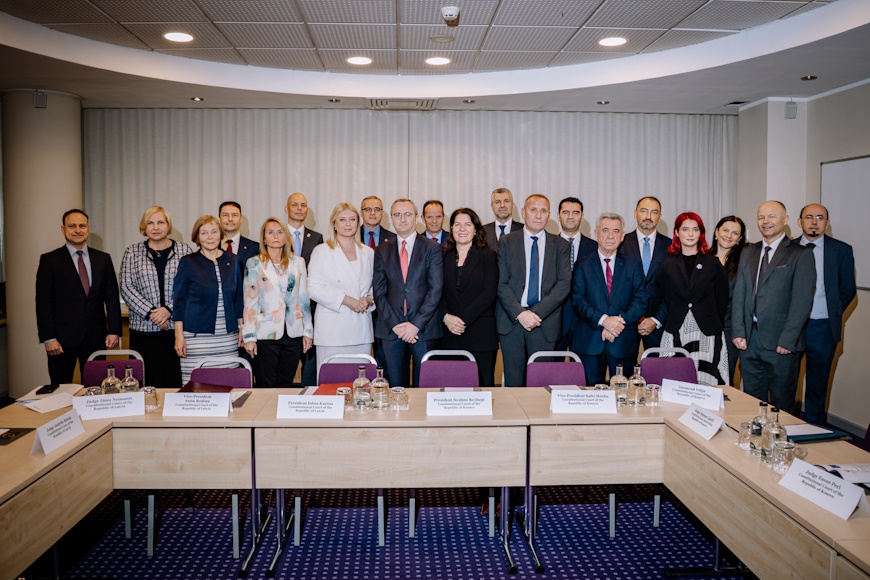
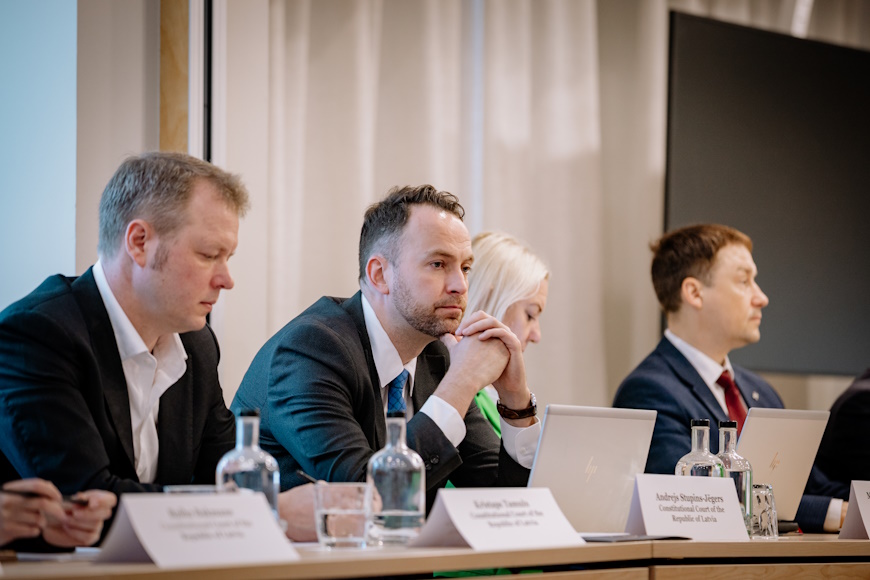
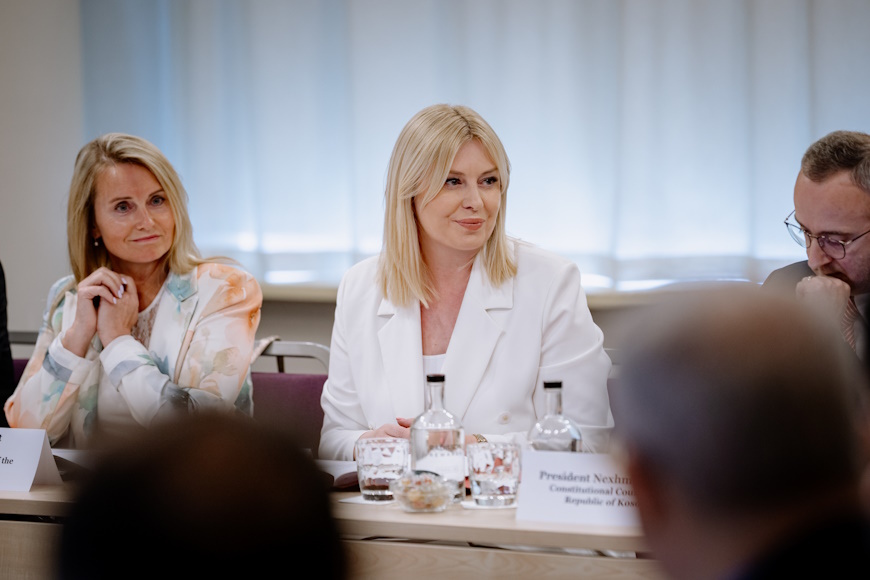
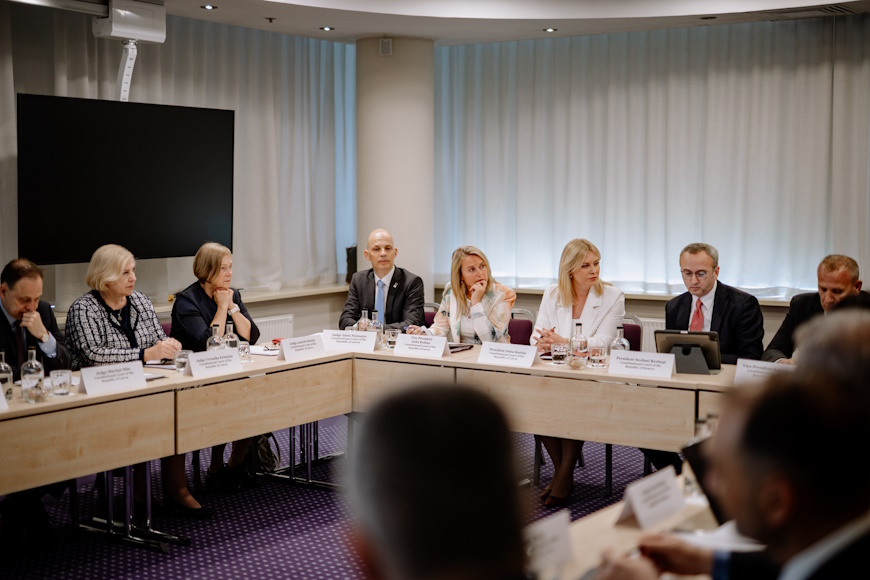
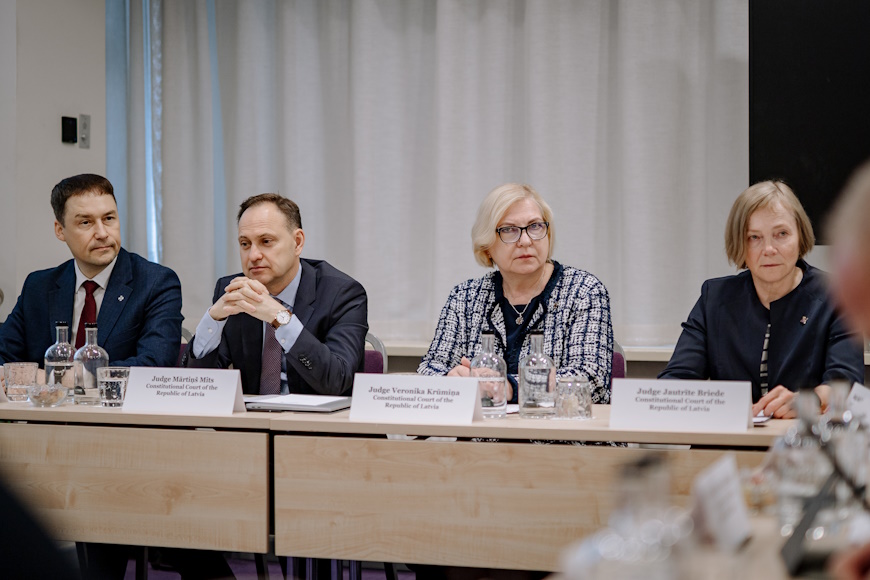
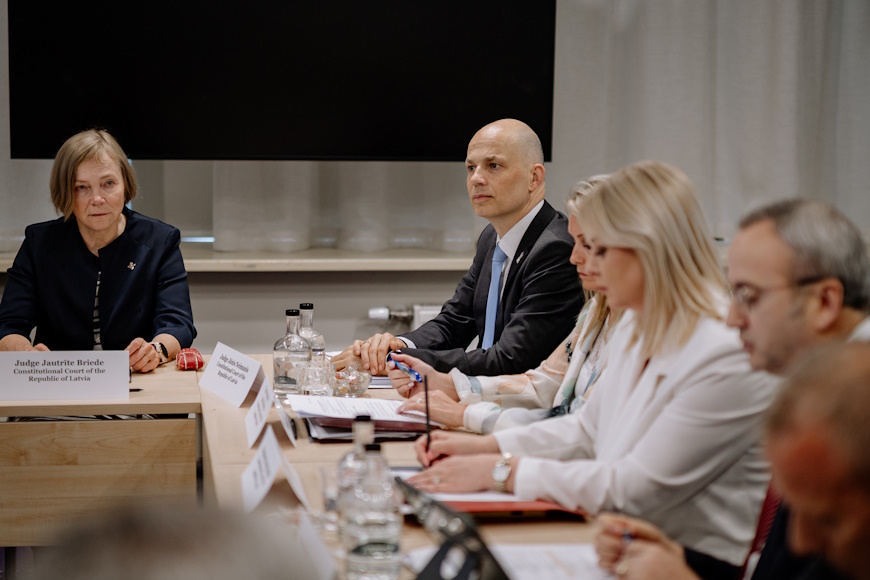
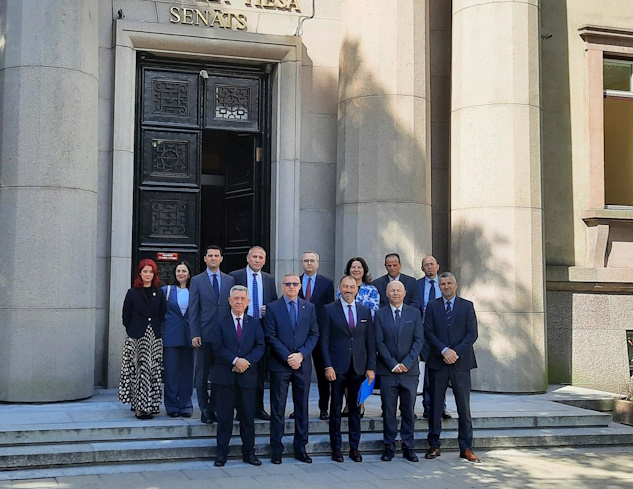
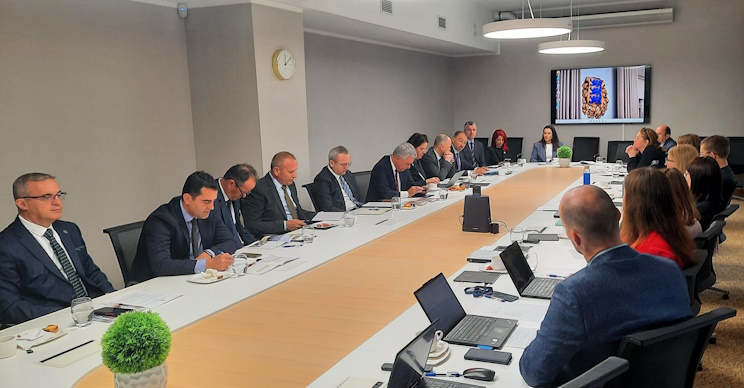
The project organised a study visit for judges and legal advisers of the Constitutional Court of Kosovo* to Latvia and Estonia, enabling fruitful exchanges with their counterparts from the superior courts of both countries. The visit fostered peer-to-peer learning and professional dialogue on issues of common interest drawn from their respective judicial practices.
During bilateral meetings with the Constitutional Court of Latvia, participants discussed comparative approaches to constitutional review, including preventive, abstract and incidental review of legal acts, as well as the implementation and enforcement of constitutional court judgments.
Opening the discussions, the President of the Constitutional Court of Latvia, Irēna Kucina, emphasised that the two courts share a common European constitutional space and a common responsibility to safeguard constitutional values, democracy, human rights and the rule of law. She acknowledged the contribution of the Constitutional Court of Kosovo* to constitutional dialogue in Europe.
The President of the Constitutional Court of Kosovo*, Nexhmi Rexhepi, congratulated the Constitutional Court of Latvia on the occasion of its 30th anniversary and highlighted the longstanding value-based partnership between the two institutions. He stressed the important role of constitutional courts in times of increasing political polarisation and fragmentation of public discourse.
The exchanges focused on the methodologies applied by both courts in constitutional adjudication, including the application of the proportionality test, the assessment of legitimate aims and the fulfilment of positive obligations by the State in the protection of human rights. Participants also discussed landmark judgments from their respective jurisprudence.
Representatives of the Constitutional Court of Latvia presented, inter alia, the court's practice concerning the review of the constitutionality of international agreements prior to ratification, including the European Convention on Preventing and Combating Violence against Women and Domestic Violence (Istanbul Convention), as well as the role of non-governmental organisations in initiating proceedings related to environmental protection and public interest.
On behalf of the Constitutional Court of Kosovo*, Judge Remzije Istrefi highlighted the direct applicability of core international and European human rights instruments and the case law of the European Court of Human Rights under Articles 22 and 53 of the Constitution of Kosovo*. She also presented several landmark cases concerning the constitutional review of legislation, including cases related to asset confiscation and salaries in the public sector.
A dedicated session focused on the execution of constitutional court judgments. Participants exchanged experiences regarding institutional mechanisms, challenges and good practices in monitoring and ensuring the implementation of judicial decisions. Comparative approaches adopted in Latvia and Kosovo* were discussed, including internal follow-up mechanisms, dialogue with other state institutions and the legal consequences of non-execution of court judgments.
The delegation also visited the Supreme Court of Estonia, where participants were introduced to the Estonian judicial system and the constitutional review jurisdiction exercised by the Supreme Court. Discussions covered the scope of constitutional review, review procedures, landmark case law and the interaction between constitutional law and European Union law.
The Estonian counterparts presented the mechanisms of abstract and concrete constitutional review, the role of ordinary courts and the Chancellor of Justice (Ombudsperson) in constitutional proceedings, as well as the Supreme Court's competence to provide opinions on the interpretation of the Constitution in conjunction with European Union law.
Throughout the visit, participants exchanged experiences with their peers on judicial dialogue with other national courts, relations with the legislative and executive branches, digitalisation of case processing and case management, the use of artificial intelligence tools to support judicial work and legal research, and public communication and outreach initiatives.
As a follow-up to the visit, the participating courts agreed to continue exchanging case law and professional expertise and to further strengthen institutional cooperation. Representatives of the Latvian and Estonian courts are expected to participate in the forthcoming "Judicial Year" event to be organised by the Constitutional Court of Kosovo* in Pristina in October.