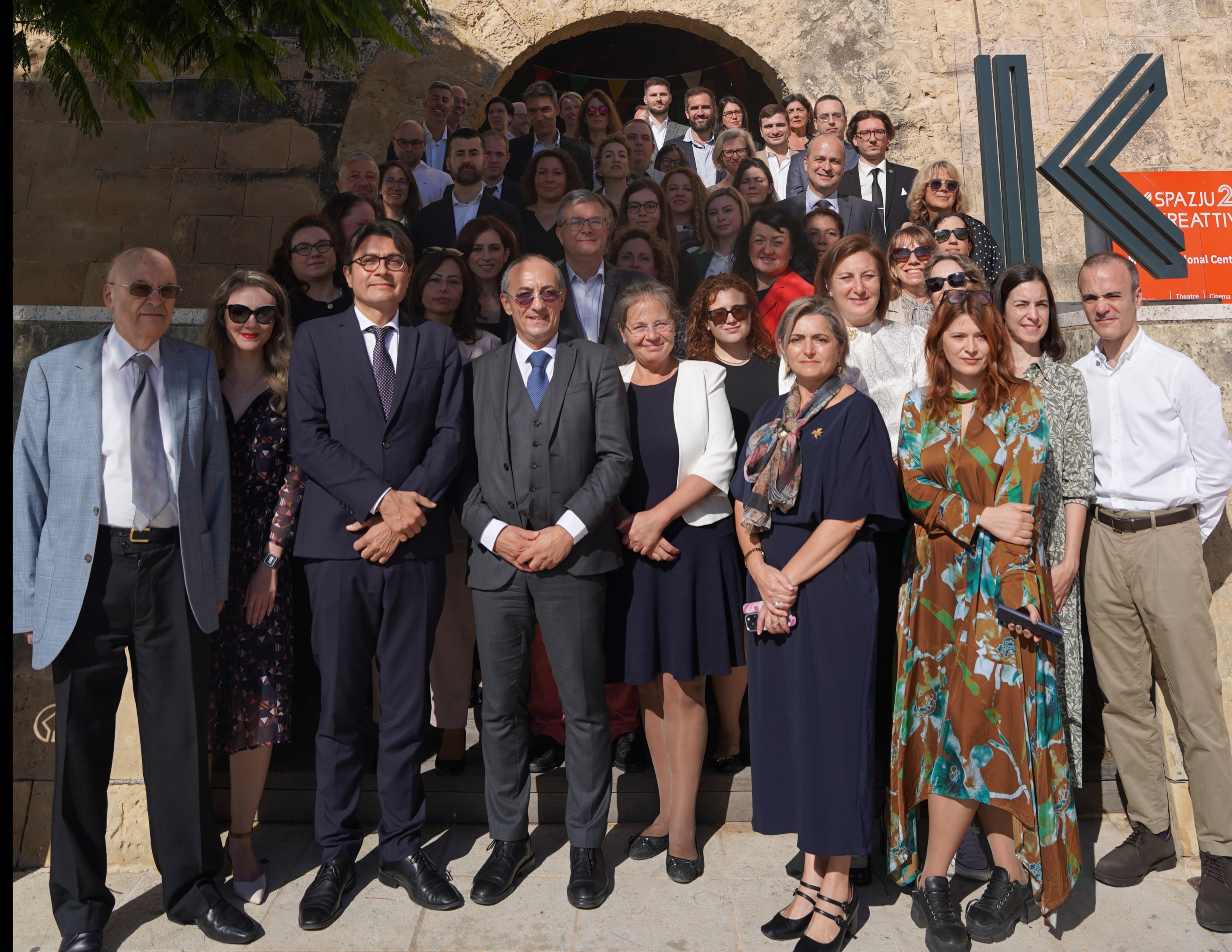
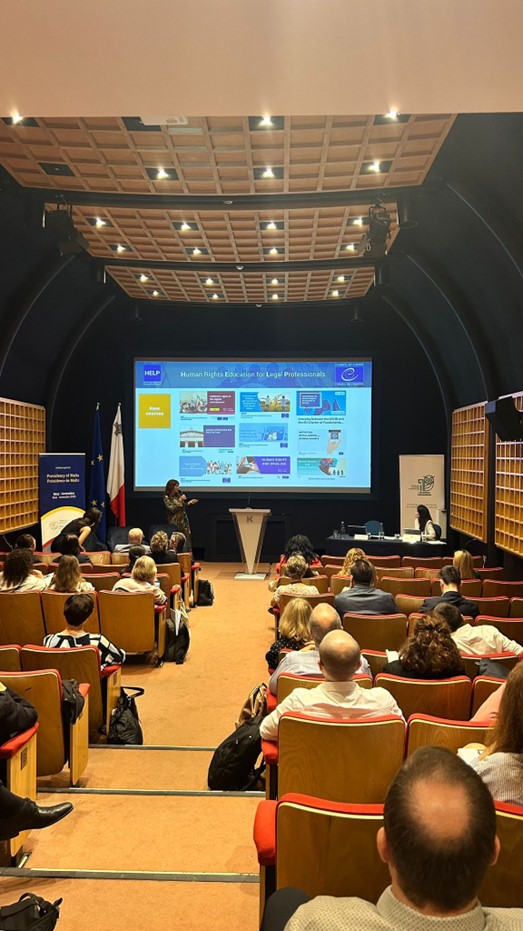
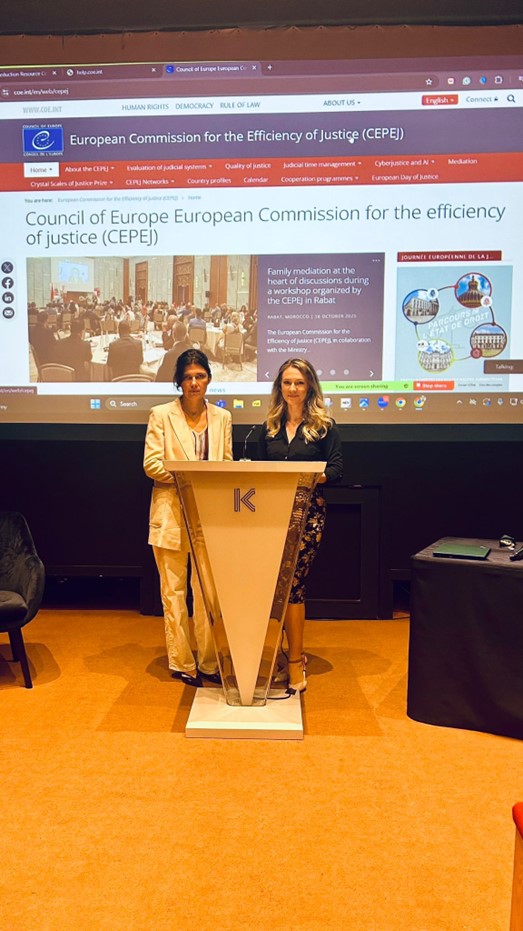
On 22-23 October 2025, over 50 judges and prosecutors from 18 EU states gathered in Valletta, Malta, for a 1.5 day thematic seminar and the launch of the Council of Europe HELP course on Quality of Justice – the Work of the CEPEJ. The event was jointly organised by the Council of Europe and the Judicial Studies Committee of Malta.
This initiative is part of the EU-CoE HELP in the EU IV Project, which seeks to build the digital capacity of legal practitioners and nurture cross-border cooperation through training and networking. The seminar’s dynamic programme included keynote speeches, expert presentations, interactive discussions, and practical demonstrations of the HELP e-learning platform. Participants gained valuable insights, shared experiences, and explored innovative CEPEJ tools to enhance judicial efficiency and quality; this prepared them for active engagement with the online HELP course.
Opening and Keynote Addresses
The seminar opened with a welcome address by Francesco Depasquale, President of the CEPEJ, who underlined the Commission’s ongoing commitment to improving the efficiency and quality of justice across Europe. He also emphasised the importance of training among the judiciary.
This was followed by a keynote from Mattias Guyomar, President of the European Court of Human Rights, stressing the central role of judicial standards and human rights protection within European justice systems. He also talked about the priorities of his Presidency, namely efficiency, visibility and responsibility, while describing the challenges in achieving such goals. Muriel Décot, Secretary of the CEPEJ, provided an overview of the Commission's initiatives, main tools, and recent reforms designed to advance judicial efficiency.
These interventions set the stage for the following sessions, giving participants a practical understanding of how CEPEJ’s guidelines are applied to judicial practice.
Dives into the Quality of Justice
The session on measuring the quality of justice, led by Jasa Vrabec and Christel Schurrer (President and Secretary of CEPEJ-GT-EVAL), addressed how judicial systems are evaluated and how data-driven approaches can drive improvements. Focusing on practical dimensions, they discussed approaches to measuring the quality of justice, outlining CEPEJ’s evaluation standards and best-practice indicators for modern courts. Among others, they touched upon the attractiveness of the judicial profession and the challenges of using digital tools in the justice system. Later, Joao Arsenio de Oliveira (President of CEPEJ-GT-QUAL) discussed the perspective of justice system users, emphasizing the importance of user experience and communication for court effectiveness. He looked of several relevant CEPEJ tools and their role in supporting the work of the judiciary.
Technological Transformation in Justice
Bojan Murec and Daniel Schmidt (member and Secretary of CEPEJ-GT-CYBERJUST) led a workshop on digitalisation and the use of artificial intelligence in European courts. Their presentations explored current trends and ethical considerations for deploying new technologies within judicial systems.
Judicial Time Management
On the second day, Pawel Wrzaszcz and Eva Konecna (member and Secretary of CEPEJ-GT-SATURN) focused on time management and backlog reduction in courts, sharing practical examples and strategies for improving efficiency in the handling of judicial cases.
Interactive Elements and Course Implementation
The programme was interspersed with exchanges and practical demonstrations of the HELP course interface. The presentation of the HELP Programme and the EU-CoE HELP IV Project was led by Oana Girlescu (Project Manager). Anca Radu and Anna Skrjabina (HELP tutors), showcased the course’s methodology, detailed its learning objectives, and encouraged participants to make full use of online educational resources for professional development.
Over the coming months, participants will follow the online HELP course on Quality of Justice: the Work of the CEPEJ under the guidance of their HELP tutors. This will provide them with opportunities to deepen their understanding and reflect on the application of CEPEJ tools in their professional environments, exchange practices, and share experiences.
By investing in these high-level trainings, the Council of Europe and the European Union demonstrate their unwavering support for a judicial culture rooted in professionalism, integrity, and the shared pursuit of justice for all and human rights protection.
---------------------------------------------------
The HELP course on Quality of Justice – the Work of the CEPEJ
The HELP course on Quality of Justice – the Work of the CEPEJ was developed in 2023 and aims to present the CEPEJ’s main tools and working methods to both judicial practitioners and the public at large. Through practical exercises, it shows how the tools can be applied in judicial systems to strengthen their quality and efficiency. The online course has been developed with contributions from several CEPEJ members and is the result of cooperation between the CEPEJ and Human Rights Education for Legal Professionals (HELP) Secretariats of the Council of Europe.
The course is available in self-learning format, having a duration of 19 hours. It can be followed in English, but also in several other languages, such as Albanian, Bosnian and Romanian. Upon completion, users can generate their electronic Statements of Accomplishment, in proof of their acquired knowledge and skills.
HELP courses are intended, in the long term, to become an integral part of the overall learning curricula of the national training institutions and/or other competent authorities of the Council of Europe member states and beyond.