


Resilient Europe through deliberative democracy: cities and regions in action!
 26 November 2025
  Stasbourg, France (Palais de l'Europe, Room 1)

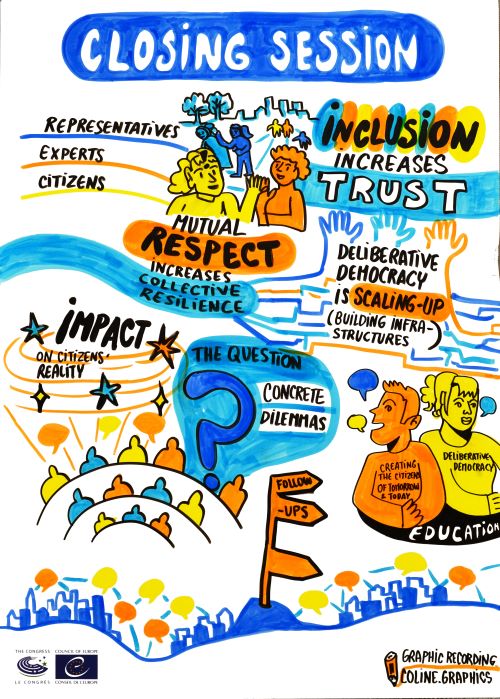
Citizens’ deliberations have gained prominence in European cities and regions, committed to address today’s multiple crises. When democracy is threatened, is deliberative democracy building trust in politics and public decision making? Looking forward, what are the developments in public deliberation, the potential benefits and the challenges ahead? How can the Council of Europe strengthen citizens’ deliberation for a more resilient Europe?
These questions were addressed during the European Conference “Resilient Europe through deliberative democracy: Cities and regions in action!”, organised by the Congress of Local and Regional Authorities, on 26 November 2025 in Strasbourg.
The event gathered participants from local and central authorities, academia, civil society organisations and practitioners to explore current challenges in deliberative processes at local level and share ideas with the Council of Europe for innovating democracy at local level.
The event contributed to the New Democratic Pact for Europe. The Pact will serve as a collective and inclusive process – not to reinvent democracy, but to reinforce its foundations, amplify its benefits, and innovate its form to make it tangible for everyone, especially younger generations. The directions set during the consultation phase running through 2026 will shape the work that follows.
Through the Reykjavík Principles for Democracy, the Council of Europe member states committed to actively enable and encourage democratic participation at national, regional and local levels through free and fair election and other form of participatory democracy, including deliberative democracy.
In 2023, the Council of Europe adopted the first international standards on deliberative democracy. Recommendation CM/Rec(2023)6 of the Committee of Ministers to member States on Deliberative Democracy sets out the following principles for deliberative processes.


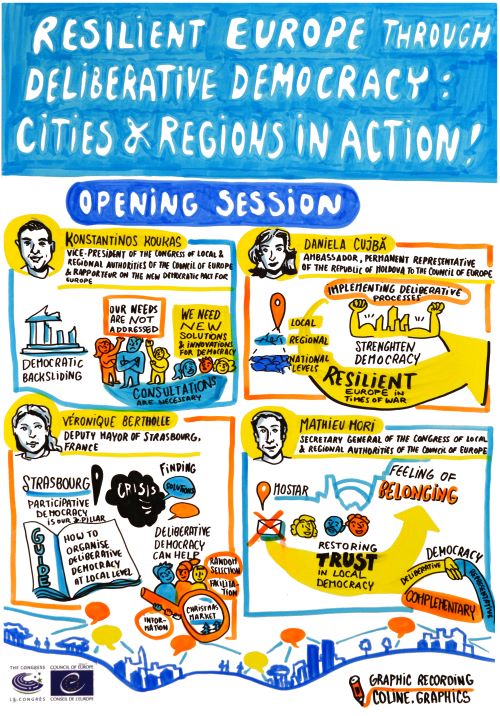
Mathieu Mori, Secretary General of the Congress of Local and Regional Authorities of the Council of Europe.

Daniela Cujbă, Ambassador, Permanent Representative of the Republic of Moldova to the Council of Europe.

Véronique Bertholle, Deputy Mayor of Strasbourg, France

Konstantinos Koukas, Vice-President of the Congress of Local and Regional of Local Authorities of the Council of Europe and rapporteur on the New Democratic Pact for Europe

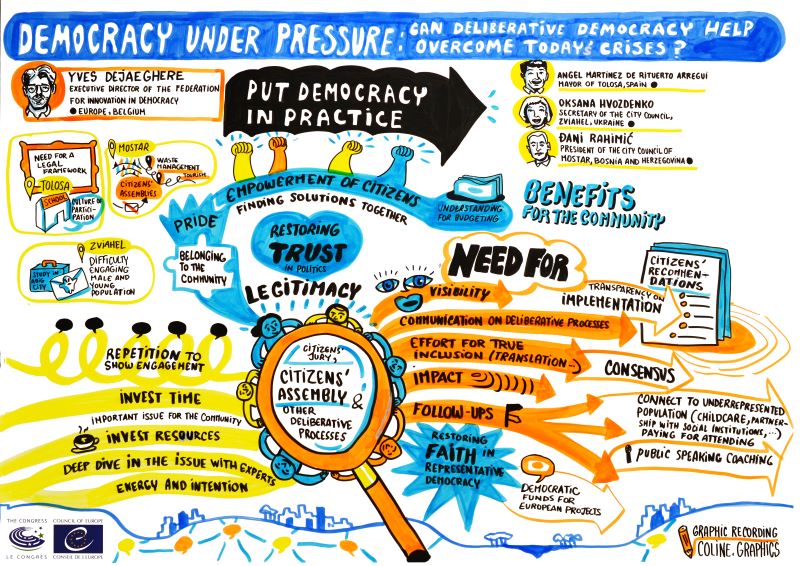
Yves Dejaeghere, Executive Director of the Federation for Innovation in Democracy – Europe, Belgium

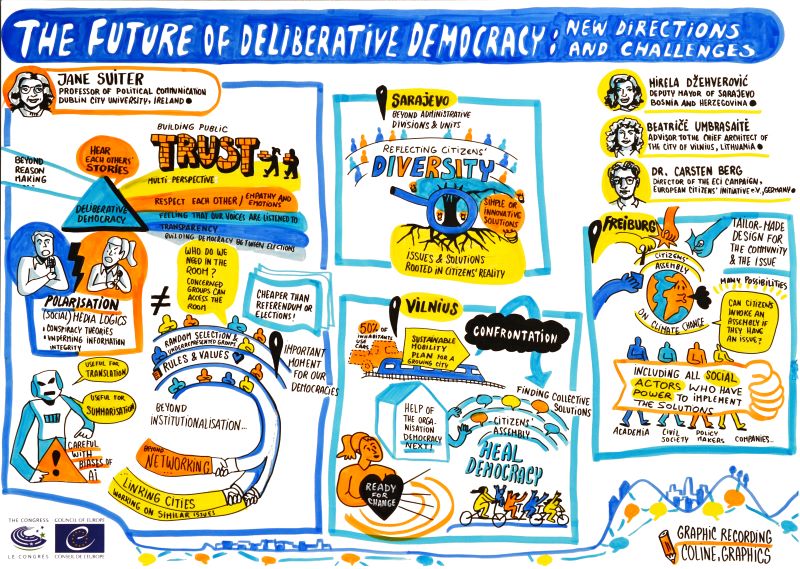
Jane Suiter, Professor of Political Communication, Dublin City University, Ireland

Jonathan Moskovic, European University Institute, Belgium

Claudia Luciani, Director of the Congress of Local and Regional Authorities of the Council of Europe

Damir Kapidžić, Rapporteur of the conference “Resilient Europe through deliberative democracy: cities and regions in action!”

Democracy under pressure: can deliberative democracy help overcome today’s crises?
Panelists:
- Angel Martinez de Rituerto Arregui, Mayor of Tolosa, Spain
- Oksana Hvozdenko, Secretary of the City Council, Zviahel, Ukraine
- Đani Rahimić, President of the City Council of Mostar, Bosnia and Herzegovina

The future of deliberative democracy: new directions and challenges
Panelists:
- Mirela Džehverović, Deputy Mayor of Sarajevo, Bosnia and Herzegovina
- Beatričė Umbrasaitė, Advisor to the Chief Architect of the city of Vilnius, Lithuania
- Dr. Carsten Berg, Director of the ECI Campaign, European Citizens’ Initiative e.V.,
Germany

Supporting democratic innovation at local level: the role of international organisations
Panelists:
- Matjaz Gruden, Director for Democracy, Directorate General of Democracy and
Human Dignity, Council of Europe
- Daniel Fleischer-Ambrus, Team Leader – Democracy, Anti-Corruption, Union
Citizenship and Free Movement, Directorate-General for Justice and Consumers,
European Commission
- Alexis Durand, Centre for Entrepreneurship, SMEs, Regions and Cities of the
Organisation for Economic Co-operation and Development (OECD)
Additional resources
- New Democratic Pact for Europe
- Roadmap Towards a New Democratic Pact for Europe - Building a resilient, inclusive and agile democracy
- Reykjavík Declaration - United around our values
- Recommendation CM/Rec(2023)6 on deliberative democracy
- Congress report “Beyond elections: The use of deliberative methods in European municipalities and regions”
- Guide “How to organise a deliberative process at local level?”
(box)

(popup)
Why a New Democratic Pact for Europe?
Democratic backsliding, disinformation, impunity, and authoritarianism are undermining democracy in Europe. People are increasingly afraid and frustrated. It comes at a time when democratic security – the resilience of our democratic institutions, freedoms, and values – is our first line of defence against the threats we face. A collective response is needed. There is no quick fix and no single solution. With the New Democratic Pact, the Council of Europe unites with its partners to boost solutions that work and create new responses. To identify them, consultations are needed. The Pact will serve as a collective and inclusive process – not to reinvent democracy, but to reinforce its foundations, amplify its benefits, and innovate its form to make it tangible for everyone, especially younger generations. The directions set during the consultation phase running through 2026 will shape the work that follows.