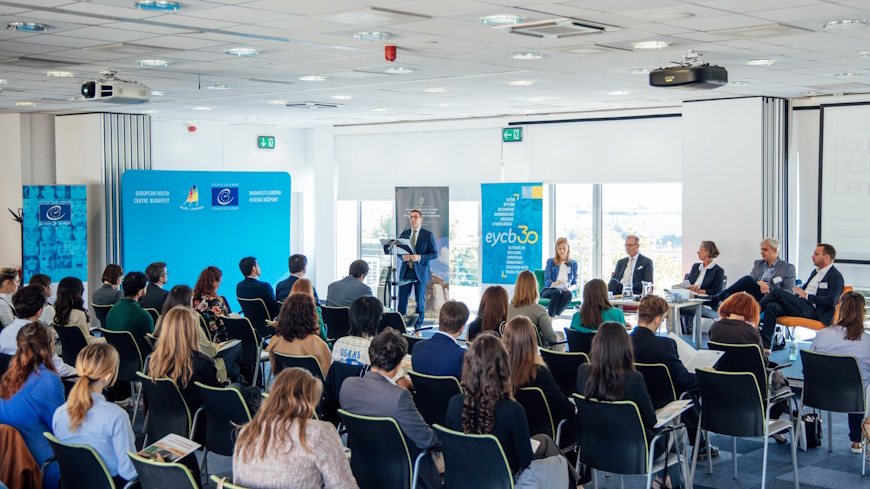
Can citizens’ assemblies help rebuild trust, empower young people, and push back against polarization?
Speakers at the European Youth Centre Budapest (EYCB) were unanimous: they can — if done well.
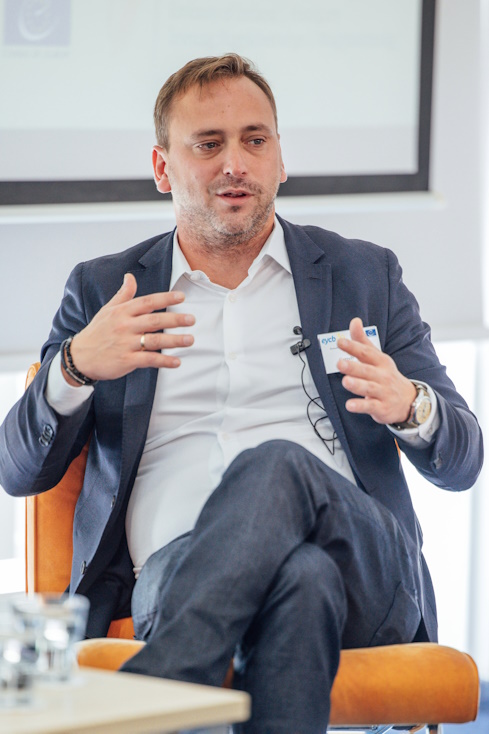
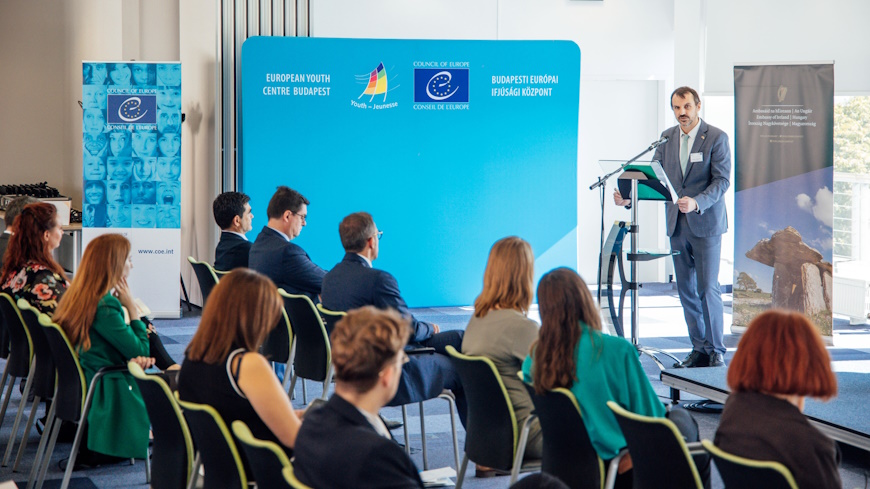
 Opening the event, Bálint Molnár, Executive Director of the EYCB, warned of the challenges ahead: “Across the continent, democracy is facing profound challenges. Levels of trust in institutions are falling, political participation is uneven, polarization is rising, and many young people feel their voices simply do not matter.” He underlined that deliberative processes, when well designed, “bring in otherwise overlooked voices, encourage learning and dialogue, and can transform mistrust into mutual understanding.”
Ireland’s Ambassador to Hungary Ragnar Almqvist struck a personal and literary note, recalling the humanism of Leopold Bloom in James Joyce’s Ulysses: “Force, hatred, history, all that. That’s not life for men and women. Love is the opposite of hatred. And that is the essence of democracy.” He warned against complacency: “Democracy is our world’s most precious metal. But without a free press, without civil society, without independent courts it corrodes — and eventually collapses.” Looking ahead, he argued: “In this age of algorithms and anonymous posts, we hear much of virtual town squares. But digital discourse is so often polarizing. The citizens’ assemblies Ireland has pioneered are the opposite: they draw the heat from sensitive issues and convert it into light.”
Cornelia Perle, an independent expert on deliberative democracy and the event’s moderator, framed the discussion by stressing that “there is no single or easy answer to democratic decline. But one step is to learn from each other, to share experiences, and to test innovative approaches such as citizens’ assemblies that bring people back into the heart of decision-making.” She also emphasised the importance of meaningful youth participation: “Too often, youth engagement is symbolic. Deliberative processes can change that by giving young people a seat at the table, where their voices carry the same weight as everyone else’s.”
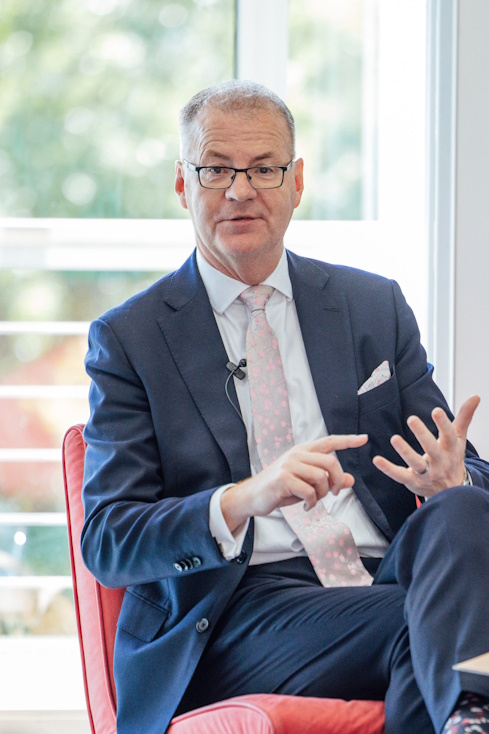
From Ireland, Art O’Leary, Chief Executive of the Irish Electoral Commission, shared lessons from over a decade of citizens’ assemblies: “Every time Ireland faces a new challenge, we set up a new citizens’ assembly. That means participants arrive with fresh energy, without baggage, and with a real sense of responsibility.”
He recalled how assemblies dealt with some of the most sensitive issues in Irish society:
“We went on a journey for a year. We designed a body which brought randomly selected individuals together with politicians to have a look at some really, really contentious issues for Irish people. It led to some truly transformational changes. We introduced marriage equality into our constitution. We introduced abortion into our constitution. Holy Catholic Ireland had a conversation, and at the end of it we decided that women’s reproductive health and reproductive rights should be enshrined in our constitution. The Citizens’ Assembly became a forum where some of our most intractable political problems could be discussed in a respectful way.”
O’Leary stressed the ground rules that made this possible: “We had very, very few rules about our Citizens’ Assembly but the one inviolable rule is respect. We’ve got zero tolerance for conflict. We don’t allow it in the room. Everybody has to understand that they can walk in, express an opinion, and be respected for it.”
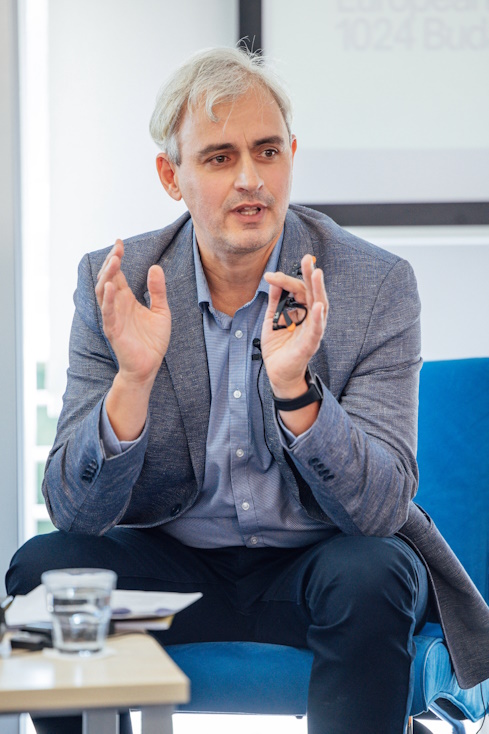
Hungarian mayors echoed these experiences at the local level. László Csőzik, Mayor of Érd, described his initial doubts about the concepts of deliberative democracy and citizens’ assemblies: “When I first heard about citizens’ assemblies, I was curious but also doubtful. Could ordinary residents really deliberate on complex issues and produce something useful? My initial reaction was scepticism — but I was proved wrong. What I saw instead was that people, when given the opportunity, are more than capable of listening, debating, and shaping real policy recommendations.”
Csőzik added how an assembly his city organised 3 years ago “gave residents a real sense of ownership. People came with doubts, but they left with pride in contributing to the future of our community.” On youth engagement, he noted: “When young people take part in these processes, they see that their views matter and that politics is not a closed shop. That can spark a lasting interest in public life and reduce the sense of distance between citizens and decision-makers.”
Gergely Őrsi, Mayor of Budapest’s 2nd District, presented a unique innovation: “In the 2nd District we have just launched the world’s first women-only citizens’ assembly. This is a bold step, designed to ensure that voices too often left out of decision-making are heard clearly and decisively.” Reflecting on youth engagement, he added: “Young people are often the most creative and fearless contributors in these settings. Our challenge as decision-makers is to ensure their ideas are taken seriously and carried forward.”
He also illustrated the very practical risks of excluding youth: “If young people are not around the table when decisions are made, you end up with ‘smart benches’ across the district that no young person actually wants to use. It’s a waste of resources and a missed opportunity.”
Looking to the future, he announced: “We are working to initiate a youth assembly in the 2nd District, but the hardest part is reaching those young people who are not already active or politically engaged. They are the ones whose perspectives are most needed — and the ones hardest to bring into the conversation.”
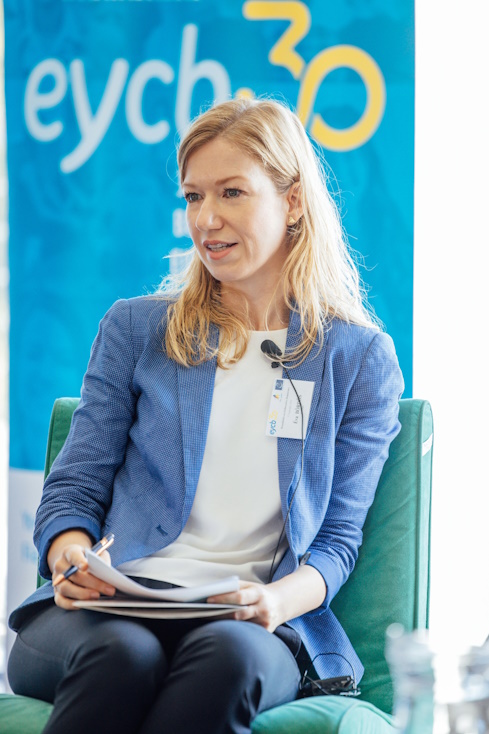
From a civil society perspective, Éva Bördős, Director of DemNet, underlined that “deliberative democracy is not only a local experiment; it is also an international necessity. In Ukraine and across Europe, citizens’ assemblies are proving their value even under difficult conditions.” She highlighted the youth dimension as well: “Young people are often told they are the future, but they are also the present. Deliberative processes give them real power here and now — to set priorities, to challenge assumptions, and to shape solutions.”
 The discussion also connected directly to the Council of Europe’s New Democratic Pact for Europe, which calls for a collective response to democratic backsliding, disinformation and authoritarianism. Speakers agreed that deliberative democracy and meaningful youth engagement are crucial ingredients in this strategy. As Molnár stressed, youth participation should “move from tokenism to true partnership, where young people are co-creators of democratic renewal, not just consulted after the fact.”
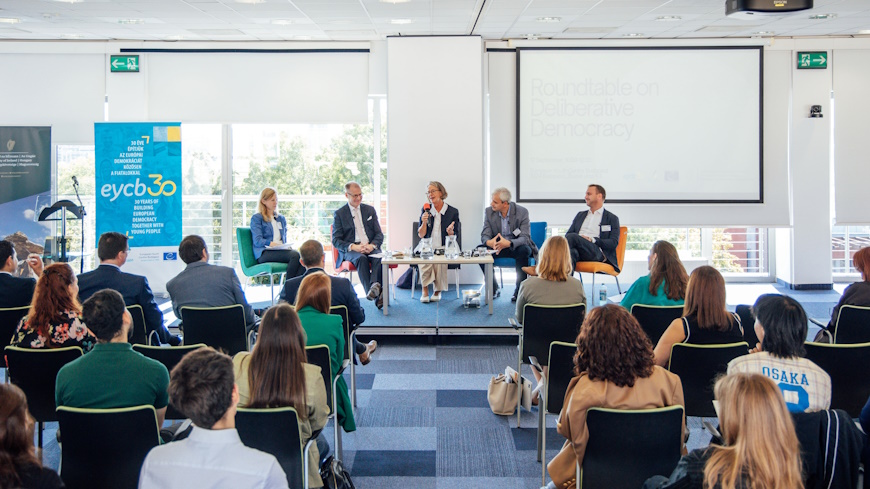
 The lively debate continued with questions from the audience and from those following online, touching on issues such as: “Why is meaningful — as opposed to tokenistic — youth participation essential for the future health of our democracies?”; “Can deliberative processes provide platforms for young people, and how can their outcomes feed into real decision-making?”; and “What risks and opportunities come with these processes compared to more traditional participation, such as elections, protests or online activism?”
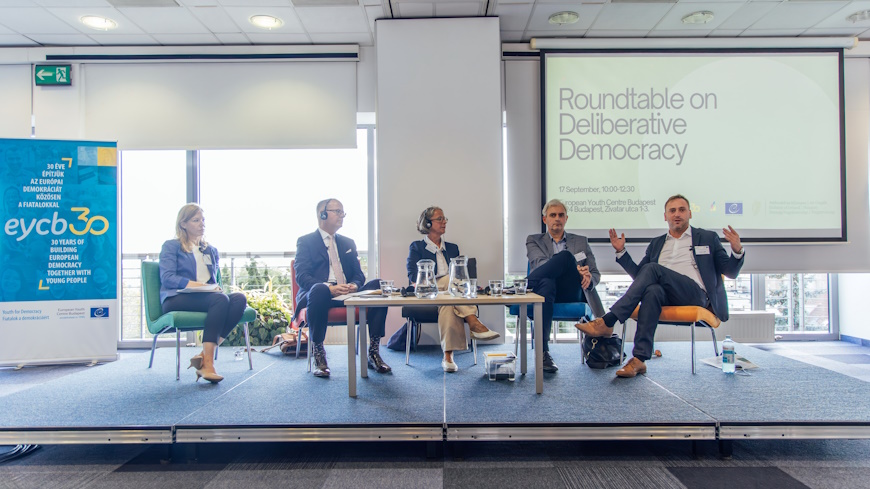
The roundtable, co-organised by the Council of Europe and the Embassy of Ireland in cooperation with DemNet, launched the series “Strengthening Democratic Resilience through Youth Engagement and Deliberative Democracy”. Over the next two years, the initiative will aim to explore how citizens’ assemblies and other deliberative processes can provide inspiration, guidance and tools to renew democracy across Europe — with young people as active co-creators of a stable and democratic future.
 For detailed info consult the dedicated webpage.