


How to use the Portfolio

On this page you can find ideas about how the Portfolio can be used in different ways as a support for the quality development of youth work. If you have further ideas or suggestions or ways in which you have used the Portfolio, please write to us, please write us via the contact form.
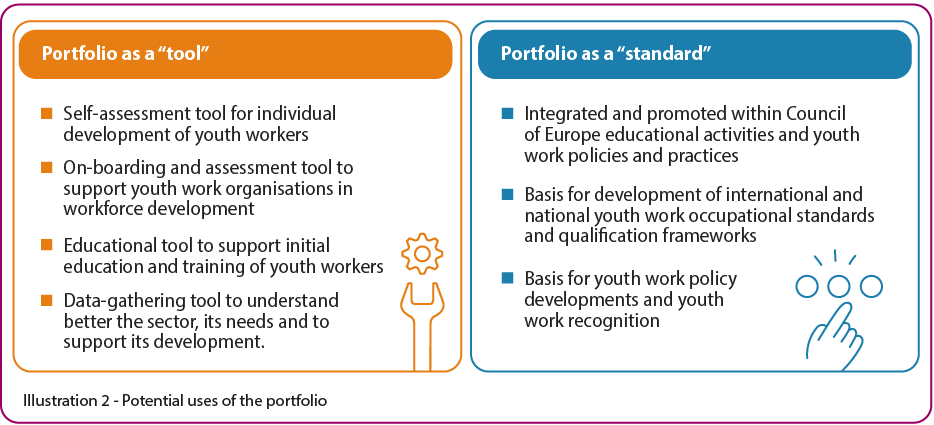
The Portfolio is seen as both a ‘tool’ for assessment and as a ‘standard’ for quality youth work development. Since its first publication, it has been used as an educational, as a manage rial and as a general tool for mainstreaming youth work quality standards, as well as for assessment purposes. Its competence framework has supported the aspirations of members of the youth work community of practice to youth work excellence. The following illustration outlines initial ideas for use of the Portfolio (and/or its elements):

Using the Portfolio for education and training of youth workers/youth leaders
The Council of Europe Youth Work Portfolio can be useful for the education and training of youth workers and youth leaders. It is useful for introducing what youth work is, what it is supposed to do (its functions) and the competences youth workers need in order to be able to fulfil those functions in practice.
Educators and trainers can use the Portfolio as a reference when they develop youth work education and training course curricula.
The Portfolio can also be used as a self-assessment tool for participants of education and training activities interested in the development of their youth work competence. For example, participants can use the Portfolio at the beginning of a training course to assess where they are now with their youth work competence, as well as to identify learning goals that they want to achieve during the training course. The trainers can then use these learning goals to shape and fine-tune the curriculum of their training course.
The Portfolio is used in training courses of the Youth Department of the Council of Europe on youth work topics. It has been used for developing course curricula and by individual participants to develop their own competence assessments during training activities. As such, it has also served as a basis for the certification of the Council of Europe Youth Department’s training courses.
Educators wishing to support learners in their competence development can set up processes of accompaniment using the Portfolio. Trainers can use it as a support tool for mentoring or coaching. Furthermore, it can be used to support youth leaders who want to develop their youth work competence, or to transition to a more explicit or professional youth work profile.
Using the Portfolio for youth work competence development
Youth work competence development is a shared responsibility of individual youth workers and youth leaders, and the wider community of practice that includes training teams, organisations and youth work managers. The following are ideas for how the Portfolio can be used by those actors:
Ideas for use by individuals
As an individual youth worker or youth leader, the Council of Europe Youth Work Portfolio can be useful for:
- self-assessing your current level of youth work competence
- setting-up learning and development aims and pursuing those in ways you will identify through the process
- after a certain time, revisiting your self-assessment to see what has changed, updating your Portfolio or restarting the process.
For youth leaders in particular, the Portfolio can be helpful for the purpose of professionalisation and for planning one’s competence transition to a more explicit youth worker profile.
Making a Portfolio is a dynamic process, and we invite you, if you use the tool, to revisit it regularly. It can be a good friend in supporting you in keeping your motivation up for learning more and developing your youth work competence. You can easily check whether the self-assessment made at one point in time is still valid, and then update the parts for which changes or developments have taken place.
If you are engaged with a formal institution or structure, you might have to take part in a performance review or appraisal. It can be relevant to conduct your Portfolio review shortly before such an appraisal takes place because it can provide you with information and arguments to include in discussion of your performance and/or professional development plans with your supervisor.
Otherwise, you can decide for yourself when it makes most sense to work with it – for example, in conjunction with a regular team evaluation, or a discussion with your volunteer or professional supervisor, at the beginning and/or end of an internship, when you need to revise your CV for a job application, or simply to support
Ideas for use by teams
The Portfolio can be used as a learning and development tool in a team! There are two ways to carry out a team competence assessment using the Portfolio.
The first takes place in two steps, with each team member conducting their own self-assessment, and then collectively discussing aspects of team competence using the competence framework as a guide.
The second way is for all the team members to conduct the Portfolio assessment exercise together, with their teamwork being the subject of the assessment, rather than individual competence. In most cases, this only requires that you replace ‘I’ with ‘We’ when conducting the assessment. So, for example, when thinking about intercultural competence, the team exercise would be to assess how the team collectively understands its own
intercultural reality (i.e. team composition and composition of the groups of youth it is working with) and how it deals with it (i.e. with each other and collectively with the participants).
Ideas for use by organisations and by youth work managers
The Portfolio can be used as a learning and development tool for an organisation as a whole!
Like teams, organisations can learn collectively and reach higher potential, and the Portfolio provides people in positions of responsibility in organisations with a framework for reflecting on the way the organisation is functioning and developing.
Youth work organisations and managers can use the Portfolio as a basis for the development of a ‘quality assurance framework’. A quality assurance framework is a set of principles and guidelines that an organisation uses to make sure it is doing its work adequately, in line with its stated mission and objectives and with the needs of its beneficiaries. The development of an organisational competence assessment and learning plan can form the foundations of such a framework and can also be used for contributing to an organisational development strategy.
You can integrate the functions and competences that individual staff and/or volunteers you co-ordinate or manage have developed as part of their
personal Portfolio assessments into processes of appraisal and objective setting. Furthermore, you can develop an assessment tool for youth work within your organisation based on the Portfolio.
The development of its human resources is essential for each organisation. You may use the Portfolio for on-boarding staff and volunteers, as well as for
rolling-out an accompaniment process for their transition into different roles (for example, from youth leader to youth worker, or from youth worker
to youth work manager). You can also use the Portfolio framework as a tool for identifying the learning needs of the youth workers and youth leaders you are managing in your organisation or institution, and for developing plans to address those learning needs in the most efficient and effective manner.
Using the Portfolio for youth work policy and eco-system development
The Portfolio is a specific example of the commitment of Council of Europe member states to the promotion of the recognition of youth work based on the principles of non-formal education. This commitment was formalised through the adoption of Recommendation Rec(2003)8 of the Committee of Ministers to Member States on the promotion and recognition of non-formal education/learning of young people and subsequent follow-up texts. In particular, the Portfolio is a unique tool connecting directly with Recommendation CM/Rec(2017)4 of the Committee of Ministers to Member States on Youth Work.
Namely, the Portfolio operationalises the Council of Europe’s political commitment to “establishing a coherent and flexible competency-based framework for the education and training of paid and volunteer youth workers that takes into account existing practice, new trends and arenas, as well as the diversity of youth work.”2
In particular, this edition of the Portfolio outlines a youth work competence framework for the education and training of paid and volunteer youth workers, in line with this Recommendation. Furthermore, it considers digitalisation trends in society, the digital transformation of the youth work sector and of youth work practice. This edition of the Portfolio includes consideration of developments within the youth work community of practice as reflected in deliberations at the European Youth Work Conventions.
Policymakers at any level, from local to European, can use the Portfolio to develop youth work policies and to establish standards or tools for the recognition of youth work. Importantly, the Council of Europe Youth Work Portfolio has already been used for youth work policy and eco-system development.
Namely, it served as a reference and starting point for the development of national competence frameworks, occupational standards, youth work strategies and, in general, new fit-for-purpose policies, frameworks, and mechanisms and tools in various contexts and at different levels.
- 1. The Portfolio can be used as a basis for the development of a ‘youth worker profile’, thereby supporting the recognition of youth work as a profession.
Example: The Portfolio was used for developing a national certification system in Lithuania, and a competence model and occupational standards in North Macedonia. It inspired an organisation in Georgia to create its own competence framework adapted to context and use it to advocate for government recognition.
- 2. The Portfolio can be used by policymakers in the definition of curricula for the state-recognised training of youth workers. The Portfolio can also be useful in certifying the training or the learning outcomes that youth workers gain as a result of youth work training.
Example:The Portfolio is now integrated into the vocational education programme for youth workers in North Macedonia.
Example:The Portfolio has been translated and introduced into youth work in Ukraine through a training module for youth workers.
- 3. In an effort to bring the Portfolio closer to youth workers and their context, the trainers developed case studies on competences. In the realities where youth workers already need to undergo a specific training course in order to be recognised as youth workers, the Portfolio could be a complementary tool for self-assessment and development.
Example: The Portfolio was used for on-boarding youth workers in the ENTER! course on Access to Social Rights for Young People.
- 4. Policymakers can support youth organisations in making use of the Portfolio as a tool for quality improvement of youth work.
Example:The Portfolio has been used for the development of youth work strategy in Serbia.
Adaptations of the Portfolio to specific context
The Portfolio competence framework offers comprehensive guidance on core youth work functions. It focuses a lot of attention on individual competences for the relationship between people doing youth work and young people, as well as on the outcomes for the young people participating in youth work.
Furthermore, it looks at ‘collective’ functions, focusing on youth work as a practice and as a field, and on its functions for both community and society. Both of those aspects need to be present for any individual youth worker to be adequately positioned and supported within the community of practice.
Furthermore, to engage best with specific groups of young people, their contexts and needs, youth workers might need to explore and develop additional specific functions and related competences. Such contextualisation and/or specialisation should be developed through a deliberative process that involves both youth workers and the young people concerned, with particular sensitivity to the contexts in which the youth work takes place.
You may contact the Council of Europe’s Youth Department via this form and share information about potential adaptations.


