Human trafficking for labour exploitation is a serious and ever-growing global concern that affects people of all ages. At its core, it means that people are forced or deceived into working under abusive conditions, which infringe upon their human dignity. The victims are severely overworked, underpaid (or not paid at all), their identity documents are confiscated, they are kept under a strict surveillance by trafficker and cannot leave the work, regardless of the conditions.
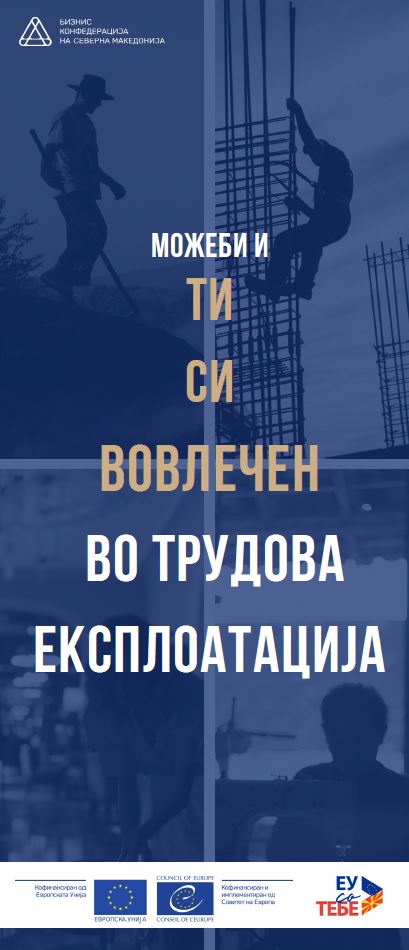
In light of GRETA recommendation on the importance of information and awareness campaigns for groups most at risk of human trafficking for labour exploitation, the Business Confederation of North Macedonia, supported by the European Union and the Council of Europe anti-trafficking action, concluded a major awareness initiative called “Maybe you are also involved in labour trafficking” in 2025. This initiative focused on the risks, prevention and consequences of labour exploitation in different sectors of the economy.
This awareness initiative involved public discussions and an on-line social media campaign targeting trade unions, migrant and seasonal workers, the business community and the general public. In 4 workshops, 179 participants discussed the perils and consequences of human trafficking for the purpose of labour exploitation. The participation included diverse sectors, such as, company representatives, labour inspectors, workers and civil society organisations. Tailored informational materials including leaflets (for employers / for employees) , a general guide for employers and 3 sectoral guides (hospitality & tourism / civil construction / agriculture ) were distributed both to employees and employers. A social media campaign reached over 25,000 people across North Macedonia, sharing valuable information about labour exploitation, while many articles and TV chronicles warned against human trafficking for labour exploitation and its consequences.
We met the President of the Business Confederation, Mile Boskov. The idea for this initiative sparked from the observation that most of the businesses are fully profit oriented and mostly uninformed of the right to decent work and of the consequences of labour exploitation. By the same token, students, seasonal and migrant workers are often not aware of the risk of trafficking for labour exploitation. “We wanted to explain to them their rights and the indicators of labour exploitation. In addition, we empowered the employees and the trade unions to actively prevent any risks and report this crime.”, underlined Boskov.
In exchanges with members of the Business Confederation, we learned that construction, agriculture and hospitality are industries at the highest risk of labour exploitation. More specifically, in the agriculture sector, the focus is on both labour contract legality and the conditions of stay. In construction, which offers better paid jobs, employers tend to minimise costs related to protection and well-being of workers. “The co-operation with the Council of Europe has been instrumental for bringing this anti-trafficking initiative forward, aiming at raising awareness about this sensitive topic and protecting worker’ rights. Yet, labour exploitation is a never-ending story and we will continue to be active with other preventive and educational initiatives.”, said Mile.
Information materials for employers were designed for different sectors in accordance with that sector’s features and risks. The workers were informed about their rights and reporting procedures in a specially designed leaflet. Unregistered workers are especially vulnerable to labour exploitation in the country. Most violations are seen in agriculture and construction. “The issue is beyond legal contracts, as employees are sometimes exposed to safety and hazard risks. At the same time, investing in safety, better working conditions and formalising relations with the employees might mean less profit for the employer”, explained Mile.
From 2017 to 2025, official statistics identified 52 victims of trafficking for the purpose of labour exploitation, including seven forced into begging. Ana Burageva, the Secretary of the National Commission for fight against human trafficking and illegal migration, highlighted the link between exploitation and economic vulnerability, while stressing the importance of co-operation among all actors for an effective response. “Strengthening early identification, inter-institutional co-operation and aligning with European standards is key to protecting victims.”, said Burageva.
Since 2018, the anti-trafficking action of the European Union and the Council of Europe (part of the Horizontal Facility for the Western Balkans and Türkiye), in partnership with the State Labour Inspectorate, runs capacity building activities for inspectors to better identify and protect victims. Daniela Stefanovska, inspector and trainer, confirmed this: “These trainings help professionals understand real-world scenarios and roles, leading to more effective detection of and support for victims.”. GRETA has also welcomed the trainings provided for labour inspectors and has asked the authorities to provide the Inspectorate with adequate human and financial resources.
As awareness about labour rights rises and co-operation between actors deepens, North Macedonia is aiming to create safer workplaces, uphold human dignity and most importantly prevent and combat human trafficking for the purpose of labour exploitation across the country.

 +389 2 3100 327