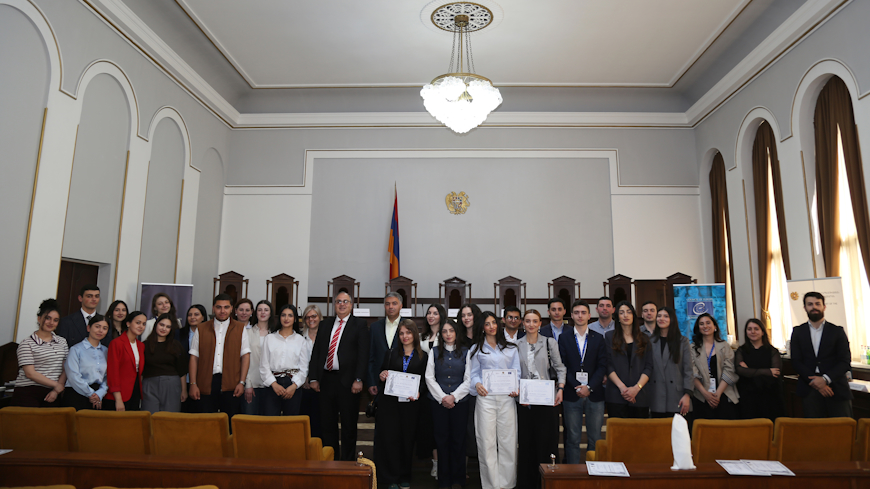
Narek, Arthur and Roman sit in front of us, shining with pride and joy. For the three law students, this is more than just a victory. They have won the first moot court competition on constitutional justice ever held in Armenia and argued not in a lecture hall, but before real judges of the Constitutional Court itself.
The competition, organised by the Council of Europe together with the Constitutional Court and the Armenian International Law Association, brought together teams from law faculties across the country. For the winners, it was the moment when constitutional law stopped being something on paper.
An interview which started as a highlight of their victory in a moot court competition turned into a broader one-hour discussion on what it means to be a lawyer, defend fundamental rights, and how essential a truly independent judiciary is for any democratic state.
What inspired the team to step into the courtroom, the power of practice
They initially participated in other moot courts, but they were genuinely looking forward to a moot court on constitutional justice.
“Although it was not the first moot court we had participated in, it was our first on constitutional justice, and we had been eagerly waiting for this opportunity,” says Arthur. Moot courts exist in Armenia on international law, arbitration, criminal and civil matters, but until now, never on the field they cared about most.
“Moot courts do more than just teach the law,” says Narek. “They prepare you for the realities of the courtroom: how to structure a persuasive argument, how to present yourself confidently before a judge, even how to breathe and how to stand under pressure.”
He shared his view on the constitutional justice: “The stakes are even higher. As a primary guarantee of the rule of law, constitutional justice plays a pivotal role in society. Its core mission is to strengthen public trust in state institutions, ensuring that citizens feel protected and confident that their fundamental rights will not be violated. From the perspective of safeguarding human rights, it is one of our most critical legal institutions.”
However, that initial curiosity quickly shifted into a deep sense of responsibility once the competition began.
“Even though it is a court simulation, it feels like a real stage,” says Arthur. This was our first interaction with the Constitutional Court, and it’s given us hands-on experience that we will absolutely carry into our future legal careers."
Switching sides
The assigned case was anything but simple. “Even the question of admissibility of a case was open to interpretations,” says Narek.
To build their arguments, the team worked with real material: judgments of the European Court of Human Rights, opinions of the Venice Commission, and the Constitutional Court's own case law.
“By analysing the real-world precedents and patterns of the Constitutional Court, we were able to build arguments in actual judicial practice,” adds Roman.
Then came the twist that defined the competition. In one round, the students defended the applicant. In the next, they had to argue from the perspective and defend the position of the National Assembly.
Did it feel strange to argue both sides of the same case?
“Not at all,” they replied. “This isn’t about double standards. Genuine courtroom competition, paired with an independent judiciary, is what makes the law work. Each side must be thoroughly prepared to ensure rights are properly protected.”
“Standing right there, before the judges of the Constitutional Court, is a unique, unforgettable experience,” they agree unanimously.
However, true confidence isn't born immediately, it comes through repetition.
"By the third time you stand up there, something changes," they continue. "You already feel more confident. You start to anticipate the judges’ line of questioning, and you learn how to handle the pressure they apply."
The judges played their part by pressing the students with sharp, unexpected questions. “They didn't just test us on textbook theory,” the team recalls. “They pushed us into real legal practice with questions that demanded absolute precision.”
Behind the two speakers was a third role and both Arthur and Narek hurried to commend their teammate Roman who took the lead on the research: studying precedents, following the opposing teams and the judges during hearings, and passing notes that shaped his teammates’ presentations. “I realised that I could help my team more if I do most of the research, and find precedents,” he says. “Thorough study of the materials is what carried our case.”
Not starting from scratch
To our question whether these academic simulations truly prepare students for the complexities of real life, the teammates respond:
“It doesn't feel different from real life, because our work was entirely real,” explains Narek. “We weren't using fictional scenarios. We were digging into real European Court of Human Rights judgments. When you work with such documents, the knowledge you gain is authentic.”
“If a complex case on freedom of expression or a constitutional complaint lands on our desk one day,” adds Arthur, “we won't be starting from scratch. Because of this experience, we will already have some of the answers.”
A path for the future
This victory has fundamentally given them a vision of who they want to become.
“This experience cemented my intention to definitely become a constitutional judge one day,” Narek reveals.
For Arthur, this experience strengthened his interest in legal academic work and research. He plans to continue his education abroad, with the aim of bringing international legal experience back to Armenia. Roman, for his part, has already been admitted to a master’s programme in law and is continuing his path of professional growth.
Their advice to fellow students weighing whether to enter a future moot court is unanimous: “Don't say, ‘I won’t participate because it’s hard.’ Difficulties shape real lawyers. A diploma alone doesn't make you a lawyer, but experience does.”
Defending democracy in turbulent times
For the three winners, the stakes of constitutional justice go far beyond a trophy.
The conversation quickly shifted from personal questions to a more global one. In an era where democracy and the rule of law face global restraints, is it harder to be a lawyer today than it was twenty years ago?
“Today, democracy is often perceived as more formal than substantive,” Narek observes. “A strong democratic culture is still missing in many places. Democracy without limits risks descending into anarchy, which is why it must go hand in hand with the rule of law. The goal is not a perfect democracy, but a functioning one, built on public trust in courts.”
All three of them emphasise that a strong democracy cannot survive without an independent judiciary capable of balancing the scales against the executive and legislative branches and without public trust in the courts that comes from seeing rights genuinely protected. The profession of a lawyer today carries a profound societal weight.
They are equally clear-eyed about their own profession.
“When a problem arises, people go to a lawyer, but sometimes lawyers use overly complicated terminology. The person leaves without understanding anything,” they point out. To bridge this gap, they believe the profession needs to connect with everyday people.
“That’s why we should understand how people think, and how to communicate legal ideas clearly.” They imagine a future where major decisions of the Constitutional Court and the European Court of Human Rights are not filed away in archives, but debated in classrooms and explained to the public.
“A lawyer’s work is as important as a doctor’s,” Arthur reflects. “A doctor saves a person’s life; a lawyer protects the rights that make it worth living.”
The journey continues
The moot court was technically a simulation, but for these three, it was the opening chapter of their professional lives. They walked away with more than just a certificate; they left with a shared conviction that the future of justice depends not just on mastering the rules, but on having the courage to step onto the stage and defend them. It relies on a living, breathing culture of justice, carried forward by people who care.
The moot court competition was organised under the framework of the Council of Europe project on Support to the development of constitutional justice in Armenia in line with European standards and Promoting freedom of expression, media and access to information in Armenia.


 Contact us