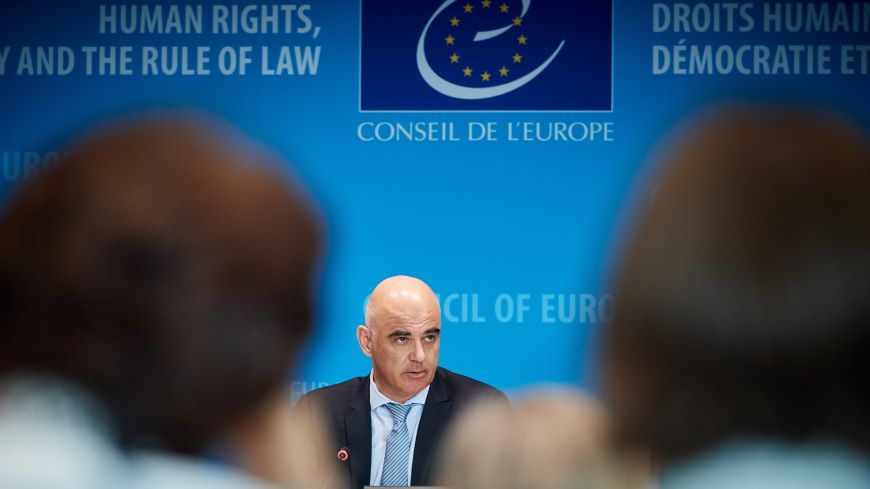
Secretary General Alain Berset of the 46-member Council of Europe met Croatian political leaders and international partners at the Dubrovnik Forum on 26–27 June, highlighting the importance of democratic security, multilateral cooperation and shared European values in responding to today's geopolitical challenges.
The visit included meetings with Croatian Prime Minister Andrej Plenković, Minister of Foreign and European Affairs Gordan Grlić Radman, Speaker of Parliament Gordan Jandroković and other senior interlocutors. Discussions focused on democratic resilience, support for Ukraine, accountability for Russia's aggression, the Western Balkans and the future of European cooperation in an increasingly multipolar world.
Democratic security in a changing world
Participating in the leaders' panel “The age of multipolarity: navigating new realities” alongside Prime Minister Plenković, Italian Deputy Prime Minister Antonio Tajani, and OSCE Secretary General Feridun H. Sinirlioğlu, the Secretary General stressed that Europe must respond to growing fragmentation by reinforcing democracy, human rights and the rule of law.
The Secretary General stressed during the panel discussion that the Council of Europe's strength lies in the common legal space shared by its 46 member states. Built on the European Convention on Human Rights and reinforced through more than a million decisions of the European Court of Human Rights, this shared legal framework provides a level playing field that promotes stability, strengthens democracy and enables Europe to engage confidently with partners while remaining anchored in common values.
In his meeting with the Minister of Foreign Affairs of Slovenia, Mr Tone Kajzer, the Secretary General again emphasised that this shared legal foundation remains one of Europe's greatest strengths and thanked Slovenia for its steadfast support for the Council of Europe's mission. He underlined that the European future of the Western Balkans are central priorities shared with Slovenia and noted the growing international support for Council of Europe legal instruments as evidence of their relevance beyond the European continent. The discussion also looked ahead to continued engagement at the Bled Strategic Forum, including on the Council of Europe’s role in strengthening dialogue and stability across the Western Balkans.
The discussion explored how European institutions, and democratic states, can respond to geopolitical competition, foreign information manipulation, declining trust in institutions and other emerging security challenges – and preserve the values that underpin lasting peace and stability.
Continued support for Ukraine and accountability
Throughout the forum, the Secretary General underlined that Europe’s security is undergoing a profound transformation in a context marked by growing multipolarity and the erosion of the international order, notably illustrated by Russia’s war of aggression against Ukraine. While increased defence efforts are necessary, he stressed that military rearmament alone is not sufficient to ensure lasting stability. Security must also rest on resilient democratic institutions, the rule of law, and societies protected against disinformation, cyber threats and foreign interference. In this sense, “democratic security” was presented as Europe’s first line of defence, complementing rather than replacing traditional defence approaches.
Drawing on the Western Balkans, he noted that lasting stability has been achieved where legal frameworks have been embedded into political settlements and domestic systems, turning former conflict lines into shared legal guarantees. However, he called for renewed engagement for stable peace, including stronger regional focus on democratic security, to consolidate gains and prevent backsliding in a changing geopolitical environment.
Alain Berset also highlighted the Council of Europe's New Democratic Pact for Europe as a framework for reinforcing democratic resilience across the continent through stronger institutions, greater civic participation and renewed public trust.
Russia's war against Ukraine featured prominently in discussions throughout the Forum, and the Secretary General reaffirmed the Council of Europe's unwavering support for Ukraine, highlighting the organisation's leading role in advancing accountability through the Register of Damage for Ukraine and the wider international compensation and accountability mechanisms established in cooperation with partners.
Croatia's contribution to European democratic security
Meetings with Croatian leaders provided the opportunity to discuss Croatia's contribution towards strengthening democratic security in Europe, including regional stability in the Western Balkans, continued support for Ukraine and the importance of effective multilateral cooperation.
As Croatia marks 30 years of membership of the Council of Europe this year, the Secretary General welcomed the country's continued engagement in promoting democracy, human rights and the rule of law both nationally and internationally.
“As fragmentation and geopolitical tensions test Europe’s cohesion, Croatia brings a unique role and experience,” he said. “A valued member of the Council of Europe, Croatia’s commitment to cooperation and dialogue reinforces the Council of Europe’s role as a stabilising force, strengthening democratic security across our continent.”
While in Dubrovnik the Secretary General also presented the Council of Europe's broader agenda for strengthening democratic security, including implementation of the New Democratic Pact for Europe, efforts to counter foreign information manipulation and interference, work on the Council of Europe's Framework Convention on artificial intelligence, and ongoing preparations for a legally binding international treaty on artificial intelligence and democracy.
Concluding his visit, he stressed that Europe's response to an increasingly uncertain international environment must be founded on cooperation rather than fragmentation.
“In a world with more centres of power, Europe must remain united around the principles that have guaranteed peace, stability and human dignity for generations. Democratic security is not an abstract concept; it is our common responsibility.”
 Secretary General Alain Berset
Croatia and the Council of Europe
The Council of Europe and the OSCE