National human rights structures
National Human Rights Structures (such as National Human Rights Institutions (NHRIs), Ombudsman Institutions, Equality Bodies, National Preventive Mechanisms and others) are crucial in bridging the gap between States’ obligations and the actual realisation of human rights. The Commissioner is mandated to co-operate with them and facilitate their work. He supports their independence and effectiveness and the establishment of accredited NHRIs where they do not exist yet. The Commissioner recognises these institutions as essential partners in the promotion and protection of human rights and reacts to threats to their independence and effectiveness.
A summary of the Commissioner’s activities for and with NHRSs, including support to those under threat, can be found in the Commissioner’s activity reports.
Partnership with national human rights and equality bodies key to advance common human rights goals

 full article
Exchange of views with Equality Bodies and NHRSs on reaching the most marginalised groups
17 October 2024
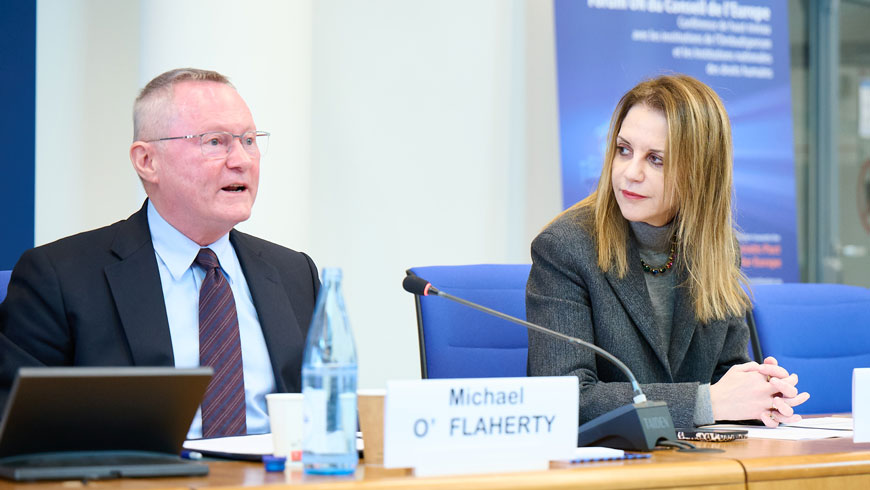
- On 17 October 2024, the Commissioner O’Flaherty convened a half-day exchange of views with heads and representatives of over 35 Equality Bodies, some of them also Ombudsman institutions and/or National Human Rights Institutions, from across the Council of Europe, to initiate his dialogue and partnership with these structures. After sharing their current outlook about human rights and their respective priorities moving forward, the Commissioner and the participants discussed the importance of effective co-operation between the institution and national human rights structures and how to strengthen it. The second part of the meeting was linked to the Commissioner’s priority of working with those most vulnerable in our societies. Discussions focused on the challenges that the most marginalised people face in accessing national human rights structures and strategies deployed by Equality Bodies to reach out to them in order to improve their access to human rights and to redress for the human rights violations they suffer.
Exchange of views with heads of NHRSs on addressing the impacts of artificial intelligence on human rights
30-31 March 2023
- On 30–31 March 2023, the Commissioner Mijatovic met with 30 heads and senior representatives of national human rights structures to discuss their experiences as well as challenges and promising practices with respect to the implementation of her 2019 Recommendation “Unboxing AI – 10 steps to protect human rights”. The Commissioner welcomed the initiatives taken by NHRSs and their European networks to increase their capacities to tackle human rights issues arising from the use of AI systems and raise public awareness on the potential and risks of AI for human rights. She stressed that AI design, development and deployment must be supervised through one or more authorities that were fully independent, adequately resourced, and mandated to handle, investigate, and monitor human rights-related complaints. Supervisory authorities should be required to cooperate closely with NHRSs given their role as guardians of human rights at national level. Insights from the meeting were incorporated in the Commissioner’s 2023 follow-up Recommendation “Human Rights by Design – future-proofing human rights protection in the era of AI”.
Exchange of views with Equality Bodies on algorithmic discrimination
26 September 2019
- On 26 September 2019, the Commissioner Mijatovic convened an exchange of views with representatives of 35 European Equality Bodies and the EQUINET Network. The Commissioner and Equality Bodies discussed their respective priorities in the promotion of equality, as well as the challenges faced by Equality Bodies in the current political environment in Europe. The second part of the meeting was focused on the role that Equality Bodies can play in tackling algorithmic discrimination, as a follow-up to the Commissioner’s Recommendation “Unboxing Artificial Intelligence: 10 steps to protect Human Rights”. Participants recognised that discrimination related to the use of algorithms and automated decision-making was appearing in many areas of their anti-discrimination work and required urgent attention.
High-level panel discussion on “Beyond Jargon: Reframing communication on human rights”
6 March 2018
- On 6 March 2018, on the margins of the 37th session of the Human Rights Council in Geneva, the Commissioner Muiznieks participated in a high-level panel discussion entitled “Beyond Jargon: Reframing our Communication on Human Rights”, organised jointly with UN OHCHR, EU FRA, ENNHRI and GANHRI. The objective of the event was to bring together leaders from national, regional, international and non-governmental human rights institutions to discuss the difficulties they are facing in getting their message across in the current political environment marked by populism and widespread disaffection with institutions, and to identify ways to communicate more effectively to convince the public at large about the importance and value of human rights. The participating organisations adopted a joint statement in which they pledged to work harder to improve the way they reach out to people in order to build broader and stronger support for human rights, so that the promise contained in the Universal Declaration of Human Rights, which was adopted 70 years ago, can truly become a reality for all.
Roundtable with NHRIs on refugee family reunification
18 october 2017
- On 18 October 2017, the Commissioner Muiznieks and the European Network of National Human Rights Institutions (ENNHRI) organised a round table on refugee family reunification in Brussels. The round table brought together representatives of NHRIs from 11 Council of Europe member states. The basis for the discussion was the issue paper ‘Realising the right to family reunification for refugees in Europe’, which the Commissioner published in June 2017. The round table was used to exchange examples of NHRI engagement with the issue of family reunification, and to explore how the Commissioner, ENNHRI and individual NHRIs could reinforce each other’s work in this area.
Brainstorming with NHRIs on protecting human rights while countering terrorism
20 May 2016
- On 20 May 2016, the Commissioner’s Office and the European Network of National Human Rights Institutions (ENNHRI) organised a brainstorming meeting in Paris on the role of NHRIs in the context of state action against terrorism. The main objective of the meeting, attended by nine NHRI representatives, was to exchange and generate ideas with a view to developing a deeper understanding of the role of NHRIs in that field. The participants also discussed next steps and co-operation opportunities to assist NHRIs in building effective tools and strategies for human rights protection at national and regional level. The meeting led to the publication of a human rights comment by the Commissioner.
Expert workshop on effective and independent structures for promoting equality
8-9 July 2010
- On 8-9 July 2010, the Commissioner’s Office organised an Expert workshop on “Effective and independent structures for promoting equality”. The workshop explored the role of equality bodies and other national human rights structures in combating discrimination and promoting equality. It reviewed their structure, mandate, function, powers, resources and practices to gauge their effectiveness and independence. The equality bodies’ outreach and accessibility among the public as well as their interaction with other human rights structures were highlighted. The workshop shared experiences from different countries and discussed good practices and challenges regarding the different models. The workshop led to the publication of a 2011 opinion on the Commissioner for Human Rights outlining standards for the independence and effectiveness of national structures for the promotion of equality.
Projects aimed at facilitating the creation, effective work and networking of NHRSs
2007-2009
- One important project that led to several roundtables was carried out by the Commissioner Hammarberg between 2007 and 2009 as a joint programme with the European Union (“Peer-to-Peer Project”) with the aim of facilitating the setting-up of an active network of national human rights structures in Europe. In this context, a series of “Peer-to-Peer” workshops were organised to offer the staff of these institutions the possibility to share experiences with colleagues and to receive updates about relevant Council of Europe norms and mechanisms. The last “Peer-to-Peer” workshop organised by the Office was held in Budapest from 24 to 25 February 2009 on the theme of the role of NHRSs in protecting the rights of Roma. Other issues covered in earlier workshops included the rights of persons deprived of their liberty, complaints against the police, protecting the human rights of irregular migrants, freedom of expression and information and the rights of persons with disabilities. Several of these workshops contributed to the preparation of publications by the Commissioner on the issues discussed.
Other notable projects included the Eunomia project for the promotion of Ombudsman institutions in Southeastern Europe and a project to strengthen regional Ombudsman institutions in Russia.
Meetings between the Commissioner and NHRSs
2003-2006
- Between 2003 and 2006, the Commissioner Gil-Robles hosted biannual meetings between the Council of Europe and national Ombudsman institutions, at which issues such as the execution of judgments of the European Court of Human Rights, and the Council of Europe’s websites as sources of human rights information, for example, were discussed. In April 2007, the Commissioner hosted a Roundtable in Athens gathering Ombudsman institutions and National Human Rights Institutions/Commissions in order to enhance the co-operation between the Commissioner and all NHRSs for the benefit of the long-term effectiveness of the ECHR system.