



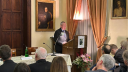
Commemorative symposium for the 250th anniversary of Daniel O’Connell: “Finding the heart of his global legacy in the 21st Century.”
Edited transcript of the keynote speech delivered by Council of Europe Commissioner for Human Rights, Michael O’Flaherty: “Daniel O'Connell's legacy as we confront a new era for human rights”
Rector, Ambassador, Excellencies, dear friends,
It has recently become commonplace to distinguish between the notions of an era of change and a change of era. Commentator Austin Ivoreigh describes the former as a situation in which societal changes occur within an existing, stable cultural framework. The latter, a change of era, addresses a situation in which the framework is shattered by rapid social and technological advances that surpass the capacity of human culture to grasp them.
There can be no doubt that Daniel O'Connell lived through a change of era. In Europe, we witnessed the collapse of the Ancien Regime, the emergence of revolutionary ideas, the post-Napoleonic reordering of the continent, and the onset of the Industrial Revolution. For Ireland, to these could be added the emergence of a Catholic middle class, demands for religious emancipation; and, devastatingly, the Great Hunger and all its terrible consequences.
Against this backdrop, one of the great values of this year's anniversary events is to shed light on the impact of O'Connell - on his role as a key protagonist of the change of era.
Some of the story is well known. you are all very familiar with it, and you have discussed much of it today, but let me add some elements.
While his work for Catholic emancipation is rightly celebrated, his efforts for freedom of religion more generally are less acknowledged. In this tragic week of the savage attack in Australia, it is important to recall his outright repudiation of antisemitism.
His anti-slavery efforts are also recognised, but the comprehensiveness of his effort is remarkable. He railed against the practice in the United States and across the British colonies. He also defended the indigenous peoples of Australia and New Zealand.
His lifelong quest for Irish home rule is well understood, but this should never be disassociated from his radical and rare insistence that it be attained by peaceful means alone.
He also contributed to the foundation of modern democratic theory, through his insistence on secret ballots and the separation of church and state. Of course, there was also his final campaign for famine relief in Ireland and his belief that it was the state’s duty to provide it.
I believe that we can discern some unfolding threads across the range of O'Connell's social engagements and campaigns. None of these threads will surprise you.
First, he believed that he was demanding no more than what humans are entitled to, by virtue of their humanity.
Second, he believed that the state has a duty to honour these entitlements.
Third, as we've heard so extensively and eloquently this afternoon, the origin of these entitlements lies in the dignity of each human being. In other words, he considered that he must act whenever he saw an affront against human dignity, whether in defence of religious liberty or in providing hunger relief.
In fact, -if you allow me to invent a term- Daniel O'Connell was a ‘proto-human rights champion’. His understanding was remarkably prescient, anticipating core modern day human rights understandings:
• the origins of human rights in human dignity
• the universality of human rights
• and the indivisibility of rights: where what we call today socio-economic rights are considered as co-equal with civil rights and freedoms.
I would very much welcome greater scrutiny from scholars of the threads that link O'Connell to modern human rights understanding, distinguishing between direct and indirect influences.
For now, suffice to acknowledge his very important contribution to the development of human rights laws and institutions especially since the Second World War.
What an achievement that has been. The modern basis is the Universal Declaration of Human Rights, adopted by the United Nations General Assembly in 1948. This astonishing text sets out the essentials required for human dignity to be respected. In fact, the Declaration has been described as the only globally agreed roadmap for honouring human dignity.
To grasp the Declaration’s significance, just consider the tour de force speech delivered by Pope John Paul II at the United Nations General Assembly in September 1979.
As is well known, the Declaration was followed by a series of binding human rights treaties, including the European Convention on Human Rights.
To promote and supervise the implementation of the treaties, institutions and bodies were established, including the Council of Europe and its European Court of Human Rights.
Human rights were also embedded in national level constitutions and laws, and their delivery was supported by so-called ‘national human rights institutions’, such as the current Irish Human Rights and Equality Commission.
Over time, these official bodies were matched by a thriving network of civil society organisations.
So far, so good. But it is now 2025. We can no longer afford to be complacent about our achievements. The human rights aquis is under threat. Unimaginably, we risk losing it.
There are a number of dimensions to this threat.
First, there is the sheer scale of human rights abuses and violations that we see across the world. The levels of violence are higher than they have been for a very long time; there have been more wars in recent years than in a generation.
However, it is not just the scale of abuse that makes me perceive the threat. Human rights abuses have always been a significant issue.
There is a second dimension: the extent to which the standards, treaties, and instruments themselves have been repudiated. Until relatively recently, we saw this in the extremes of politics. We saw it in the leadership of people like Putin and Lukashenko. We could consider that perhaps this could be contained.
However, something has been happening in the past year that worries me greatly. The shift towards the possibility of repudiation in the middle ground of our politics is a worrying development.
This is particularly evident in the management of migration, where there is a willingness to disavow fundamental human rights principles at borders such as those with Belarus - something that would have been unthinkable just a short time ago. There was a low point of this shift in the form of 27 countries adhering to a problematic statement at a meeting in Strasbourg just last week.
Alongside all these worrying developments there is increasing pressure on institutions and civil society. There are numerous countries, including on this continent, where if the state had its way, there would be no free and challenging civil society.
So, how do we understand these developments? How do we contextualise them in contemporary society? I think, to do so, we need to recognise that we now are again living in a change of era. Popes Francis and Pope Leo have referred repeatedly to this phenomenon: a moment in which we witness the shattering and rebuilding of the social framework.
What elements are triggering or engaging or becoming visible in this process of shattering?
First, as we have just heard from Bishop Tighe, there is the impact of artificial intelligence.
Then there is the triple planetary crisis and all its destabilising dimensions.
There are the shocking and worsening levels of inequality. There is the as yet underappreciated impact of the COVID-19 pandemic.
We see the widespread diminishment of trust: trust between citizens and the state, between young and old, and between old and young.
There is the rise of populist politics.
What is more, multilateralism is in decline.
So, what are we to do? How should we respond? How can we push back?
First, we must acknowledge the significance of the moment. Despite its banal daily iterations, we must recognise the significance of the historical moment, the accident of the moment of history, in which we, are living. We must acknowledge the treasure of human rights that we risk losing.
Then, among many other actions, we must seek inspiration, including from history. Today, I am thinking of O'Connell, who played such an important role in navigating an earlier change of era.
Above all, as he did and as speaker after speaker has emphasised today, we must put the human at the heart of public affairs.
We must demand and work towards honouring human dignity as the primary consideration.
Then, with our 21st century sensibility, we should demonstrate how the roadmap for delivering human dignity is, above all, the corpus of human rights standards.
Furthermore, we must be applied and confront the great issues and challenges of our time.
Here in Europe, I would suggest that the single greatest issue and challenge is the war being waged against Ukraine.
I need not remind you of the horrors of the blatant aggression, the killing of civilians and soldiers, the abduction of children, the destruction of infrastructure and the trauma inflicted by years of attacks. Nor do I need to remind you that this is a war certainly against the people of Ukraine, but against us all, against Europe and our values.
You are also aware of the current peace efforts that are in the news every day. They worry me greatly. They smack of great power politics. Ukraine is treated as a supplicant. Negotiations seem transactional. Ordinary people are missing. I see little mention of the six million people in the occupied territories, the millions of internally displaced people and refugees, or the destruction of the social infrastructure. I see no mention of the involvement of women or civil society. In fact, I see a near-total absence of the things we have learned over generations are needed to ensure lasting peace.
Over recent months, one of my greatest preoccupations has been the peace process; working with others seeking to find a way to shift the dial back to where it should be.
Last July, I presented to the Ukrainian government a memorandum outlining ten areas of action that would be required to restore human dignity and human rights to the heart of the peace process.
Then, a couple of weeks ago, I convened a meeting in Warsaw with human rights and peace-making leaders from around the world, to see if we could distil those ten areas into core messages. There were three clear takeaways from the Warsaw meeting, as I describe in a report published last week.
First, we need to put the well-being and concerns of ordinary people to the forefront in peace discussions. Who are these ordinary people? They are the prisoners and the civilian detainees. They are the displaced people. They are the refugees. They are the demobilised soldiers. They are the people in occupied territories, territories that might be ceded to the aggressor.
The second issue is the need to ensure justice, accountability and redress. The Warsaw meeting reiterated that there can be no peace without justice. We are not suggesting this just as a matter of principle but also as an empirical observation: a peace without justice will not survive.
The third issue raised at this meeting concerns the ongoing need to engage all relevant actors in discussions on peace in Ukraine. For instance, the UN is in large part missing, for well-known reasons. Given its extensive knowledge and experience of peacebuilding around the world, its contribution to the Ukrainian peace negotiations is crucial.
The Warsaw meeting report is currently being disseminating, and I encourage governments, parliaments and others to engage with it and its recommendations.
Will we succeed? I do not know. However, I do believe that these efforts are gaining traction in some places where there is the capacity to shift the agenda, however slightly.
But what about the bigger struggle? What about the transition through this change of era? Will human rights survive it intact? Here, too, I am hopeful. I do not have time this afternoon to explore this in any detail, but I will say that we do have the toolbox for survival. The challenge lies in deploying it properly.
Even if my hopefulness were in question, I could still draw on the legacy of Daniel O'Connell.
I could draw on his tenacity and dogged persistence in challenging wrong, repeatedly, as we might say, playing the long game.
I could draw on the fact that he was so often ultimately vindicated, even decades after his death. Consider the story of Irish independence, or his role, as I mentioned earlier, in the development of human rights.
Finally, I could draw on his final campaign to alleviate the Irish famine. I think he knew he would fail, yet he persisted regardless. He demonstrated the duty to act, regardless of the chance of success.
Ultimately, I believe that this too is the duty of our generation.
Thank you.