Best Practices Awards 2024
Budapest, Hungary, 27 September 2024
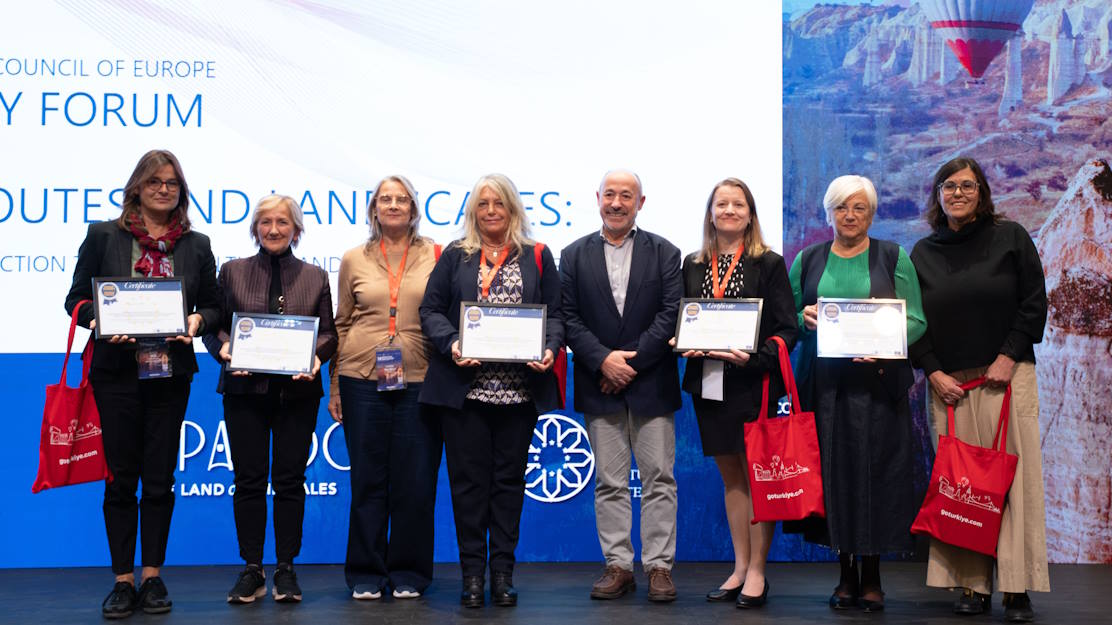
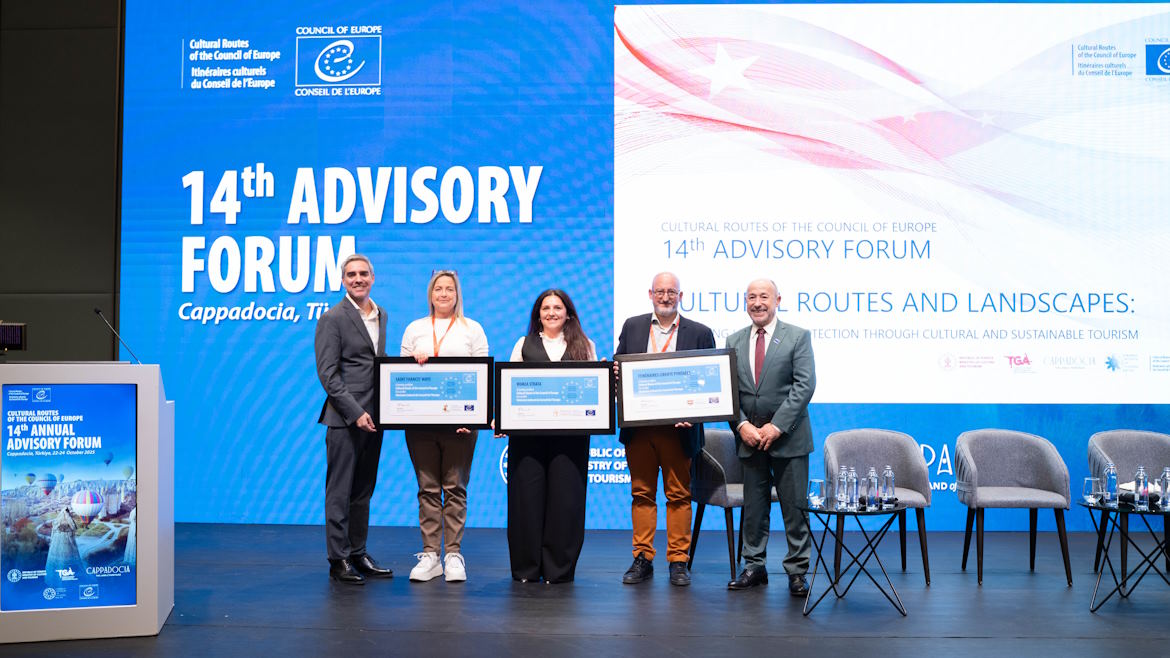
The 2024 Best Practices Awards were presented during the closing ceremony of the 13th Annual Advisory Forum on Cultural Routes in Budapest (Hungary). Mr. Sergio ORTEGA MUNOZ, Vice-Chair of the EPA Governing Board, and Mrs. Meltem ÖNHON, Chair of the EPA Governing Board, awarded the certificates to the representatives of the certified Cultural Routes of the Council of Europe.
Six Cultural Routes of the Council of Europe received the 2024 Award for their “Best Practices”:

Awarded Best Practice on Cooperation in research and development:
Analysis of Framework Conditions for valorisation and capitalisation of the cultural heritage
From January to June 2024, the members of the Cultural Route carried out research on wine cultural heritage in the post-covid era. The report analysis provided valuable insights into nine key topics covered by the research along the Roman Emperors and Danube Wine Route. The analysis highlighted both the strengths and potential of the participating localities in cultural tourism.

Awarded Best Practice on Enhancement of memory, history and European heritage:
XX Anniversary of the Phoenicians’ Route as Cultural Route of the Council of Europe
To celebrate the 20th Anniversary of the certification as “Cultural Route of the Council of Europe”, the network launched several events (conferences, exhibitions) in 2023 and in 2024 in different countries such as Cyprus, Italy, Spain, Malta as to strengthen the ties between its member countries.
The result in terms of communication and participation has been very high, including an increase in requests for membership, even in countries where the Route it is not yet present. The panel exhibition on the destinations of the Phoenicians' Route started to travel along different locations the Route and will be exhibited throughout 2025 as the Phoenicians’ Route showroom during the year of Nova Gorica European Capital of Culture (Slovenia), allowing a continuous promotion of the Route.

Awarded Best Practice on Enhancement of memory, history and European heritage:
Bold and Borderless, a cross-border literary walk
The guided tour on International Women’s Day was dedicated to formidable women who pursued their literary careers in Gorizia and Nova Gorica on the Italian and Slovenian side of the border. The literary walk linked the two towns, once cut by the Iron Curtain, into a single conurbation, aware of their common history and of the important female historical figures - women writers of different origins, who wrote in different languages: Slovenian, Italian and German.
A special booklet was prepared for the occasion so those who missed the tour can take a stroll tour by themselves. The booklet also includes a cycle route for those who would like to visit more points of historical and cultural interest.

Awarded Best Practice on Contemporary cultural and artistic practices
ROUTE OF LEONARDO DA VINCI: the travelling exhibition
53 artists created artworks to present their interpretation Leonardo's figure within the contemporary world. The collection of artworks, paintings, sculptures and others were assembled into an exhibition, catalogues and brochures. The interest of young people and school administrations in the project is particularly striking.

Awarded Best Practice on Cultural Tourism and Sustainable Development
Week of discovering European Cemeteries: Environmental sustainability and climate change
The Association invited its members to participate to the Week of Discovering European Cemeteries under the common thematic of Cemeteries as green oases which will influence visitors to consider their impact on the city sustainability. 22 members from 7 European countries followed by organising over 30 events related to sustainability. From guided tours, exhibitions to open calls for the incorporation of new sustainable practices in cemeteries.

Awarded Best Practice on Cultural and educational exchanges for young Europeans
The ArchaeoGim pilot project
The 16 years old students of the Požega High School attended every month the “ArcheoGim”, a two-hour course given by Iron Age Danube’s Route staff. The educational programme consisted of lectures, workshops and field trainings on the Kaptol archaeological site. They learned about archaeology, tourism and the value of the "Iron Age Danube Route" heritage. The pilot project was successful as the students enjoyed and actively participated in the Hallstatt festival of revived history, from preparation of Hallstatt food, Iron Age weaving or restoration of ceramics.