


The Rule of Law Checklist
The principle of the Rule of Law is often enshrined in legal texts, at the national, European and international level. Despite its frequent use, especially in political debates, its meaning is not always clear. To address this, in 2016, the Venice Commission adopted the Rule of Law Checklist, outlining detailed questions to assess the degree of respect for the Rule of Law in any given country.
Various developments since 2016 have made an update of the Rule of Law Checklist timely and necessary. Following a comprehensive consultation process involving a wide range of stakeholders, including Venice Commission member states, Council of Europe bodies, the European Union, United Nations’ representatives, constitutional courts, Ombud institutions, academics and civil society organisations, the Venice Commission adopted its Updated Rule of Law Checklist in December 2025.
The Updated Rule of Law Checklist has been endorsed by the Committee of Ministers of the Council of Europe on 15 May 2026, and by the Parliamentary Assembly of the Council of Europe on 22 May 2026.
What is the Updated Rule of Law Checklist?
The Updated Rule of Law Checklist is not only a text explaining the essential elements that form the Rule of Law: it is a practical assessment tool for governments, parliaments, civil society organisations, and international institutions, to support objective, transparent, and comprehensive evaluations of Rule of Law conditions in any given country. Moreover, it is used as a point of reference, not only in the opinions and reports of the Venice Commission itself, but also in the judgments of the European Court of Human Rights, the resolutions of the Parliamentary Assembly of the Council of Europe, the Rule of Law monitoring of the European Union and the Court of Justice of the EU.
Why was the Rule of Law Checklist updated?
The Checklist is intended as a living instrument, which changes over time when new issues arise needing the content of the Checklist to be further refined. Since 2016, a number of such new issues have arisen, which have made an update of the Rule of Law Checklist both timely and necessary: the development of digital technologies, the rise of powers of private actors and the need to restore the Rule of Law after a period of backsliding.
Updating the Rule of Law Checklist was given further momentum with the adoption of the Reykjavik Declaration by the 4th Summit of Heads of State and Government of the Council of Europe in May 2023, which called for stronger visibility and support for the Rule of Law Checklist as a key instrument for promoting democratic governance and legal standards across Europe.
What is new in the Updated Rule of Law Checklist?
The Updated Rule of Law Checklist responds to new challenges that have emerged since the 2016 Rule of Law Checklist. While preserving the original structure and core Rule of Law principles — legality, legal certainty, prevention of abuse of power, equality and non-discrimination, and access to justice — the Updated Rule of Law Checklist introduces stronger benchmarks on constitutional review and checks and balances. These additions emphasise the importance of institutional oversight in preventing erosion of the Rule of Law.
Furthermore, the Updated Rule of Law Checklist now includes obligations derived from the Rule of Law for the development and use of digital technologies, including by private powers. Finally, it includes new challenges to the Rule of Law, such as restoration of the Rule of Law and education on the importance of the Rule of Law in order to create a shared culture for the Rule of Law to thrive.
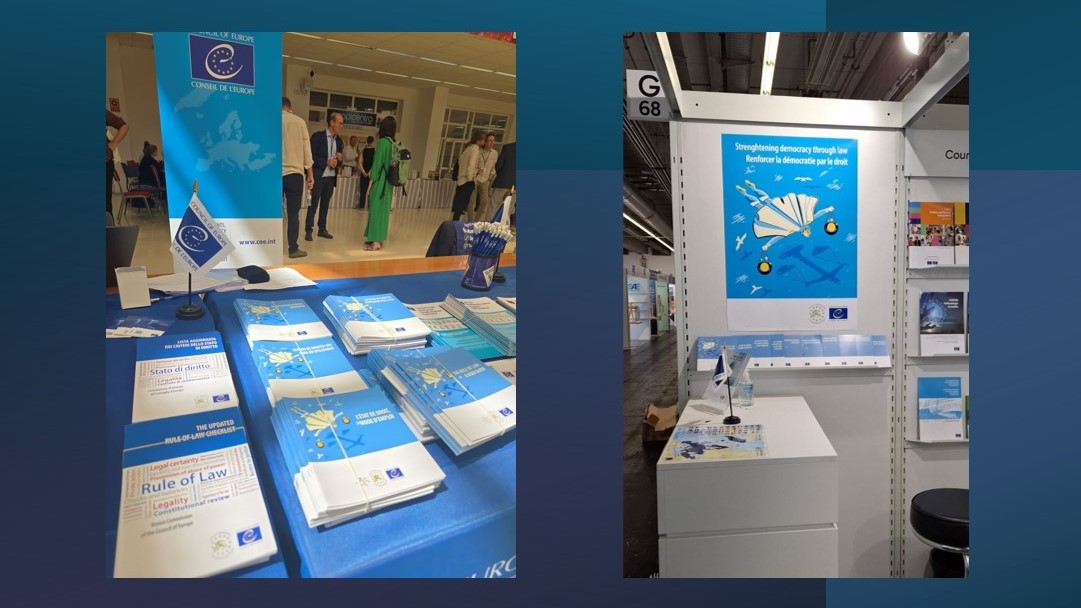




 The exhibition “The Rule of Law: A User Guide” presents key rule of law principles—legality, legal certainty, equality before the law, prevention of abuse of power, and access to independent justice—in an accessible and engaging way.
The brochure “The Rule of Law: A User Guide”, available in more than 40 languages, helps people understand why the rule of law matters and how it protects their rights and freedoms every day.

European Commission for
Democracy through Law

