


Contact Group on Belarus
The Council of Europe was set up to anchor human rights, democracy and respect for the rule of law throughout the whole of the continent. One European country has never been a member - Belarus: but that hasn’t stopped the Council of Europe from reaching out to spread its values there and to bring the country closer to the standards needed for membership.
From 1992 onwards, Belarus signed up to a number of conventions and was included in various Council of Europe projects. This came to a halt in March 2022 after Russia began its full-scale war of aggression against Ukraine and was expelled from the organisation. The next day, the Committee of Ministers decided to suspend all co-operation with the Belarusian authorities too. But work with Belarusian civil society and the democratic forces in exile continues, particularly young people, independent media and human rights defenders. A decision to launch a Council of Europe Contact Group on Cooperation with Belarusian Democratic Forces and Civil Society was taken in September 2022. It met for the first time two months later, and the momentum continued with the adoption of the 2023 Council of Europe Reykjavík Summit Declaration, which underlined the need for co-operation and the commitment to pursue the work of the contact group.
 Priorities
The new list of activities 2026-27 to be implemented under the Contact Group on Belarus is based on the jointly agreed priorities. This new phase will enhance ongoing cooperation and respond to new needs in the areas of promoting the standards of the European Convention on Human Rights, abolition of the death penalty, anti-discrimination, gender equality and countering violence against women, parliamentary cooperation, local democracy, support to civil society, cultural rights, youth participation and Belarusian journalists in exile. A tailored placement programme for Belarusian professionals at the Council of Europe, developed in 2024-25, is to continue. Launching an information point for Belarusian people in Vilnius under the agreement between the Council of Europe and the Government of Lithuania, to reinforce the organisation’s capacities to implement activities on the ground, is part of the new list.
In 2024-25, a number of projects were implemented under the contact group. The Council of Europe’s activities have notably contributed to the drafting by the democratic forces of the Memorandum on the abolition of the death penalty in Belarus, and of the Statement of principles on non-discrimination adopted by the Coordination Council. A strategic dialogue was initiated between young Belarusians and decision-makers from the Parliamentary Assembly of the Council of Europe (PACE) and the Congress of Local and Regional Authorities. Belarusian democratic forces were represented in these two bodies since early 2025. In 2024, PACE put together “The Luxembourg solutions” – a compilation of recommendations and good practices of national parliaments for Belarusians in exile to ease their stay, support their access to education and preserve their cultural identity. The Congress has been providing expertise in local self-government reform and preparing ‘leaders for change’ in view of a future democratic transition and has also worked on the local response to transnational repression against Belarusians in exile, including through the localisation of the “The Luxembourg solutions”.
The activities followed the work under the previous 15-point plan for Belarus, launched in February 2023, which set up projects to promote human rights and the rule of law; change attitudes to the death penalty; support journalists in exile, political prisoners, women and discriminated minorities, and strengthen pluralist democracy at national and local level, with an emphasis on involving civil society and young people.
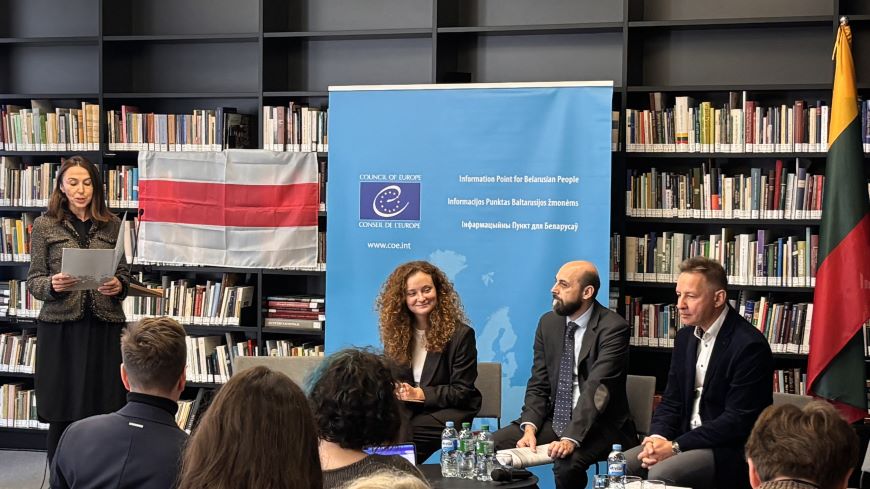
Death-penalty abolition in focus of the first event in Vilnius by the Council of Europe Information point for Belarusian people
Council of Europe reaffirms its strong political opposition to capital punishment

Empowering the next generation of local leaders for a democratic Belarus
From 7 to 9 July 2026, 28 representatives of the Belarusian democratic forces and civil society, as well as experts and the Congress Rapporteur for a democratic Belarus, Belinda Gottardi (Italy, SOC/G/PD), met in Strasbourg for the third edition of the workshop “Leaders for change: Promoting...
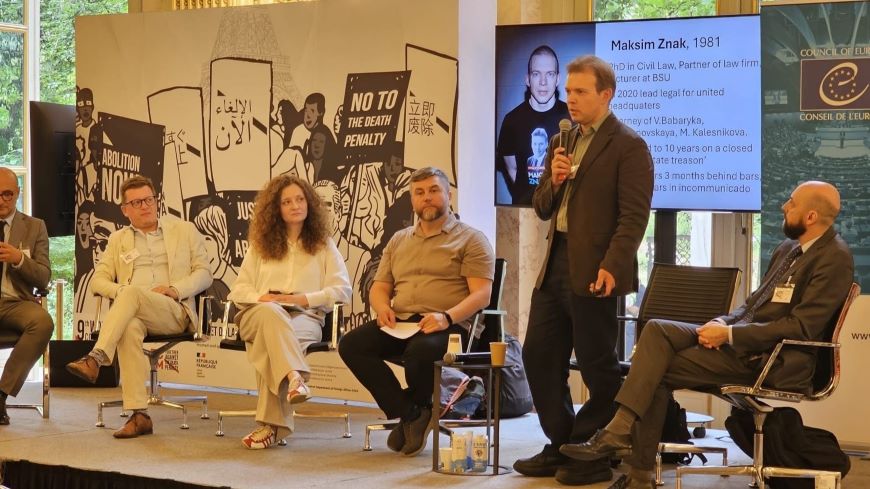
Council of Europe draws attention to the death penalty in Belarus at World Congress in Paris
Abolition advocacy discussed with Belarusian democratic forces and civil society in exile at a Council of Europe-supported event
 Who is doing what?
Committee of Ministers

The Committee of Ministers has been at the forefront of work to support Belarusian democratic forces and human rights defenders. In September 2022, it invited Secretary General to set up a Contact group to work with representatives from the Belarusian democratic opposition and report back. The aim is to provide Council of Europe support and expertise to strengthen Belarusian democratic society in line with the Organisation’s core values and along the activities for human rights, rule of law and democracy. To this end, the Contact Group ensures a pioneering framework for expert co-operation with Belarusian democratic forces and civil society in unprecedented conditions whereby they operate in exile against the background of ongoing political repressions in Belarus.
At its 134th Session, held in Luxembourg on 13-14 May 2025, the Committee of Ministers “reaffirmed its engagement for the work of the Contact Group on co-operation with Belarusian democratic forces and civil society, which has continued to provide an efficient and innovative framework for co‑operation, and reiterated the need to find ways to enhance co-operation with Russian and Belarusian human rights defenders, democratic forces, free media and independent civil society who are fully committed to the Organisation’s values, principles and goals, and welcomed the initiatives undertaken in this respect by the Parliamentary Assembly and the Congress of Local and Regional authorities, as well as the agreement signed between the Council of Europe and Lithuania on the establishment of a Council of Europe Information Point for Belarusian people in Vilnius (Lithuania)”.
It should also be recalled that the Ministers’ Deputies hold regular meetings with Ms Sviatlana Tsikhanouskaya and other representatives of Belarusian democratic forces in exile.
Parliamentary Assembly

The Parliamentary Assembly – which brings together parliamentarians from the Council of Europe’s 46 member states –has emphasised its strong support for Belarusian democratic forces, condemned repression by the Lukashenka regime, called for free and fair elections in the country, and demanded the release of political prisoners. The leader of Belarus’s democratic forces Sviatlana Tsikhanouskaya has addressed the Assembly on several occasions.
In a 2025 resolution, the Assembly said the so-called presidential elections in Belarus in January 2025 “lack any democratic credibility” and as a result it sees “no grounds for recognising the legitimacy of Aliaksandr Lukashenka as president”. In a resolution a year earlier, the Assembly set out wide-ranging proposals to build a democratic future for Belarus, including the creation of a representative delegation of Belarusian democratic forces to the Assembly, which has participated in its work since January 2025. The Assembly has also established a General Rapporteur for a Democratic Belarus.
A June 2023 resolution on Belarusians in exile called for legal and practical steps to ease their stay outside Belarus, and to support Belarusian education and culture outside the country. Concrete actions – "The Luxembourg Solutions"– were developed in 2024 , with parliamentarians and Belarusian democratic forces to carry this work forward. An IT tool to support the implementation of “The Luxembourg Solutions” is currently under preparation.
The Assembly has also demanded an international tribunal for Belarusian leaders involved in aggression against Ukraine. It awarded the Václav Havel Human Rights Prize to Belarusian human rights activist Maria Kalesnikava in 2021, condemned her detention and welcomed her release in December 2025.
Congress of Local and Regional Authorities

The Congress, as an active member of the Contact Group, implements activities aimed at promoting democratic values in line with the principles of the European Charter of Local Self-Government. A specific focus is placed on the key role of local authorities to promote and uphold human rights, and engage with women, youth, and under-represented groups.
In November 2023, the Congress gathered in Strasbourg a group of activists from diverse political affiliations, carefully selected with representatives of the Contact Group, for a first peer exchange on the principles and standards needed to establish an efficient local self-government system. Since then, the Congress has provided expertise in local self-government reform in view of a future democratic transition.
As of 2024, the Congress has implemented activities focusing on political support to the Belarusian democratic forces and on the provision of capacity development and expertise to guide the preparation of reforms and related legislation on local self-government and multilevel governance, based on the European Charter of Local Self-Government (which has been translated in Belarusian) and the 12 Principles of Good Democratic Governance.
In January 2024, Congress members attended the Helsinki Dialogue, and in March 2024, the leader of the Belarusian democratic forces Sviatlana Tsikhanouskaya addressed the Congress at its 46th plenary session.
In late 2024, Congress experts reviewed the “Local Self-Government Concept for a New Belarus” prepared by the Belarusian democratic forces and organised a series of online workshops to discuss about concepts and principles of local self-government, dimensions of decentralisation, and transition stages towards a free and democratic Belarus. A second series of webinars was conducted in December 2025 to delve into models of local self-government, good democratic governance, and democratic participation.
In March 2025, a representative group of the Belarusian democratic forces participated for the first time in history in a Congress session, following a decision of the Congress Bureau to invite such delegation to participate in the Congress sessions and statutory committees. In October 2025, the participation in the 49th session of the Congress was marked by the co-organisation of a side event on local responses to transnational repression against Belarusians abroad.
In December 2025, the Congress Rapporteur on a Democratic Belarus conducted a field visit to Poland (as the country where a large part of the Belarusian diaspora resides) with a view to drafting a report on the Belarusian democratic forces, including on local solutions to transnational repression. During this visit, a roundtable was organised in Warsaw to present a Congress’s expert analysis of the draft law on local self-government and relevant provisions of the draft Constitution of a democratic Belarus.
Commissioner for Human Rights

As part of his vital role in protecting human rights defenders, the Council of Europe Commissioner for Human Rights consistently called for support for Belarusian civil society following the suspension of relations with the Belarusian authorities. In 2022, the Commissioner stressed the importance of offering them stable residency in host countries, providing social benefits to them and their families, facilitating their work and easing the process of legal registration for new legal bodies. He welcomed the fact that some member states have implemented relocation and protection policies and called on others to follow suit.
Safety of Journalists Platform

 History
Belarus has ratified twelve of the Council of Europe’s conventions, including the anti-doping convention, the convention on the recognition of higher education qualifications and the convention against trafficking in human beings. Belarus also participated in various formats in the work of the European Commission for Democracy through Law, known as the Venice Commission, in the Enlarged Partial Agreement on Sport (EPAS) , in the Group of States against Corruption and in the European Pharmacopoeia. This participation has been either stopped or put on hold after 2022.
 Documents
Committee of Ministers
- Agreement between the Government of the Republic of Lithuania and the Council of Europe on Co-operation for the establishment of the Council of Europe Information Point for Belarusian People in Vilnius, Lithuania (6 November 2024)
- Reply by the Committee of Ministers to the Parliamentary Assembly Recommendation 2266 (2024) “A democratic future for Belarus” (9 October 2024)
- Co-operation with Belarus democratic forces and civil society (30 January 2024)
- Relations between the Council of Europe and Belarus - modalities for the participation of Belarus in open conventions (29 September 2022)
- The Council of Europe and Belarus (7 September 2022) (inviting the Secretary General to set up the Contact Group)
- Relations between the Council of Europe and Belarus (17 March 2022) (suspension of relations with the official Minsk)
- Relations between the Council of Europe and Belarus (16 March 2022) (participation of Belarus in the work of the Council of Europe)
Parliamentary Assembly
- The arbitrary detention of Vladimir Kara-Murza and the systematic persecution of anti-war protesters in the Russian Federation and Belarus (April 2024)
- A democratic future for Belarus (January 2024)
- War of aggression against Ukraine – Participation of Russian and Belarusian athletes in the Paris 2024 Olympics and Paralympics (June 2023)
- Addressing the specific challenges faced by the Belarusians in exile (June 2023)
Congress of Local and Regional Authorities
- Contemporary commentary by the Congress on the explanatory report to the European Charter for Local and Regional Authorities (in Belarusian: Актуальны каментарый Кангрэсу да тлумачальнага даклада па Еўрапейскай хартыі мясцовага самакіравання) (7 December 2020)
- The European Charter of Local Self-Government (in Belarusian: Еўрапейская хартыя мясцовага самакіравання)
Secretary General
- Possible steps to be taken with regard to Belarus’ participation in Council of Europe activities (16 March 2022)
Commissioner for Human Rights
- Support Russian and Belarusian civil societies and human rights defenders (Human Rights Comment, 31 August 2022)
Venice Commission
Thematic documents
Violence against women
- Istanbul Convention: Questions and answers (in several languages, including Belarusian)
Youth
- Resolution on the Council of Europe youth sector strategy 2030 (in Belarusian: Рэзалюцыя CM/Res(2020)2 аб стратэгіі моладзевага сектара Савета Еўропы да 2030 года)
Corruption
Trafficking in human beings
Civil society
- Stocktaking of the state of co-operation with the Russian and Belarusian civil society, September 2022
- Recommendation on the legal status of non-governmental organisations in Europe (in Belarusian: Рэкамендацыя CM/Rec(2007)14 Камітэта міністраў дзяржавам-удзельніцам аб прававым статусе няўрадавых арганізацый у Еўропе)
Abolition of the death penalty
- European and World Day against the Death Penalty, 10 October 2024 (including the joint statement in Belarusian)
Helping Belarusians in exile
- “Luxembourg Solutions“: outcomes and perspectives (including a checklist for national parliaments) in English, French and Belarusian
- Guide to Belarus (in English, French and Belarusian)
 Media requests can be sent to the Media Department of the Council of Europe in Strasbourg