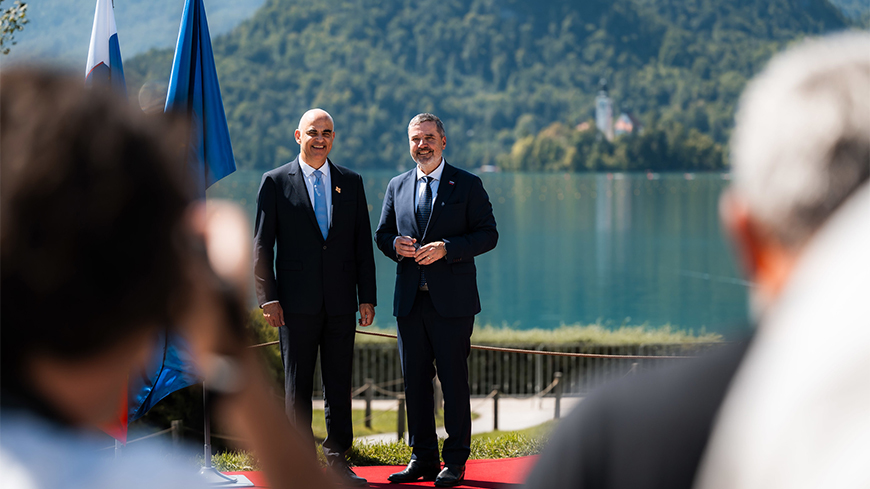
Ahead of Ukraine’s Independence Day on 24 August, Council of Europe Secretary General Alain Berset has reaffirmed the organisation’s solidarity with – and continued support for Ukraine, one of its 46 member states.
“Dear Ukrainians, 35 years ago, you restored your independence,” Alain Berset said. “You have defended it every single day. The Council of Europe is with you - in this war, for justice, into peace on your own terms”.
After more than four years of Russia’s war ravaging Ukraine and affecting the whole continent, a sustainable peace must be built by Ukraine, together with the rest of Europe, grounded in law and with accountability at its core. This has been the rationale behind the Council of Europe’s efforts to establish robust compensation mechanisms and to bring those responsible to justice.
Register of Damage and International Claims Commission: building a comprehensive compensation mechanism
The Council of Europe’s Register of Damage for Ukraine in The Hague has already received more than 180,000 claims for damage, loss or injury arising from Russia’s aggression. Some 58,000 of those claims have been recorded in the register, while the remaining are still being analysed. Just this month, the Register of Damage has opened nine new categories of claims, bringing the overall number of categories to almost 30.
In addition to claims submitted by individuals and organisations, the State of Ukraine can now claim compensation for humanitarian public expenditures, demining costs resulting from Russia’s aggression and losses due to the destruction of property. By the end of September, all of the planned categories will be open, including those related to loss of gainful employment due to the war, damage to cultural heritage and the environment, and loss of access to healthcare and education.
Work on the second step of the compensation mechanism, an International Claims Commission, is also underway. Once established, the claims commission, building on the work of the Register of Damage, will review, assess and decide upon claims, and determine any amount of compensation due in each case. Its legal foundation – the Convention establishing an International Claims Commission for Ukraine – was opened for signature in December 2025. Twenty-five ratifications and sufficient financial commitments are needed for the convention to enter into force and the claims commission to be set up. As of today, there are 40 signatories to the convention, of which seven states and the EU have also ratified it.
This June, the preparatory committee for the claims commission held its first meeting in The Hague.
Special Tribunal for the Crime of Aggression: accountability at the core
In June 2025, Ukraine’s President Volodymyr Zelenskyy and the Secretary General of the Council of Europe, Alain Berset, signed an agreement on the establishment of a Special Tribunal for the Crime of Aggression against Ukraine. After the signature, interested parties – including Council of Europe members and non-member states from around the world, plus the European Union – began considering joining an Enlarged Partial Agreement on the Management Committee of the Special Tribunal. In May 2026, in Chisinau (Republic of Moldova), 36 countries and the European Union expressed their intention to join the Enlarged Partial Agreement. The Netherlands has offered to host the Special Tribunal, and a Council of Europe advance team has been working towards establishing the Special Tribunal – with funding from the European Union – since January 2026.
The entire Council of Europe stands behind Ukraine
The Parliamentary Assembly of the Council of Europe (PACE) continues to push relentlessly for a comprehensive system of accountability for the Russian Federation, in particular accelerating the creation of the Special Tribunal. PACE stands alongside Ukraine by helping to further strengthen its democratic institutions, by contributing to vital reforms and by accompanying Ukraine on its path towards deeper European integration. The Assembly does so through its monitoring process and parliamentary support for the Verkhovna Rada. PACE’s Parliamentary Network on the situation of the children of Ukraine also supports the Ukrainian authorities in facilitating the identification of and search for deported children, as well as promoting the rights of displaced and refugee children.
The Congress of Local and Regional Authorities and its Centre of Expertise for Multilevel Governance work alongside Ukrainian authorities to strengthen local democracy and good governance as pillars of democratic security. Deliberative democracy is being rolled out through citizens’ assemblies in Ukraine. The work of the Congress bolsters public investment and local finances, fosters civic participation and intermunicipal co-operation, provides legal expertise to align Ukrainian legislation with the European Charter of Local Self-Government, and supports exchanges between mayors from Ukraine and other European cities. The Congress also raises awareness of the Register of Damage for Ukraine among war-affected communities.
The Commissioner for Human Rights continues to stress that human rights considerations must be central to any peace processes. In light of escalating Russian attacks and the unprecedented increase in Ukrainian civilian casualties, he has warned against the premature winding down of protection and assistance for millions of Ukrainians displaced across Europe by Russia’s ongoing war. The Commissioner has advocated that Council of Europe member states continue to provide protection for these Ukrainians for as long as necessary, until conditions in Ukraine permit their safe, dignified and durable return, in accordance with international refugee law and human rights obligations.
The European Court of Human Rights remains the only international judicial body holding Russia to account for its human rights violations in Ukraine, through the European Convention on Human Rights.
The mandate of the Special Envoy of the Secretary General on the situation of children of Ukraine includes raising awareness of the challenges faced by the children concerned and of the Council of Europe’s support to them, fostering international cooperation and internal coordination, including with the Register of Damage and the Consultation Group on the Children of Ukraine.
Democratic security for Ukraine: new action plan for 2027-2030
Building on the work carried out under the 2023-2026 Action Plan for Ukraine, entitled “Resilience, Recovery and Reconstruction”, which was the largest and most ambitious action plan in the organisation’s history tailored to a single country, the Council of Europe, in cooperation with its Ukrainian partners, is finalising the preparation of a new action plan for Ukraine for 2027–2030. Its goal is to reinforce Ukraine’s democratic resilience by advancing good governance, the rule of law and human rights, in order to support Ukraine’s strategic goal of strengthening its security through European Union membership, by aligning reforms with European standards.
The main priorities of the new action plan, entitled “Democratic security for Ukraine”, will include safeguarding human rights and accountability for peace and stability, fostering social inclusion and the protection of minorities, vulnerable groups and women, as well as reinforcing democratic institutions, information integrity and helping with the preparation of elections when conditions permit. The fight against corruption and for independent justice will remain among the key areas of the Council of Europe’s support to Ukraine in the years to come.