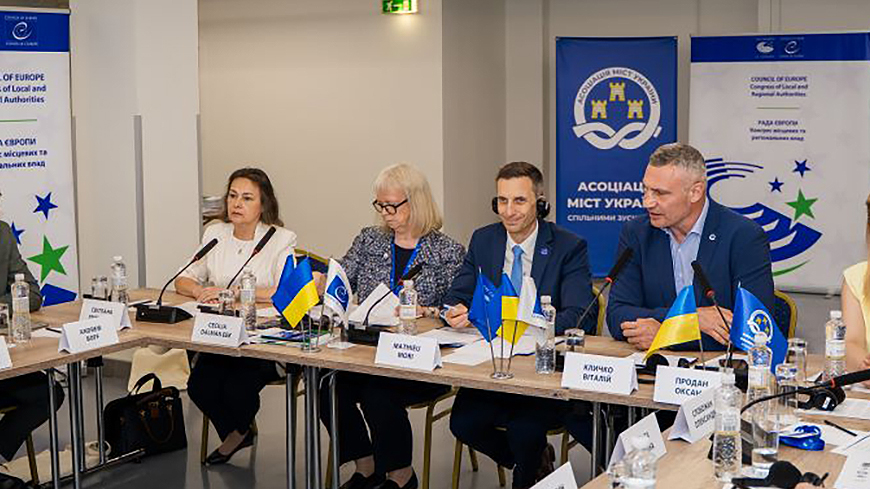
Kyiv’s Obolon district has concluded a citizens’ assembly dedicated to supporting veterans and their families, one of the most pressing challenges faced by Ukrainian communities during the Russian Federation's war of aggression against Ukraine. After three weekends of deliberation, participants developed and presented 24 recommendations to local authorities to strengthen local support for this fragile part of society.
Organised with the support of the Congress, the process brought together randomly selected residents reflecting the diversity of the district. The final session took place on 16 and 17 May 2026. Throughout the assembly, participants worked alongside experts, facilitators and veterans to identify key challenges and formulate practical proposals. These focused on improving access to services, strengthening inclusion, and enhancing communication between institutions, veterans and the wider community.
What has the citizens’ assembly recommended for war veterans?
The 24 recommendations addressed a broad range of issues, including dedicated spaces, such as a support and interaction space for veterans in the district, alongside a mobile support hub for veterans and their families; digital integration, by developing an interactive map of services and opportunities for veterans; improved access to social and digital services, with better coordination between local service providers; and awareness and education, through launching educational initiatives to promote respectful communication with veterans, alongside awareness-raising campaigns to counter stereotypes and support reintegration.
For many participants, the assembly became their first meaningful experience of civic participation. In their feedback they noted that the deliberative process created a rare opportunity for meaningful dialogue, mutual understanding and joint decision making among residents with different backgrounds and experiences. They also emphasised that implementing even a portion of these recommendations would represent a major milestone for both the local community and veterans’ policy as a whole.
The preparation and implementation of the citizens’ assembly were conducted as part of the Council of Europe Action Plan for Ukraine “Resilience, recovery and reconstruction” for 2023–26 and the project “Strengthening multilevel governance and local democracy to support Ukraine’s recovery”, implemented by the centre of expertise for multilevel governance at the Congress of Local and Regional Authorities.