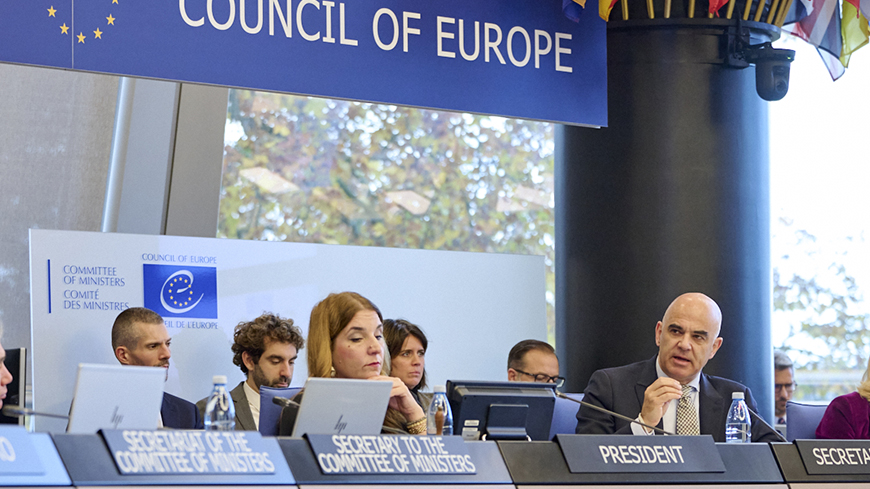
The human-rights situation in the areas affected by the armed conflict between the Russian Federation and Georgia in August 2008 is impacted by the fragile security environment, according to the new biannual consolidated report on the conflict in Georgia by the Council of Europe’s Secretary General, Alain Berset. The report also looks at major developments between April and September 2026.
Human rights issues in Georgia’s Abkhazia and Tskhinvali region / South Ossetia reported
“It is a fundamental objective of the member states of the Council of Europe to uphold the territorial integrity of Georgia,” the Secretary General’s report stresses.
It looks closely at the Georgian regions of Abkhazia and the Tskhinvali region / South Ossetia from the point of view of security, freedom of movement, humanitarian situation, identity documents and access to education, including teaching of and in Georgian as a native language.
Regular various scale illegal military exercises conducted by Russia and local security actors, violation of Georgian airspace and occupation line overflights, as well as military infrastructure reinforcement observed pointed towards a systematic militarisation trend while entrenching the overall perception of insecurity.
Illegal “borderisation” being imposed on Georgian territory
The illegal so-called “borderisation” and other unilateral restrictions continued, affecting the daily lives and enjoyment of human rights of the conflict-affected population, disrupting their access to basic rights, services and livelihood opportunities. Various forms of discrimination against ethnic Georgians, including by depriving conflict-affected children of the right to an education in their mother tongue, continue to deepen their alienation and increase the risk of new displacement. Concerns equally persist about the deterioration and distortion of Georgian religious and cultural heritage in both regions, the Secretary General’s report stresses.
No progress could be reported as regards the voluntary, safe, dignified and unhindered return of internally displaced persons (IDPs) and refugees on the basis of internationally recognised principles.
The report also covers the supervision by the Committee of Ministers of ECHR judgments in interstate cases brought by Georgia against Russia, namely the first examination in September 2026 of the case Georgia v. Russia (IV) related to the human-rights violations resulting from the so-called “borderisation”.
Consolidated reports on the conflict in Georgia have been prepared by the Secretary General since 2010, following a Committee of Ministers decision. The current report builds on the previous consolidated reports, the related decisions by the Committee of Ministers, as well as on the results of the fact-finding visit to Tbilisi on in September 2026.
 Full report on the conflict in Georgia
Secretary General Alain Berset
Read about the ECHR’s key judgment on “borderisation” in Georgia