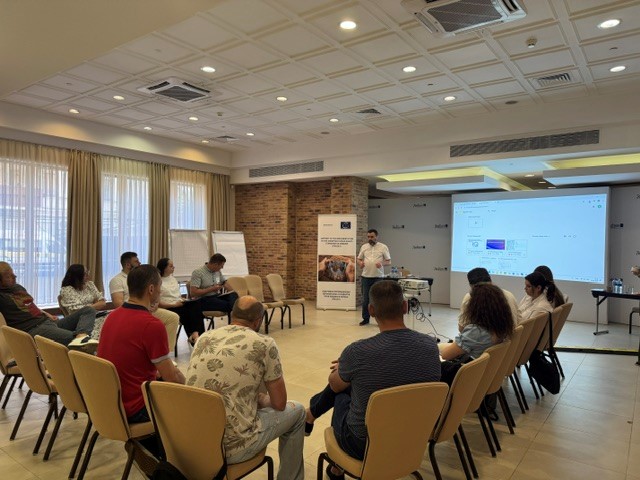
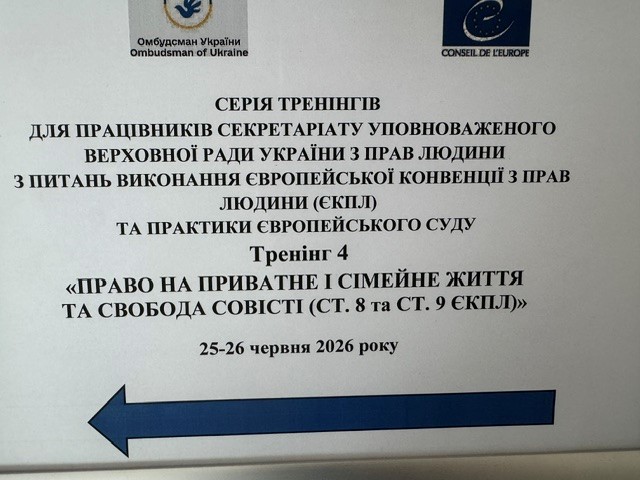
On 25–26 June 2026, a training session entitled “The Right to Private and Family Life and Freedom of Conscience (Articles 8 and 9 of the European Convention on Human Rights)” was held in Kyiv and organised by the Council of Europe. The event was part of a series of capacity-building trainings for staff of the National Preventive Mechanism (NPM) Department of the Secretariat of the Ukrainian Parliament Commissioner for Human Rights. The series aims to strengthen participants’ ability to monitor compliance with human rights standards in places of deprivation of liberty in line with European standards.
During the training, participants explored key aspects of the application of Articles 8 and 9 of the European Convention on Human Rights, including the protection of private and family life, the limits of state interference with these rights, and guarantees of freedom of thought, conscience and religion. Particular attention was paid to the practical implementation of the right to privacy in places of deprivation of liberty, including the protection of personal data, medical confidentiality, the confidentiality of psychiatric care, and the maintenance of family ties through visits, correspondence and modern means of communication.
The training combined expert presentations, small-group work and an analysis of the case law of the European Court of Human Rights. A dedicated session focused on the impact of martial law on the standards of protection guaranteed under Articles 8 and 9 of the Convention, as well as the possibility of derogations from these obligations during wartime. The training was delivered by lawyers Serhii Zaiets and Nataliia Gurkovska, who shared their extensive experience in the field of human rights protection and monitoring of places of deprivation of liberty.
Reference information: the Council of Europe Project "Support to the Implementation of the European Human Rights Standards in Ukraine: Phase II" is aimed at strengthening the system of human rights protection in Ukraine by bringing the national legislation in line with international standards and enhancing the operational capacity of the Ombudsperson to prevent torture and ill-treatment in places of deprivation of liberty and guarantee protection of the right to privacy and personal data.