Europe does not have to choose between security and democracy. It never did and cannot afford to start now. In his 2026 annual report, entitled “The New Democratic Pact for Europe in times of rupture”, Council of Europe Secretary General Alain Berset calls for a legal and democratic framework that lasting European security can depend on, and for rebuilding people’s trust in institutions.
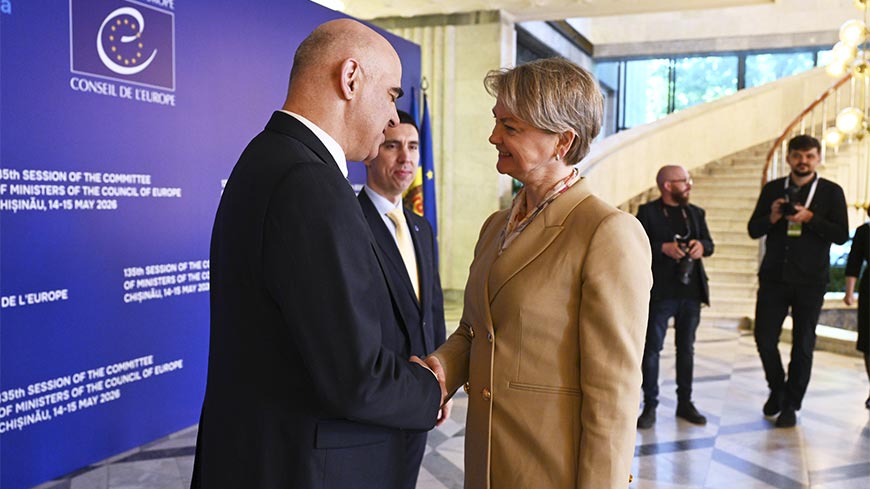
The Secretary General presented the report to the Ministers for Foreign Affairs of the 46 Council of Europe member states during their annual Committee of Ministers session in Chişinău on 15 May.
In the report, Secretary General Berset warns that “as Europe rearms on a scale not seen since the Cold War, we should ask what we are really defending, and whether force alone will ever be enough. That is where Europe’s current security model falls short, and where democratic security must begin”. He highlights the damage being caused by Russia’s full-scale invasion of Ukraine and other international crises. “Each unchallenged threat or use of force pushes the international legal order closer to the brink,” he adds.
Foreign information manipulation and interference, alongside the erosion of trust in democratic systems, undermine both the rule of law and social stability, jeopardising European democracies from within, he argues. He also emphasises the need for safeguards upholding human rights and democratic principles to keep pace with rapid technological change, particularly in digital technology and artificial intelligence.
Strategic importance of social rights, health, education and institutional trust
The Secretary General stresses that the strategic importance of social rights, health, education, and institutional trust has for too long been underestimated and dismissed as “soft security”. But that distinction, he argues, belongs to the last century. It no longer fits the Europe we live in. “Real security begins with institutions people can trust and democracies resilient enough to withstand pressure”, he underlines.
To address the challenges to democratic security, the Secretary General advocates broad partnerships, in Europe and beyond, and sets out the Council of Europe’s aim to take an innovative and balanced approach by combining protection and prevention measures with investment in education.
The report provides a state of play of the New Democratic Pact for Europe, the strategic and political process launched by the Secretary General in 2025 to identify integrated responses to democratic backsliding and to renew democratic governance across Europe. During the pact’s first phase, running until December 2026, an extensive consultation process is underway.
In the report, the Secretary General states that “the ambition of the New Democratic Pact for Europe is to rebuild trust in institutions and strengthen democratic resilience in an age of permanent crises”. “Nowhere is this more evident than in Ukraine. There, the Council of Europe is helping build accountability for Russia’s war of aggression, where none existed before, while placing democratic resilience at the centre of recovery and reconstruction”, he says.
Six key areas of the Secretary General’s report
The Secretary General’s 2026 annual report is structured around six chapters, each devoted to a strategic transversal area selected for its critical relevance to strengthening democratic resilience:
- Countering information manipulation, disinformation, and strengthening resilience
- Promoting social rights as a factor of democratic resilience
- Defending equal rights and promoting gender equality and inclusion
- Safeguarding elections and democratic processes
- Inclusive participation, civic space and fundamental freedoms
- Positive use of digital technology and artificial intelligence, including countering cyber-enabled threats.
Each chapter combines an overview of ongoing work with emerging orientations and concrete initiatives, connecting analysis, policy directions and implementation. The report highlights the relevance of ongoing Council of Europe work and emerging directions for reflection and possible future action, introducing new ideas and initiatives emerging from the pact consultation process.
 Read the Secretary General’s annual report for 2026 in full
 Secretary General Alain Berset
Find out more about the New Democratic Pact for Europe