Ukrainian lawyers are increasingly turning not only to national courts but also to European human rights mechanisms, in particular the institutions of the Council of Europe. However, for these mechanisms to truly work in a client’s favour, it is important to understand their powers, procedures and how they are applied in practice.
It was with this aim in mind that the Council of Europe projects “Fostering Human Rights in the Criminal Justice System in Ukraine – Phase II” and “Strengthening the Social Dimension in Ukraine” supported the Ukrainian Bar Association in organising a series of webinars for lawyers from civil society organisations working on war-related cases.
During July and August, 50 participants took part in a series of educational webinars on European human rights protection mechanisms and the work of key human rights institutions.
One of the first lectures was delivered by Ms Alla Fedorova, a member of the European Committee of Social Rights, who introduced participants to the Committee’s case law and its approach to interpreting European standards in the field of social and labour rights under the European Social Charter. Particular attention was paid to the Collective Complaints Procedure, including the potential benefits that its acceptance could bring to Ukraine and the opportunities it offers for strengthening the protection of social rights.
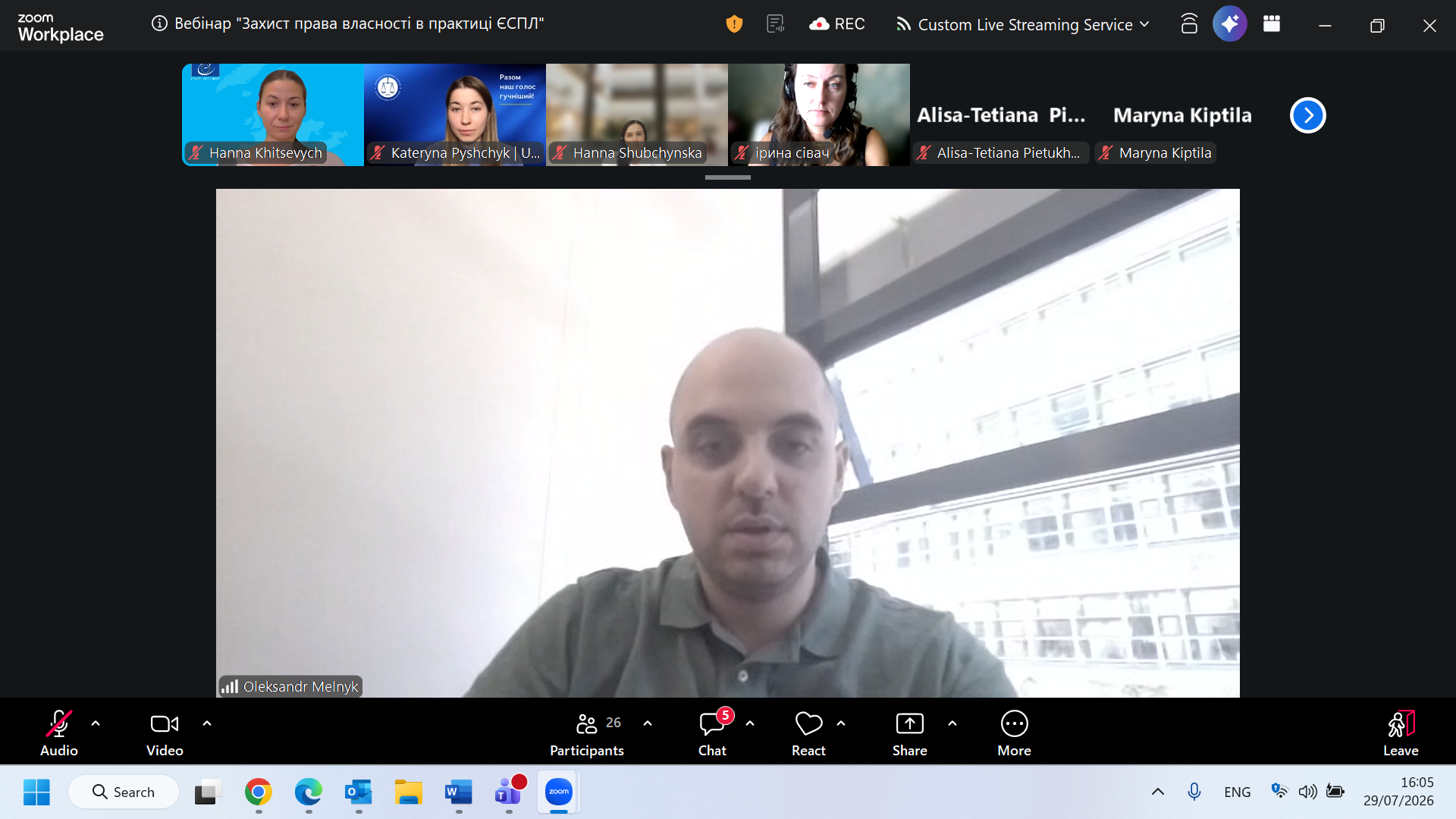
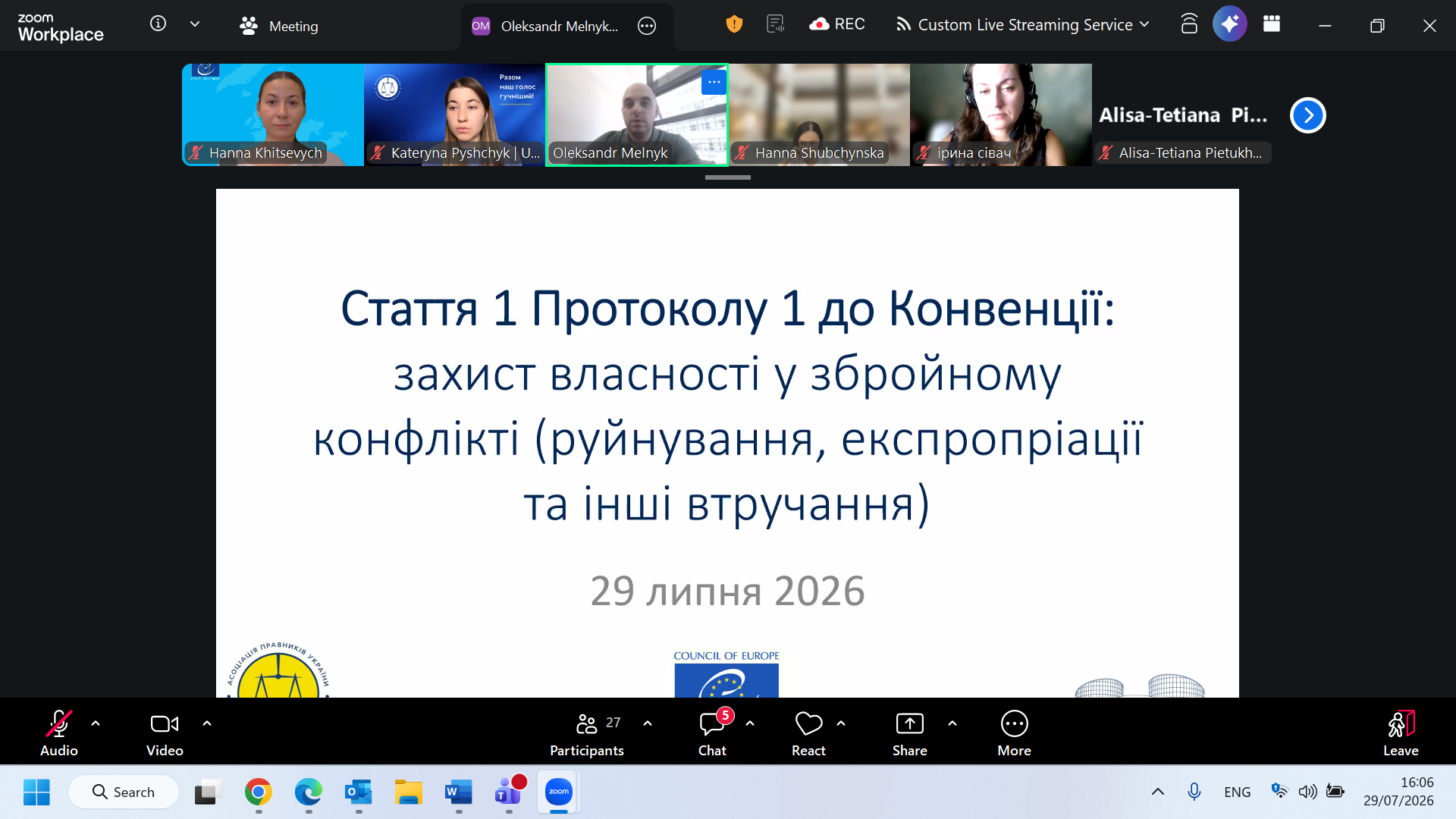
An interactive lecture by Oleksandr Melnyk, a lawyer at the Secretariat of the European Court of Human Rights, focused on the case law of the European Court of Human Rights concerning the protection of the right to property in situations of armed conflict. The speaker systematically explained the rationale behind the application of Article 1 of the First Protocol to the European Convention on Human Rights – from the classic ‘three-part test’ to the criteria for the admissibility of applications – whilst constantly referring to the Ukrainian context and current international challenges.
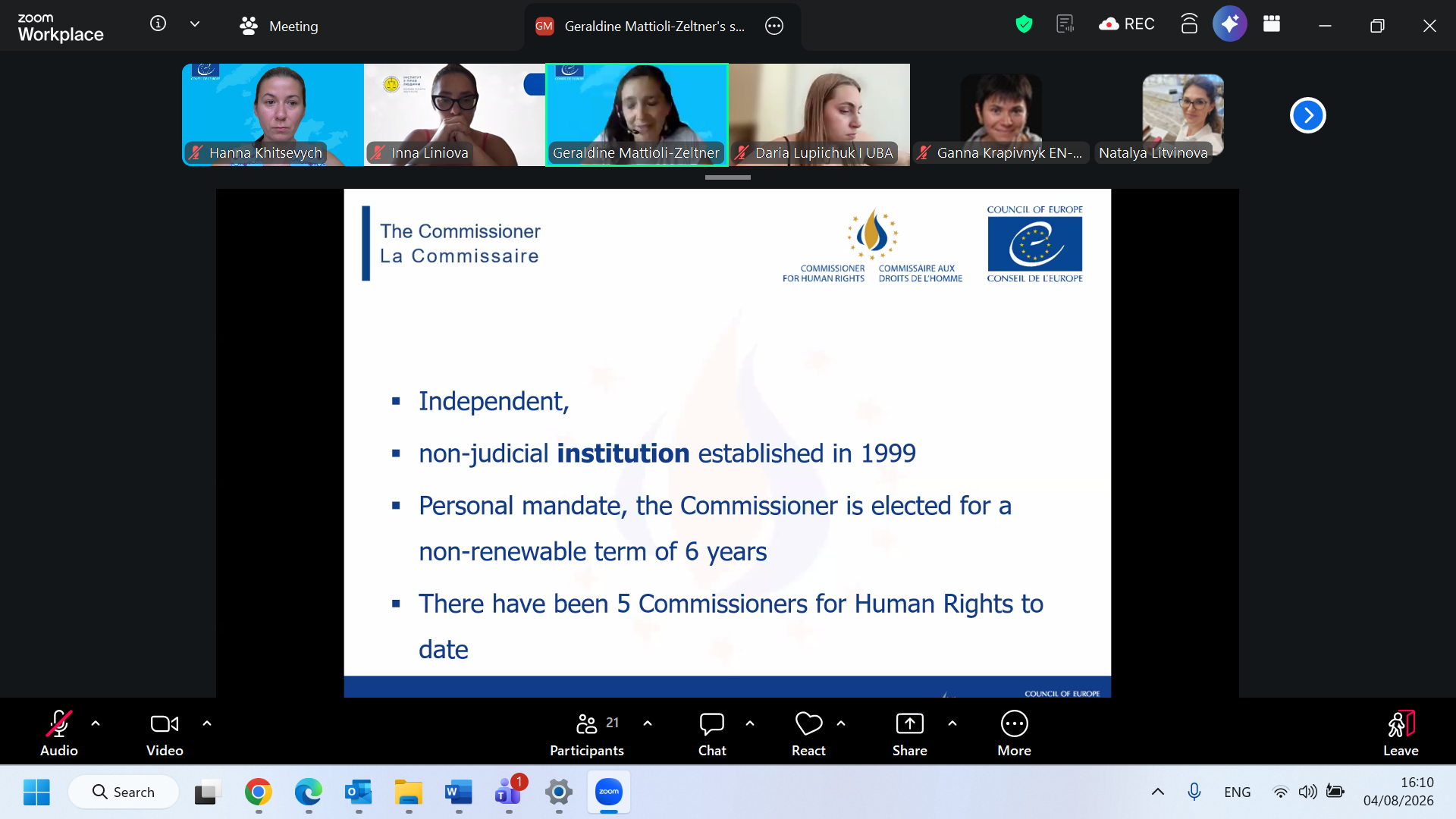
Ms Géraldine Mattoli-Zeltner, Adviser to the Council of Europe Commissioner for Human Rights, spoke about the Commissioner’s mandate and key areas of work. During a lively discussion, she answered participants’ questions regarding practical cooperation between the Commissioner’s Office, Ukrainian civil society organisations, representatives of the legal community and independent experts. Particular attention was paid to the possibilities for the systematic submission of analytical materials, expert opinions, thematic reports and proposals for the Commissioner’s memoranda and recommendations.
One of the key parts of the programme was a presentation by Ms Dalia Žukauskienė, an adviser to the European Committee for the Prevention of Torture, on the mandate and activities of the European Committee for the Prevention of Torture and Inhuman or Degrading Treatment or Punishment. Participants discussed the practical aspects of the Committee’s work and its significance for the protection of human rights in places of detention.
The series of webinars was concluded by Mr Oleksandr Marusiak, a national consultant to the Council of Europe, who presented a comprehensive overview of human rights protection mechanisms in the European Union, its institutional framework and sources of law. This topic aroused particular interest among the participants, as an understanding of how the EU’s legal system and European human rights institutions function is becoming increasingly important for Ukrainian lawyers in the context of the negotiation process regarding Ukraine’s accession to the European Union.
The event was organised by the Council of Europe as part of the projects “Fostering Human Rights in the Criminal Justice System in Ukraine – Phase II” and “Strengthening the Social Dimension in Ukraine”, which are being implemented under the Council of Europe’s Action Plan for Ukraine: ‘Resilience, Recovery and Reconstruction’ for 2023–2026.