What is Europe? Where does it start? Where does it end? How many countries are there in Europe? Who can claim to be a European? Is there a European culture?
The end of the Cold War in 1989 brought with it the processes of enlarging the membership of the Council of Europe and the European Union. The European Union enlargement has not been an easy process, entailing much more than just aligning and preparing economies for the common market. While it is common in Europe to talk about members and non-members of the European Union, it has become equally more common in recent years to talk about a European Union with two speeds. European citizenship is both an expression of a legal status with rights and responsibilities for citizens of member states of the European Union, as well as the expression and commitment of people to European values and a sense of identity that goes beyond the borders of EU.
Founded in 1949, the Council of Europe is today a Europe-wide organisation with 47 member states. At the Vienna Summit in October 1993, the Heads of State and Government cast the Council of Europe as the guardian of democratic security – founded on human rights, democracy and the rule of law. Democratic security was considered as an essential complement to military security, and a pre-requisite for the continent's stability and peace. As the continent was transformed by different political processes, particularly the European Union enlargement, it was also exposed to new threats such as terrorism, violent extremism, aggressive forms of nationalism and a resurgence of authoritarian regimes.
As the border controls disappeared between certain European countries, the barriers increased to those outside of these areas. The Schengen Agreement encompasses 22 EU member states and four non-EU member states (Iceland, Norway, Switzerland and Liechtenstein) that decided to lift or abandon border controls between them. On the day when the Accord came into force early in 1995, there were 24-hour queues at the German-Polish border. Wind forward 20 years later and the refugee crisis of 2015, in addition to the COVID-19 pandemic, saw the extraordinary situation of the Schengen Agreement being temporarily lifted and countries imposing border controls or completely shutting down their borders for the first time in many years.
Minorities in Europe
Attention! A minority in one place can easily be a majority in another place.
In nearly every state there are “traditional” minorities: ethnic groups who have been present for centuries but who have different characteristics, manners, habits and ways of life from the majority. Multitudes of examples could be cited; here are some, and you can find many more. European history is littered with expansionist movements, trading relations, and religious and military conquests. All of these have provoked movements of peoples. The 11th century Norman knights managed to set up dominions as far apart as Britain, Spain and Sicily; the forces of the Ottoman Empire reached the walls of Vienna in 1529 and again in 1683. Many places have seen terrible times; as Richard Hill points out, the town of Ilok, now on the eastern border of the independent state of Croatia, is an illuminating example. At the time of the Ottoman Empire, Ilok was a Muslim settlement. Before that it was Catholic. In 1930, many of the inhabitants were German and Jewish. In 1991 it counted 3 000 Croats, 500 Serbs and 1 900 Slovak descendants of migrants from the 19th century. A year later, in 1992, the population consisted of 3 000 Serbs. Since the end of the war, the majority population is once again Croat.
For Spain, these traditional minorities are, mainly, the Roma and Sinti (or Gitanos) people, who are also an ethnic minority in many other countries, and Muslim, Jewish and Hindu communities. In Sweden, there is a sizeable Finnish minority. In Turkey, an estimated 17% of the population are Kurds and they are only one of more than 14 ethnic minorities. There are more than 30 000 Travellers in Ireland. About 6.5% of the population of Romania are Hungarians.
Having been in the minority within the federation of Yugoslavia, Slovenians are now the majority in Slovenia, making up around 88% of the population. Declarations of independence and the carving up of territory after wars have played an enormous role in “creating” minorities. With the collapse of the Soviet Union, 25 million Russians were living outside of the Russian Federation and – particularly in Estonia, Lithuania and Latvia – formed minorities of some magnitude in the newly independent countries. In 1920, the Treaty of Trianon cut off two-thirds of Hungarian territory together with one third of its population and many of those people stayed in their towns and villages. Their descendants can be found mainly in the Romania, Slovak Republic, Ukraine, Croatia and Serbia.
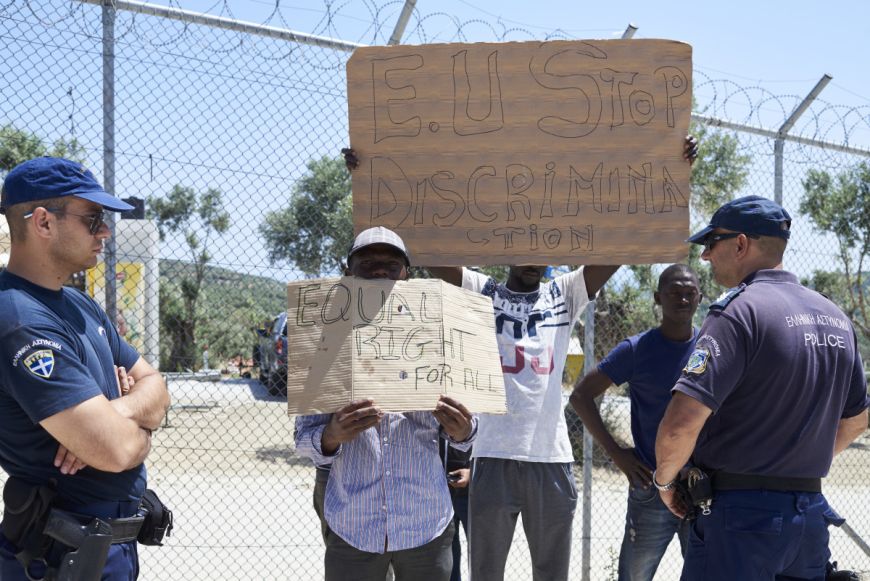
The decision to recognise or define a group of people as a “minority” is a fundamental challenge and a danger. It is dangerous because it can lead to increased discrimination and segregation. On the other hand, it can lead to an increase in recognition and respect of the rights and responsibilities of a particular group.
No state in Europe has within its borders people who only speak one language, although there are some who choose to have only one official language. Language plays an enormous role in the culture of a people and this is particularly prevalent in the case of minority languages, whose communities often associate language closely with the expression of identity and culture.
Migrants, Immigrants, Refugees
Terminology is also difficult in this area. It is an accepted practice in many European countries to talk of “migrants” as people who have origins in another country. To those young British passport holders from Manchester who are of, say, Jamaican origin and whose parents were born in Britain, it comes as something of a surprise to learn that they could be considered migrants. Some talk of “immigrants”, others of “guest workers”. Although it would suit some forces if migrants were to remain just that, it has become increasingly clear that many migrants wish to stay.
Problems of definition and different methods of collecting statistics mean that, often, comparable data between countries does not exist. Almost by definition “illegal immigrants” are incredibly difficult to count but, especially for unscrupulous politicians, incredibly easy to estimate. (It is a little like the concept of the silent majority – as it is silent, anyone can claim to speak for it.) People are not “illegal”; it is the legal system which defines them so. If you add to these considerations the fact that each country has different rules and rates for processing applications for naturalisation, it seems obvious that statistics have to be viewed with extreme care. Yes, even the few we use in this education pack.
We referred earlier to the differing patterns of migration within and into Europe. Until the beginning of the 1990s, the main cause of immigration was the re-unification of the families of migrant workers who had settled in the ‘60s and ‘70s.
At a migration conference of the Council of Europe in 1991, it was predicted that, within three years, up to 20 million people would emigrate westward from the countries of the ex-Soviet Union. This did not happen, but such wild predictions have helped produce public support for increasingly strict immigration controls in Western Europe. In the midst of the ‘refugee crisis’ in Europe in 2015, Viktor Orbán, the prime minister of Hungary, declared, “We do not see these people as Muslim refugees. We see them as Muslim invaders.”
Throughout the world there has been a massive increase in the number of refugees and asylum seekers in the last decades. The United Nations High Commissioner for Refugees called the decade 2010-2019 “the decade of displacement”, with at least 100 million people forcibly displaced. Among these people, only a very small fraction found a solution. The figure for 2019, 79 million people, is the highest ever in the records of the organisation, roughly 1% of the world population. The COVID-19 pandemic placed refugees and asylum seekers living in improvised camps at higher risk of contracting the disease and being unable to access proper medical care.