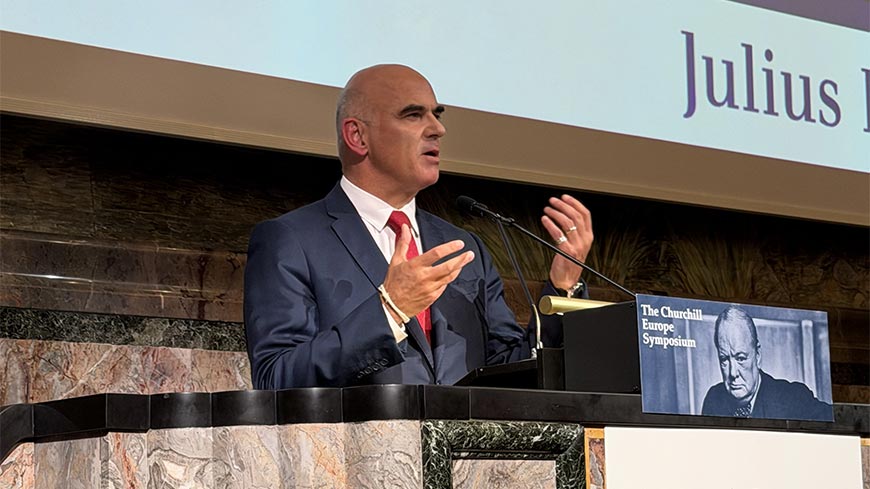
The Secretary General of the Council of Europe, Alain Berset, called on Wednesday for joint efforts to strengthen Europe’s common legal space, at a time when multilateralism is under pressure.
Ukraine, a priority for Europe
“The belief that peace is built through law and cooperation, as enshrined in the Statute of the Council of Europe, is being severely tested today,” said Mr Berset at the Parliament’s Foreign Policy Day in Bern. “In Ukraine, Russian aggression is the very antithesis of this,” he added.
Speaking to Swiss parliamentarians, he stressed that international law was losing ground. “This breakdown is not inevitable,” said Mr Berset, illustrating his point with the outcome of the elections in Serbia, where “democracy prevailed”.
The Secretary General reiterated the Council of Europe’s key role in supporting Ukraine, particularly in efforts to establish accountability through the Register of Damage, the Claims Commission and the Special Tribunal.
The European Court of Human Rights is the only international court adjudicating human-rights violations committed in this war. “Together with the European Convention on Human Rights, the Court is the cornerstone of our common legal space,” he said.
Safeguarding democratic security amid new challenges
The Secretary General also highlighted the need to strengthen democratic security, which rests on citizens’ trust in their institutions and the ability of democracies to withstand pressure, whether in the form of disinformation, corruption or attacks on the independence of the judiciary.
“When faced with these attacks, the temptation to put security first is strong. But a democracy that protects itself by restricting freedoms plays into the hands of its adversaries. What we need is a secure democracy, not one driven by security,” he stated.
The New Democratic Pact for Europe aims to address this challenge. In a changing world, Mr Berset also emphasised the need for the Council of Europe to adapt and to increase its impact.
Lastly, the Secretary General noted that, as far back as 80 years ago, in a speech delivered in Zurich, Winston Churchill called for the creation of a Council of Europe as a guarantee of peace and stability for the continent.
“Peace founded on justice is a choice, and it is up to us to make that choice again today, together. Parliaments have a part to play, too, for it is through laws that our common legal space grows. Serbian students took their anger right to parliament. That is where a democracy turns it into a choice,” he concluded.
During his visit to Bern, he also met Guy Parmelin, President of the Swiss Confederation, and Alexandre Fasel, State Secretary for Foreign Affairs, to discuss, among other things, the geopolitical situation, the reform of the Council of Europe, Ukraine, the South Caucasus and Türkiye.