All Different - All EqualCombating racism and discrimination with young people
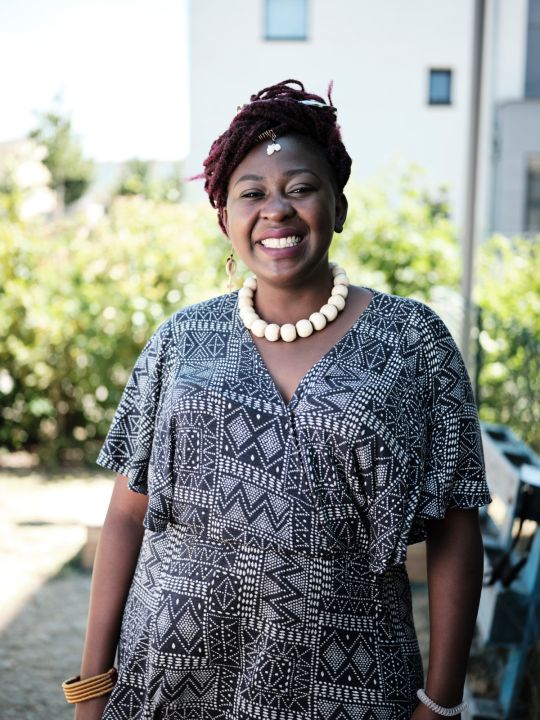
They tell us there is no racism, yet race is all over the pIace: An interview with Rokhaya Diallo [RD]
Gavan Titley [GT]
GTCould you tell the readers a little bit about the main strands of your involvement in anti-racist activism, and thought and writing?
RDBefore being involved in anti-racism, I was first involved in feminism. What struck me in the anti-sexism struggle was the fact that it was so white. This was the early 2000s, when there was the very offensive language against Muslim women, especially those who were wearing a hijab, and I didn’t understand why they should not be included in mainstream feminism. Also, I grew up in Paris in a very diverse neighbourhood; the colour of my skin was not a very important matter. But the more I advanced my studies, the less there were people that looked like me and when I became a young adult, I realised that people didn’t see me as I saw myself. I thought I was just a regular French girl at that time, but I wasn’t. Many people asked me where I was from, implying that I couldn’t be a random French person.
At this point in my life I started thinking about how France was represented itself in the media. I started my own organisation, Les Indivisibles, in 2007, because I wanted to tackle the racist statements that I encountered on the TV and in newspaper debates, and at the same time just to claim the fact that being French was not a matter of skin colour or religion. We organised a parody of the academy awards called the “Y’a bon Awards”. The purpose was to “reward” the worst racist outbursts authored by public personalities; we used activism and humour to draw media attention.
Racism and the politics of denial
GTYou described that moment, of moving from one part of the city, where the colour of your skin is not really an issue, to other parts of life, where there is clearly a sort of racialisation going on. One of the things this project emphasises is that, across the countries of the Council of Europe, racism takes slightly different shapes. In France, there is something very particular about how the Republic presents itself as colour-blind and universalist, and yet the social and political experience of so many people is one of being treated in racialised or racist ways. Could you say something about that tension in France?
RDThe main thing in France is that you are raised not to take race into account, with the myth of the French Republic as colour-blind, so you live with that idea that, whatever race you are, it is not an issue. However, once you experience your life, you feel that it is not the truth. I was fortunate because I was a good student and I mostly grew up in very diverse neighbourhoods, so it took me time to understand that. But once you are an adult and you look for a job or to find a house, you face race. You understand that people do not see you as you see yourself, and that they project things on to you. There is this constant contradiction where you are supposed to say that you are French and nothing else, but people will constantly remind you that you don’t look like a “regular French person”, so it is very confusing.
GTIt’s very confusing. And, in all the different situations in Europe, it is fascinating that there is so much denial about this. In France, where does the strength of that denial come from?
RD I think that, in France, denial is one of the strongest sources of racism. It’s the thing that really makes you crazy, that really hurts you. Because you are living something that nobody wants to address. And at the same time, race is all over the place. Politicians, public personalities and media use a coded language and you understand that it’s about race, but they rather use, say, religion. You know that it targets a group or population, but they hide behind values to just address race without saying race. Therefore, it is very difficult because you cannot openly discuss race, but at the same time it can be there, at the centre of a political programme.
GTThere is a very specific debate and conflict around Islam in France right now, but there is of course a version of this in many countries when it comes to thinking about Islamophobia as racism, a specific kind of denial, that this can be a form of racism because it is about objecting to ideas, or values or religion as such. Could you say a little bit about how this sort of anti-Islam politics works as racism in your experience?
RDFrance is very into assimilation, and a way of saying to people that they don’t belong is to point out everything that is not considered “French”. This is very strong if you have a religious practice that you are willing to make visible, and you are told not to be that visible, because of the French idea of laïcité, which is a mix of legislation, ideologies and values[1]. But this requirement it is not even included in the law, so they say that there is something above the law, like a bunch of values that you don’t know. There is also another level of denial, namely the idea that France is not a multicultural country. But it is the most multicultural country in the world, since it is on four continents. The only space in South America that is still controlled by a European country is French Guiana – you cannot have your largest border with Brazil and say that you are not multicultural! We have people all around the world; we have people who are black because they are the descendants of enslaved Africans.
GTIt seems that since 2015 the situation has become much harder in some ways for anti-racist politics; there is the strength of the hurtful denial you mentioned, but after the terrorist attacks there has been a very aggressive attack on anti-racism. What kind of effects is that having on anti-racist activists, especially when there are very particular tensions between forms of anti-racism in France?
RD You have a group of people who claim to be anti-racist, and which is mostly composed of white people who say, who tell people that are mostly people of colour, that they are not pursuing the right kind of anti-racism work. So, to me that is very telling, like how can a white person tell a group of people that is mostly a group of people of colour that they are not doing their work right when it comes to anti-racism. For some it is worrying or unacceptable to see French people of colour organising themselves and having access to the public sphere, it’s something that didn’t happen before. And it is happening thanks to social media, because those are the people who are not even allowed to be in the public debate because the media wouldn’t pick them. But now they have the possibility to make noise on social media, it has just shifted the framing a little bit. There is a minor breakthrough in the public sphere and I think that the “panic” that we are witnessing now is caused by that. There is also the fact that years ago, decades ago, it was official anti-racism organised by the government with official figures, with the official celebrities, and now it’s coming from the ground, from the grassroots like the Comité Adama[2], for example, against police brutality. This came from the place where Adama Traoré died and it came from his family, from his friends, and from that point it spread all over the French landscape, but it didn’t need to have media approval to exist. And then the media was forced by the strength of the movement to cover it. This is something that is scary to people that used to have control, the access to the public sphere, and I think that is one of the major changes of the last decade, this democratisation of the public space, thanks to the Internet.
Thinking about Black Lives Matter
GTCould you reflect a little on the way that Black Lives Matter, after the murder of George Floyd, impacted on the French political landscape? In what ways was it translated into the political context?
RD The death of George Floyd was so well-covered by the French news outlets that local activists grabbed the momentum in order to draw attention to what was going on in France. They were like, “you are covering what’s going on across the Atlantic, but we are having trouble here, so you need to pay attention to what we have to say here”. So that is the reason why the Comité Adama had these huge protests against police brutality and to make people remember that many people in France have died at the hands of the police and those names are not really known by the general public. I think that it just echoes how other European movements used the momentum to just say, “it’s going on here also, so you need to cover what is going on here, you cannot just speak about George Floyd without speaking about what’s going on here”.
GT When you look now at the range of movements that exist, all of which are mobilising against something similar, but also different kinds of racism, how would you describe that sort of landscape of movements, the points of co-operation and perhaps the forms of tension?
RD As in any movement, I am sure there are many tensions, because it’s just human relationships and that’s how it works, but what I’ve seen is that you have several different movements which are trying to do their best not to erase the work of the others and trying to understand the intersectional dynamics. For example, in this Covid-19 period, there have been attacks on people of Asian descent. There is an Asian anti-racist collective, who issued a statement. In the statement, they were really careful to include the others in their struggles and not to create an opposition against other minorities, because we have seen some people from minorities, like black people, our people, who are posting tweets that are very offensive to Asian people. So, they were very careful and I think it was interesting because they were very grateful for the struggles of other minorities that could benefit them and tried their best to say that we are not against other minorities; we understand racism as being systemic and as being one of the consequences of white supremacy, which was very accurate to me.
Anti-racisms today
GTMoving to a conclusion, when you think about anti-racism today, what do you think some of the main priorities, some of the main lines of struggle are?
RD I think that the main priority is to stop state violence. I think that is especially important as we are discussing this during the Covid pandemic, there have been several lockdowns, and it is a time where the police have more power, controlling people going out in the streets, so they have more leverage to hurt especially people who are already over-policed[3], so I think that institutional violence is one of the main priorities.
GTDo you think, at the moment, that it’s really possible for autonomous, anti-racism to work with forms of state-led or state-sponsored anti-racism? This has always been a question, but at the moment, it seems to be a very difficult one.
RD I think that it is very difficult to oppose state violence, to oppose institutional racism, if you are willing to get funds from the institutions. I don’t know how it works in other countries, but in France I definitely don’t see that happening; I see rather the opposite. When there was an Afro-Feminist organisation, trying to have safe spaces for black women only, the mayor of Paris said that she would sue them for anti-white discrimination[4]. She didn’t, because the meeting was happening in a private space, but that’s what is going on! She wouldn’t support the festival, but she would even use the force of the city to sue a group of black women, who were meeting just be together and speak about what they are experiencing as black women.
More generally, I think the fact that there are so many debates, so many young figures, so many new people speaking out about racism, is something very positive. And there is now some important vocabulary that comes from the activist circle, that is now being more and more mainstreamed, even if it faces strong opposition. To me, it’s a victory and the fact that you have so many mainstream people organising themselves to protest and to say that there is an important threat from the non-colonial movement means that something is happening, because they wouldn’t panic if there was no power from the side of the anti-racists, so I’m quite optimistic to see them so agitated. That is, because I don’t think it’s possible to have anti-racism being accepted, it’s questioning the structure of the society, so it cannot be welcomed very peacefully. So, whenever there is anti-racism or anti-sexism, it will face opposition and agitation, so I think it is part of the work!
[1] The French word laïcité refers, in a somewhat rough conceptual translation, to a form of state secularism. It was given legal and institutional form in the late 19th and early 20th centuries in a series of laws that mandated the separation of church and state through a requirement on government to be neutral in matters of religious faith, while protecting the right to freedom of religion. However, it cannot simply be considered as a matter of law, but also of dominant institutional and public values, and a major, if unstable, dimension of political ideologies.
[2] Le Comité Adama or, le comité “La vérité pour Adama” (Truth for Adama committee) is a movement set up to seek justice for Adama Traoré, who was killed by the police in Paris on 19 July 2016, his 24th birthday. Internal police investigations have cleared the police officers involved, his older sister, Assa Traoré, has been central to the campaign for a proper public investigation, and the campaign has mobilised significant protests against police violence in France. In 2020, Time magazine named Assa one of their Guardians of the Year.
[3] Some weeks after this interview was conducted, a viral video of Parisian police brutalising Michel Zecler, a music producer who was not wearing a face mask on the street outside his music studio, caused a significant political scandal.
[4] In 2017, the then Mayor of Paris, Anne Hidalgo, accused the Afro-feminist collective Mwasi of organising an event that was “prohibited to white people” and therefore ‘racist’, because, as part of their Nyansapo festival, some meetings were reserved for black women to examine their shared experiences of racism. Read the article on Aljazeera website.
Rokhaya Diallo is a French journalist, writer, and award-winning filmmaker widely recognized for her work which dismantles the barricades of racism and sexism through the promotion of equality and pluralism.
TV host and a pundit on several French and international networks, Rokhaya is also a contributor to several newspapers and magazines including the Washington Post. She has also directed several documentaries including the award-winning Steps To Liberty and Acting While Black.
She has been the recipient of several awards including the Women in Digital Feminine Communication Award from #LabcomWomen in the Generosity category created by the channel TF1 and the distinction paying homage to her work in the Journalist of the Year category 2016.