World Forum for Democracy 2025: Art events and exhibitions
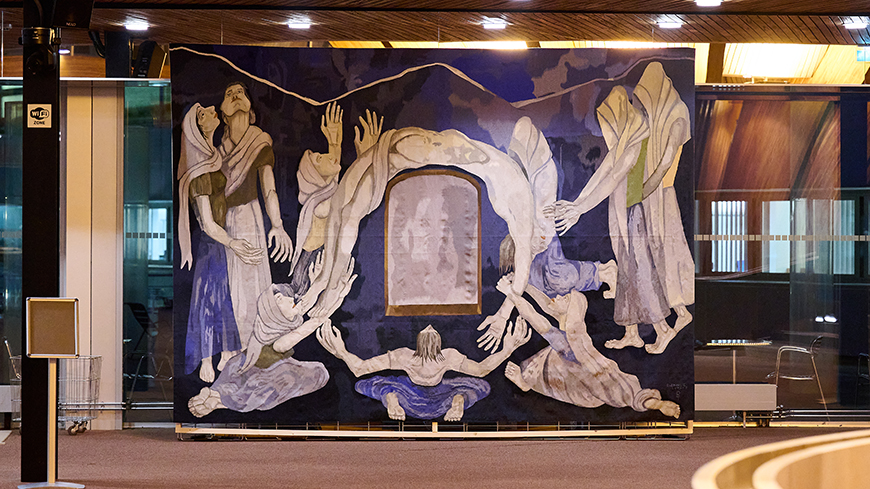
Tapestry “El Holocausto”
Lobby of the Hemicycle
A monumental piece of art measuring approximately 4x3 meters. It was woven in 2019 by the renowned French atelier Pinton in Aubusson, the same that wove one of the tapestries reproducing Picasso’s Guernica.
While “El Holocausto” clearly depicts suffering, it is also a call for remembrance and a solemn reflection on humanity. El Holocausto’s message should be reframed to show what it stands for: humanity, solidarity and resilience. The figures are not just mourners. They are witnesses and caretakers, bound together by love and empathy. They illustrate what must endure: the shared dignity, the capacity to remember, and the strength when we stand together. It is a place to grieve, and to affirm life, empathy, and justice. The figures mourn what was destroyed and honor what we must protect. It is as much about what was lost as what can still be saved. They hold space for both memory and action, thus challenging the viewer to be more than witnesses to the past. They call upon us to be defenders and activists for dignity, justice, and human rights.
In line with his mandate to promote education in and awareness of human rights across member states, the Commissioner uses artistic expression to engage with a wide audience and especially with young people.
Exhibition by Francesca Balzan, Rebecca Bonaci, Shaun Grech and Kane Cali
Existence moves in cycles: creation, growth, erosion, renewal. These rhythms echo through nature and through the human spirit, in the ways we form and decay, remember and forget, build and erode. The exhibition traces the nonlinear pulse of being, the ceaseless oscillation between becoming and unravelling, a fragile balance where opposites meet.
The works gathered here reflect a world in constant renewal, one where forms and identities pass through cycles of replication and change.
Through this dialogue between serenity and violence, the exhibition unfolds as a meditation on resilience and the cyclical nature of existence. In tracing the rhythm of creation and collapse, we glimpse our own humanity, fragile yet persistent, shaped again and again by the will to endure
The spatial arrangement follows a transition from emergence to disintegration, mirroring the exhibition’s conceptual journey. The first room invites touch and recognition, while the second immerses the viewer in emotional and material upheaval, concluding with renewal through resilience.
The House Where Ukrainian Diplomacy Was Born
Lobby of the Committee of Ministers
This exhibition, developed in collaboration with the Ministry of Foreign Affairs of Ukraine, offers an immersive journey through the evolution of Ukrainian diplomacy — from the first efforts of international recognition of the Ukrainian People's Republic on February 9, 1918 to the modern-day achievements of Ukraine’s diplomatic service. It features key milestones, virtual reconstructions of diplomatic offices, archives, and stories of outstanding Ukrainian diplomats.
Letters from Lukashenka’s Prisoners
Hall of the Palais de l’Europe
This exhibition is for and about political prisoners in Belarus. It represents an effort to ensure that political prisoners in Belarus are not, forgotten that the inhumane and degrading treatment they are being subjected to is more widely known about and denounced. The yellow colour that forms the exhibition’s background recalls the yellow tags that political prisoners are forced to wear on their uniforms to indicate their status as prisoners of conscience.
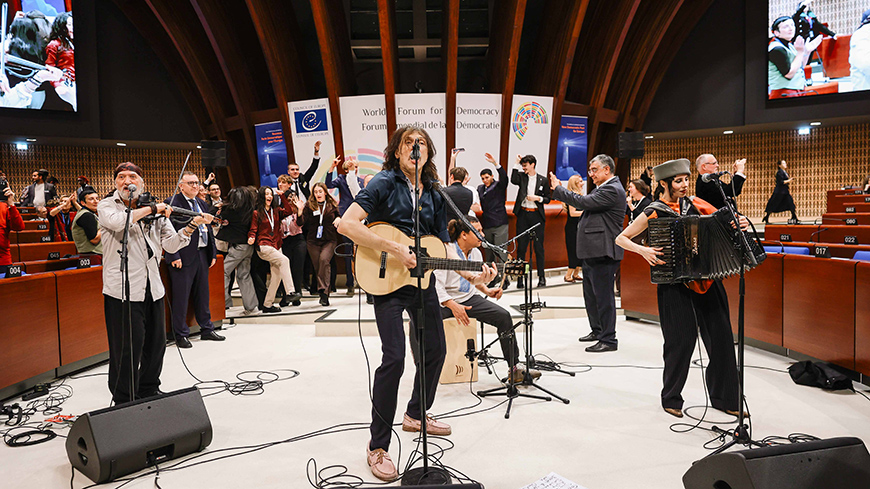
Concert by Gogol Bordello
5 November 2025 – 17h45 - Hemicycle
Gogol Bordello is an American punk rock band from the Lower East Side of Manhattan, formed in 1999 by musicians from all over the world and known for theatrical stage shows and persistent touring. "Gogol" comes from Nikolai Gogol, a 19th-century writer of Ukrainian origin. He serves as an ideological influence for the band because he "smuggled" Ukrainian culture into Russian society, which Gogol Bordello intends to do with Romani/East-European music in the English-speaking world.
Cartoons by Laurent Salles
5 and 7 November - Hemicycle
All plenary sessions will be illustrated live by the caricaturist and cartoonist Laurent Salles.
Laurent was born in Nîmes, France. After obtaining a degree in Applied Arts, he entered the “Arts Déco” school in Strasbourg in 1990 and made his television debut while still a student. His sharp pen and humor were quickly noticed, particularly through Les dessins de Salles, a weekly cartoon column on Alsatian regional news. Since 2010, his cartoons have been published in regional daily newspapers. In 2016, he joined the collective of artists Cartooning for Peace.




 Follow us on Facebook

